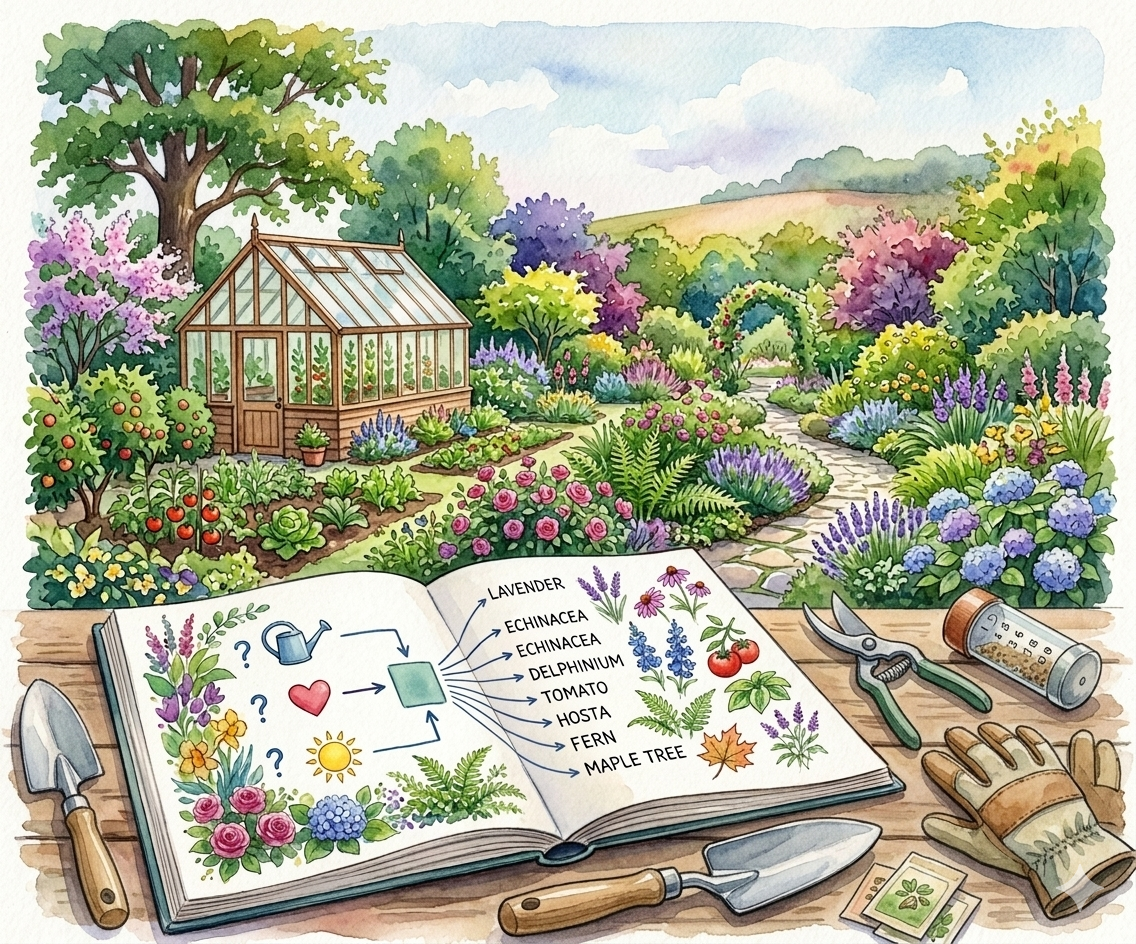
Garden Architect
The Smartest Way to Plan Your Garden
Answer a few simple questions about your garden conditions and goals — we'll recommend the perfect plants for you to grow and thrive.
8 quick questions · no account required
Planting Atlas · Plant Selection Wizard v1.0
Why a Plant Recommendation Wizard?
Walk into any garden center and you'll find hundreds of plant options, almost none of them labeled with the honest truth: this one will struggle in your soil, that one needs more sun than your yard gets, and those three won't survive your winters.Most gardening advice online is written for a generic audience — a fictional gardener with perfect loam soil, full sun, and a Zone 6 climate. If that's not you, the advice doesn't fit.
The Garden Architect was built to fix that. It works the way a good master gardener would: by asking about your specific conditions before making any recommendations. The result is a personalized plant list matched to your climate, your soil, your light, your space, and your schedule — not someone else's.
How It Works: 8 Questions, Hundreds of Possibilities
The wizard takes about two minutes to complete. You'll be asked a series of targeted questions — your plant type preferences, your growing method, your USDA hardiness zone, sunlight availability, soil type, watering habits, available space, and experience level. Each answer narrows and scores a database of 148 plants across 12 categories, including flowers, vegetables, fruits, herbs, trees, shrubs, vines, bulbs, ornamental grasses, succulents, ferns, and groundcovers.
Behind the scenes, the matching engine runs two types of logic. Hard filters eliminate plants that simply won't work for you — a Zone 4 gardener won't see plants that die below Zone 7, and a full-shade yard won't surface sun-loving crops. Soft scoring then ranks the remaining candidates based on how well they match your soil, water habits, space, and skill level, so the plants at the top of your results are genuinely the best fit, not just technically possible options.
Every recommended plant comes with a description, care notes, and growing tips written specifically for your path — traditional outdoor growing or hydroponics. You leave with a real shortlist, not a wall of text to wade through.
Covers Every Climate Across the United States
The Garden Architect supports all USDA hardiness zones from 3 to 11, meaning it works whether you're gardening in the frigid winters of Minnesota (Zone 3), the humid summers of the Gulf Coast (Zone 9), the dry heat of Phoenix (Zone 10), or the mild year-round climate of coastal California (Zone 10–11). Zone compatibility is built into the database at the plant level — every entry lists exactly which zones it thrives in, and the wizard filters accordingly.
Not sure what zone you're in? A general rule: the colder your winters, the lower your zone number. Zone 5 sees winters as cold as -20°F; Zone 9 rarely dips below 20°F. The USDA Plant Hardiness Zone Map is freely available online and pinpoints your zone down to a half-zone by ZIP code. Once you know your zone, the wizard handles the rest.
A Dedicated Path for Hydroponic Growers
Hydroponic gardening has exploded in popularity — and for good reason. Growing without soil means faster growth rates, year-round production indoors, water savings of up to 90% compared to traditional irrigation, and the ability to garden in apartments, garages, basements, and other spaces where a conventional garden is impossible.
The Garden Architect's hydroponic path is purpose-built for these growers. When you select "hydroponic" as your growing method, the wizard automatically skips questions that don't apply indoors — climate zone, soil type, and outdoor season — and instead asks about your system type: deep water culture (DWC), nutrient film technique (NFT), Kratky (passive hydroponics), ebb and flow, or wicking systems. The database is then filtered to plants with the hydroponic: true flag, and every result includes system-specific care notes covering nutrient levels, pH targets, and harvest timing.
Whether you're running a compact Kratky lettuce setup on a kitchen shelf or a full DWC system in a dedicated grow room, the wizard will find plants that fit your system and your goals.
From First-Time Gardeners to Seasoned Growers
Experience level is one of the eight wizard questions for a reason. A beginner selecting "just starting out" will receive results weighted toward forgiving, low-maintenance plants — zucchini, sunflowers, mint, cherry tomatoes — that deliver satisfying results without demanding expert care. An experienced grower selecting "advanced" will see a broader range that includes more challenging and rewarding options like artichokes, espaliered fruit trees, or specialty herbs with precise growing requirements.
The wizard is designed to grow with you. Revisit it each season as your skills improve, your garden space changes, or you want to experiment with a new plant category. Each run takes only two minutes and produces a fresh set of recommendations based on your current answers.
Once you have your plant list, head to the Plantopedia for in-depth growing guides on many of the same species — seasonal care calendars, companion planting tips, pest management, harvesting guidance, and more. The wizard tells you what to grow; the Plantopedia teaches you how to grow it exceptionally well.