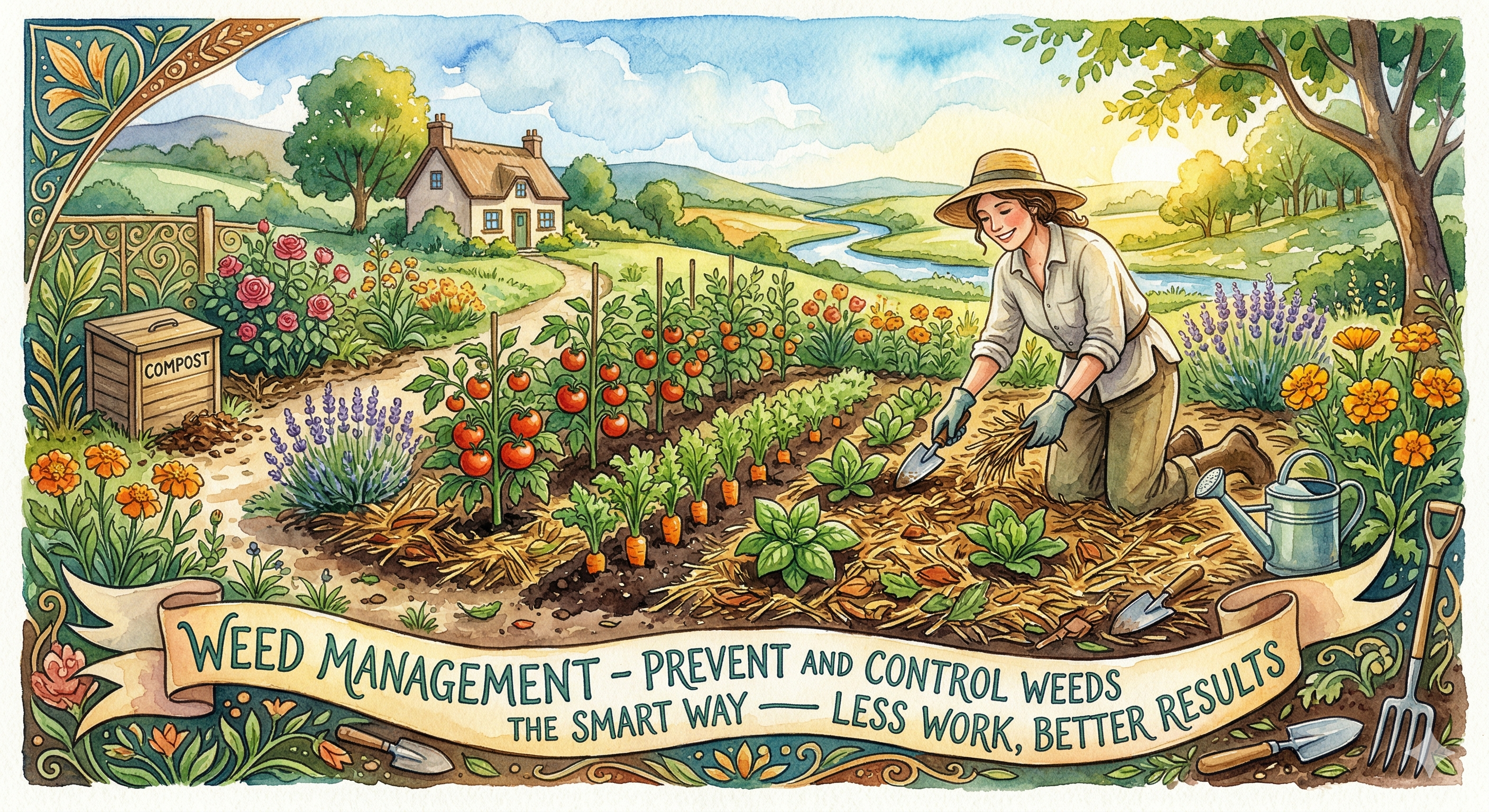
The Complete Guide to Weed Management
Prevent and Control Weeds the Smart Way — Less Work, Better Results
Most gardeners approach weeds as a battle to be won: pull them out, spray them, repeat. This reactive approach keeps the gardener perpetually behind, because weeds are not a problem to be solved but a biological process to be managed. A bare patch of soil exposed to light is an invitation that nature accepts immediately, with whichever seeds happen to be available. The gardener who understands this stops fighting the battle after the weeds appear and starts preventing the conditions that make weeds possible.
The Smart Approach: Work With Biology, Not Against It
The smart approach to weed management is built on a single biological insight: weeds need light to germinate. Cover the soil, deprive germinating weed seeds of light, and the majority of weed pressure disappears without any subsequent removal. Mulch correctly applied, cover crops, and dense plant spacing do more to reduce a season's weeding workload than the most diligent post-emergence removal ever can.
This guide covers weed management from the ground up: the biology that drives weed success, the prevention strategies that make control nearly unnecessary, the most effective manual and chemical control methods when prevention is insufficient, and region-by-region guidance on the specific weed species and conditions you are most likely to face. The goal is not a weed-free garden — that is an unrealistic and expensive standard. The goal is a garden where weed pressure is low, where what does grow is managed efficiently, and where you spend more time enjoying the garden than maintaining it.
A weed is, by the most practical definition, any plant growing where it is not wanted. Dandelions in a wildflower meadow are not weeds; dandelions in a vegetable garden are. Volunteer tomatoes from last year's garden are not weeds if you let them grow; they are if you pull them out. This guide uses the practical definition: weeds are unwanted plants that compete with your intended plantings for light, water, nutrients, and space, and that left unmanaged will reduce the productivity and appearance of your garden.
The Weed Management Hierarchy: Prevention First
| Method Level | Approach | Labor Input | Cost | Effectiveness | When to Use |
|---|---|---|---|---|---|
| Prevention | Eliminate conditions that allow weeds to establish: mulch, cover crops, dense planting, soil preparation, avoiding soil disturbance | Low once established; front-loaded investment | Low–moderate | Very high — the most cost-effective weed management approach | Always; the foundation of all weed management |
| Cultural control | Competitive plantings, correct plant spacing, irrigation management, avoiding weed seed introduction through compost and mulch | Low ongoing | Very low | High when combined with prevention | Ongoing; part of routine garden management |
| Physical / mechanical control | Hand-pulling, hoeing, cultivation, flame weeding, solarization, mowing | Moderate–high; labor-intensive | Low–moderate (tools) | High for emerged weeds; does not prevent new germination | When weeds have emerged despite prevention; for perennial weed management |
| Biological control | Natural enemies, competitive plant communities, mycorrhizal soil health, supporting beneficial insects that manage weeds indirectly | Low | Very low | Moderate; rarely sufficient alone | As a component of a longer-term management strategy |
| Chemical control | Pre-emergent and post-emergent herbicides, organic contact sprays | Low–moderate (application) | Moderate–high | High when correctly applied and timed; rapidly reduced by resistance development | When other methods are insufficient; for specific targeted problems; for large-scale or invasive weed management |
Section 1: Weed Biology — Know Your Enemy
Effective weed management starts with understanding how weeds work. Weeds succeed because they are optimized for colonizing disturbed, open environments with remarkable biological efficiency — they produce enormous quantities of seed, germinate faster than garden plants, grow quickly, and often have deep or persistent root systems that allow them to regrow after removal. Understanding these adaptations reveals the points where intervention is most effective.
Annual vs. Perennial Weeds: The Critical Distinction
The most important distinction in weed biology is between annual and perennial weeds, because they require fundamentally different management strategies. Managing an annual weed as if it were a perennial — or vice versa — wastes effort and fails to address the actual source of the problem.
| Weed Type | Life Cycle | Reproductive Strategy | Management Priority | Examples |
|---|---|---|---|---|
| Summer Annual | Germinates in spring/summer, flowers, sets seed, and dies by fall in a single season | Seed production is enormous (one lamb's quarters plant can produce 72,000 seeds). Seeds may persist in soil for decades. | Prevent seed set at all costs. Remove before flowering. Annual weeds managed before they produce seed break the cycle quickly — the seed bank depletes each year. | Crabgrass, lamb's quarters, pigweed, purslane, common ragweed, black nightshade, foxtail, galinsoga |
| Winter Annual | Germinates in fall or early spring, overwinters as a rosette, flowers in spring, sets seed, and dies by early summer | Seed germination primarily in late summer through fall; seeds can be abundant | Target fall germination with pre-emergent or solarization; hand-pull rosettes in fall and early spring before flowering | Annual bluegrass (Poa annua), hairy bittercress, chickweed, henbit, shepherd's purse, field speedwell |
| Biennial | Requires two full growing seasons: year one is vegetative growth (rosette); year two is flowering, seed set, and death | Lower seed production than most annuals; seeds may persist 2–5 years in soil | Remove rosettes in the first year before the plant develops a flowering stem in year two. A biennial managed in its first year never produces seed. | Wild carrot (Queen Anne's Lace), bull thistle, common mullein, garlic mustard |
| Perennial | Persists for 3+ years; may flower and set seed annually; regrows from roots, rhizomes, stolons, or other vegetative structures after top growth is removed | Seed PLUS vegetative spread: fragments of root or rhizome left in soil can generate entirely new plants. Tilling spreads some perennial weeds. | The most difficult category. Complete root removal is required for true eradication. Persistent top removal depletes root energy reserves over 1–2 seasons. Herbicide applications to actively growing plants are often most effective. | Dandelion, bindweed, quackgrass, bermudagrass (in cool-season lawns), Canada thistle, yellow nutsedge, dock, plantain, creeping Charlie |
The Weed Seed Bank: Why Weeds Keep Coming Back
Garden soil contains millions of dormant weed seeds per acre in even well-managed gardens — a reserve called the weed seed bank that represents years and decades of accumulated seed fall. These seeds remain viable in the soil for periods ranging from 1 year to 30 or more years for species like lamb's quarters and pigweed. Every time soil is disturbed — by tilling, digging, or even vigorous hoeing — dormant seeds buried below the germination threshold are brought to the light levels they need to germinate.
The no-till advantage: Minimizing soil disturbance is one of the most powerful long-term weed management strategies. No-till gardens disturb fewer dormant seeds per season and reduce annual weed pressure significantly over time. Sheet mulching and no-dig bed preparation preserve the seed bank's stratification rather than bringing dormant seeds to the surface.
The seed bank depletion strategy: Annual weed seeds germinate when conditions are right, and if they are never allowed to set new seed, the seed bank for those species gradually declines over years. A garden in which annual weeds are consistently removed before they flower sees progressively lighter weed pressure each year. The first year is the hardest; by year three or four, management becomes substantially easier.
Fresh weed seed is added to the seed bank whenever soil from an outside source (compost, topsoil, fill dirt) contains weed seeds; mulch contains seeds (hay mulch is notorious for this; straw is generally safer; wood chips almost never); tools carry seeds from one area to another; birds deposit seeds; or wind-blown seeds arrive from nearby infested areas. Controlling contamination inputs limits the rate at which the seed bank is replenished.
Weed Identification: Why It Matters
Identifying the specific weeds in your garden before attempting to manage them is not an academic exercise — it is practically necessary. Different weeds respond to different management approaches. Pre-emergent herbicides that prevent crabgrass do not prevent nutsedge; herbicides effective on dandelion do not touch bindweed. Hand-pulling is highly effective on annual weeds and nearly futile on bindweed. Knowing what you are managing determines whether the management approach will work.
Free identification resources: Your state's cooperative extension service maintains weed identification guides specific to your region and climate. The USDA's Plants Database (plants.usda.gov) allows identification by state. iNaturalist is a free smartphone app that identifies plants from photographs. When noting features for identification, look at: leaf shape, arrangement (opposite or alternate), texture (hairy, waxy, smooth), overall plant shape (rosette, upright, trailing), stem shape (round, square, hollow), flower color, and root structure (taproot, fibrous, rhizomes, tubers, stolons).
Section 2: Prevention — Stop Weeds Before They Start
Prevention is not glamorous, but it is dramatically more efficient than removal. An hour spent on prevention in spring — applying mulch, planting cover crops, spacing plants correctly — saves multiple hours of weeding throughout the season. The gardener who invests in prevention at the beginning of the season works consistently less than the one who skips prevention and then reacts to emerged weeds all season long.
Mulch: The Single Most Effective Weed Prevention Tool
A correct application of mulch prevents weed seed germination by depriving seeds of the light they need. Studies consistently show that 3 to 4 inches of opaque organic mulch reduces weed emergence by 70 to 90 percent compared to bare soil. This is not a modest improvement — it is a transformation of the garden's weed management burden.
| Mulch Type | Depth | Weed Suppression | Additional Benefits | Considerations |
|---|---|---|---|---|
| Wood chips (arborist chips) | 3–4 inches | Excellent; one of the most effective when applied at correct depth | Improves soil structure and biology as it decomposes; often free from tree services; excellent moisture retention | Do not apply to vegetable beds where it will interfere with direct seeding; avoid piling against plant stems. Fresh chips may temporarily tie up nitrogen as they decompose. |
| Shredded bark / bark nuggets | 3–4 inches | Very good; large nuggets suppress weeds well | Long-lasting; available in various sizes and colors; professional appearance in ornamental beds | Larger nuggets can roll downslope; use shredded bark for sloped beds. Decomposes more slowly than wood chips, providing less soil-building benefit. |
| Straw (wheat or oat) | 3–4 inches | Good when weed-free straw is used | Excellent for vegetable beds; warms soil in spring; easy to pull back for direct seeding | Can contain weed seeds (hay much more so than straw; always use certified weed-free straw). Breaks down quickly — replenish mid-season. |
| Newspaper / cardboard + mulch | 6–8 layers newspaper (or cardboard) + 2–3 inches mulch on top | Outstanding; blocks virtually all light; the gold standard for new bed creation and renovation | Sheet mulching with cardboard kills existing vegetation without tilling; excellent for converting lawn to garden; builds soil as it decomposes | Cardboard or newspaper must be overlapped 6+ inches at seams to prevent light gaps. Remove tape and staples from cardboard. |
| Landscape fabric (woven) | Install flat, then cover with 2 inches of mulch | Excellent initially; degrades over 3–5 years; weed seeds germinate in the mulch layer on top as fabric ages | Durable for paths and areas that will not be replanted; allows water penetration | NOT recommended for perennial beds or vegetable gardens — fabric becomes entangled with roots and makes removal nearly impossible. Best for permanent landscape areas only. |
| Living mulch / ground covers | Dense enough to shade soil (varies by plant) | Excellent once established | Ecological value; habitat; beauty; living root systems improve soil biology; does not need replenishing | Requires an establishment period; may need supplemental weed control while establishing; competition with desired plants in some applications |
The Mulch Depth Rule — 3 Inches Is the Minimum: The most common mulching mistake is applying too little. A 1-inch layer provides minimal suppression; 3 to 4 inches is the threshold where suppression becomes highly effective. The second most common mistake is applying mulch against plant stems and tree trunks ("mulch volcano"). Mulch should be pulled back 2 to 3 inches from all stems and trunks — contact with woody stems promotes rot, invites rodents, and encourages adventitious root development. Apply in a donut shape with the center empty.
Cover Crops: Biological Weed Suppression
Cover crops — plants grown primarily to protect and improve the soil rather than for harvest — are one of the most powerful weed suppression tools available, particularly in vegetable gardens with sections temporarily out of production. A dense cover crop outcompetes weeds for light, water, and nutrients, reducing the weed seed bank through competitive exclusion and allelopathy (chemical suppression of germination).
- •Summer cover crops (between spring and fall crops): Buckwheat is the fastest-germinating and most effective summer cover crop for weed suppression — it establishes within days, creates dense ground cover, and can be terminated by mowing before it sets seed. Sorghum-sudangrass is an excellent warm-season option for larger areas.
- •Winter cover crops (between fall harvest and spring planting): Winter rye, winter wheat, hairy vetch, crimson clover, and winter peas are the most widely used options. They protect the soil through the off-season and are terminated in spring 2 to 3 weeks before planting. Winter rye produces allelopathic compounds that suppress germination of small-seeded annual weeds even after termination.
- •Regional cover crop timing: Zone 3–4 — plant winter-hardy covers (winter rye, hairy vetch) by mid-September; plant summer covers (buckwheat) after last frost through July. Zone 5–7 — plant winter covers through October; summer covers through August. Zone 8–10 — cover crops can be grown through most of the year; choose species appropriate to the season.
Planting Design for Weed Suppression
- •Close spacing: Plants spaced to close the canopy by midsummer shade out weed seeds below. This does not mean overcrowding — it means spacing at the appropriate density for each species to achieve canopy closure. A vegetable garden where plants shade the soil surface between them requires far less weeding than one with wide, open spacing between rows.
- •Perennial ground covers: A dense, healthy ground cover in ornamental areas eliminates weeding almost entirely once established. Creeping phlox, ajuga, pachysandra (shade), creeping thyme, epimedium, and native sedges are among the most effective. Choose species appropriate to your climate and light conditions.
- •Avoid bare soil: Any area of bare soil not actively being prepared for planting should be covered — with mulch, a cover crop, or a planted ground cover. Bare soil is an invitation to weed colonization that is accepted immediately under the right conditions.
- •The importance of healthy, dense plantings: Vigorous, well-spaced, properly fertilized plants that reach their full size outcompete weeds more effectively than stressed, underfed plants. A crowded, nutrient-deficient bed with struggling plants provides more opportunity for weeds than a well-managed bed where plants are thriving.
Section 3: Manual & Mechanical Weed Control
When weeds do appear despite prevention efforts, manual and mechanical control methods are the first response for most home gardeners. Done correctly and at the right time, these approaches are highly effective and involve no chemical inputs. The key principle is timing: small weeds disturbed by a hoe on a dry, sunny afternoon die quickly; large, established weeds require much more effort to remove and often leave root fragments that regrow.
The Golden Rule of Hand Weeding: Pull Before They Flower
A weed removed before it flowers breaks the reproductive cycle and reduces future pressure. A weed removed after it sets seed has already reproduced; removing the parent plant does nothing to address the seeds now in the soil. For annual weeds, the goal is preventing seed set above all else. For perennial weeds, the goal is removing the entire root system before the plant has stored enough energy to fully regrow.
- •Timing the pull: Weed when the soil is moist (after rain or irrigation) but the surface is beginning to dry. Moist soil releases roots cleanly; wet surface conditions mean removed weeds can re-root rather than dying. Pull in the morning after overnight dew has evaporated.
- •The young weed advantage: A weed two inches tall with a small, shallow root system is removed in seconds with a finger-push or light hoe stroke. The same weed at two feet tall requires significant effort and may leave root fragments. A few minutes of weeding when weeds are tiny prevents hours of weeding when they are established.
- •Dealing with taproots: Dandelions, dock, and other deep-taprooted perennials regenerate from root fragments. Use a dandelion digger, fishtail weeder, or narrow trowel to extract the entire taproot. If the root breaks off below 3–4 inches, the weed will regrow, though smaller and weaker. Repeated removal over 2 to 3 seasons eventually exhausts the root's energy reserves.
Hoeing: The Most Efficient Tool for Large Areas
A sharp hoe used correctly is the most efficient weeding tool for bare soil areas, paths, and spaces between garden rows. Hoeing works by severing weed seedlings at or just below the soil surface. The severed tops die in the sun; the disturbed soil surface dries quickly and kills newly severed seedlings before they can re-root.
- •The right conditions: Hoe on a hot, dry, sunny day. The combination of severing plus desiccation is far more effective than hoeing on a cool, cloudy, or damp day when severed seedlings can re-root into moist soil.
- •The right technique: Hold the hoe nearly parallel to the soil surface. Use a push-pull motion to skim just below the soil surface (1/4 to 1/2 inch depth), cutting weed stems without deeply disturbing the soil (which would bring dormant seeds to the surface). Work backward so you are not walking on hoed soil.
- •Standard flat hoe: Versatile for most situations. The collinear hoe has a narrow, precisely angled blade excellent for working close to plant stems in vegetable rows.
- •The oscillating / stirrup (hula) hoe: The most effective general-purpose hoe for frequent light weeding. The oscillating blade cuts on both the push and pull stroke and skims cleanly just below the surface without disturbing deeper soil layers. Use every 7 to 10 days through the growing season and weed pressure remains minimal with very little effort per session.
Flame Weeding
Flame weeding uses a propane torch to heat weed cells until they rupture, killing the plant without chemical inputs. Despite the dramatic name, the technique does not burn the weeds — it heats them briefly and the cellular damage kills them within hours. Flame weeding is most effective on annual weed seedlings and on weeds in difficult-to-reach locations (cracks in pavement, gravel paths, fence lines).
- •Technique: Pass the flame slowly over seedlings at a walking pace — you are not trying to burn or blacken the plant but to heat each leaf briefly (2 to 3 seconds per weed). A wilted, dull appearance within a few hours confirms successful treatment.
- •Best uses: Ideal for paths, patios, gravel areas, and hardscape cracks; for the "stale seedbed" technique in vegetable gardens (allowing the first flush of weed seeds to germinate and then flame-killing them before planting, significantly reducing in-season weeding); and for flame-killing strips of weeds between vegetable rows.
- •Larger weeds require longer exposure or multiple treatments. Roots of perennial weeds are not killed by flame weeding — top growth is removed, but the root system survives.
Never use flame weeding near dry vegetation, in drought conditions, or in areas with fire risk. Keep a water source (hose or bucket) nearby. Many municipalities prohibit open-flame devices during fire restrictions — check local ordinances before use. Do not flame weed near plastic irrigation lines, edging, or any combustible material.
Soil Solarization
Soil solarization — covering moist soil with clear plastic during the hottest weeks of summer — raises soil temperatures to levels that kill weed seeds, soil pathogens, and some pests in the top several inches. It is one of the most effective non-chemical tools for clearing a heavily weeded area before replanting, particularly in warm climates.
- •Prepare the area: Remove existing vegetation; water deeply (solarization works best in moist soil); rake smooth.
- •Cover with clear plastic: Clear plastic (1–1.5 mil) is more effective than black plastic because it allows solar radiation through while trapping heat. Bury or weight the edges completely.
- •Leave in place: 4 to 6 weeks in warm climates (Zone 7+); 6 to 8 weeks in cooler climates. Peak effectiveness in July and August.
- •Plant immediately after removing the plastic without disturbing the soil profile — digging or tilling would bring viable seeds from deeper in the seed bank back to the surface. Transplants work better than direct seeding immediately after solarization.
- •Effectiveness: Reduces weed seed germination by 50 to 90% in the treated zone; kills many soilborne pathogens; reduces nematode populations. Particularly effective in the Southwest, California, and the Deep South where summer temperatures are highest.
Section 4: Herbicides — Understanding Your Options
Herbicides are valuable tools in weed management, but they are most effective when used as part of a broader management strategy rather than as the primary or sole approach. Understanding how different herbicides work — and the critical distinction between pre-emergent and post-emergent, and between selective and non-selective products — allows you to choose the right tool for each situation and avoid the common mistakes that make herbicide use ineffective or problematic.
Read the Label — It's a Legal Requirement: In the United States, pesticide labels (which include herbicide labels) are legally binding documents. Using a pesticide in a manner inconsistent with its label is a federal violation of the Federal Insecticide, Fungicide, and Rodenticide Act (FIFRA). This includes applying at higher-than-labeled rates, using on crops not listed, using in locations not permitted by the label, and using without the personal protective equipment (PPE) specified. At minimum, most herbicide labels require chemical-resistant gloves and eye protection.
The Key Distinctions: Pre-Emergent vs. Post-Emergent
| Herbicide Type | How It Works | When to Apply | What It Controls | What It Does NOT Control |
|---|---|---|---|---|
| Pre-emergent | Creates a chemical barrier in the soil that kills germinating seeds before they can emerge. Does not affect established plants or seeds that have already germinated. | BEFORE weed seeds germinate; typically early spring (for summer annuals) or late summer/early fall (for winter annuals). Timing relative to soil temperature is critical, not calendar date. | Germinating annual weed seeds in the treated zone. Highly effective for crabgrass, annual bluegrass, and other seeding annuals when properly timed. | Emerged weeds; perennial weeds (which do not reproduce primarily by seed); weeds that germinate after the treatment window has passed. |
| Post-emergent — contact | Damages or destroys the plant tissue it contacts directly. Does not move within the plant. Kills above-ground portions only; does not kill roots. | After weeds have emerged; most effective on small, actively growing seedlings. Older, larger weeds may require multiple applications. | Young annual weeds. Burns and kills above-ground tissue on many weeds. | Deep roots of perennial weeds (the plant will regrow from root tissue); any plant not directly contacted by the spray. |
| Post-emergent — systemic | Absorbed by leaves and transported throughout the plant, including to the roots. Kills the entire plant including root system. | After weeds have emerged and are actively growing. Applying to stressed, drought-affected, or dormant plants significantly reduces efficacy. | The entire plant, including roots of perennial weeds like bindweed, dandelion, and Canada thistle — making this the most effective chemical tool for perennial weed management. | Pre-emergent weed seeds; plants not directly contacted; plants not actively translocating the herbicide (stressed or dormant plants move absorbed compounds less effectively). |
| Selective | Kills specific plant groups while leaving others relatively unharmed. Grassy weed killers (fluazifop, sethoxydim) kill grasses without harming broadleaf plants. Broadleaf weed killers (2,4-D, dicamba) kill broadleaf weeds without harming most grasses. | Depends on target weed and product; see individual product labels. | The specific target weed categories the product is formulated for. | Plants outside the selective target range. Read labels carefully — selectivity has limits. |
| Non-selective (glyphosate, glufosinate, acetic acid) | Kills or seriously damages any green plant tissue it contacts. No distinction between weeds and garden plants. | Carefully targeted application; used in areas to be cleared, around hardscape, or spot-treated directly on weeds with no nearby garden plants at risk. | Virtually any actively growing plant it contacts. | Seeds in the soil (glyphosate has no soil activity); plants not contacted. |
Common Herbicide Active Ingredients: A Reference
| Active Ingredient | Type | Common Products | Primary Uses | Key Safety & Environmental Notes |
|---|---|---|---|---|
| Glyphosate | Non-selective systemic post-emergent | Roundup® and hundreds of generics | Clearing vegetation before new bed preparation; spot treatment of perennial weeds; management of invasive plants | The most widely used herbicide in the world. The EPA currently considers it non-carcinogenic at labeled use levels; IARC classified it as "probably carcinogenic." Follow label PPE requirements. Breaks down in soil relatively quickly (days to weeks). Do not apply near water bodies. |
| 2,4-D | Selective systemic broadleaf post-emergent | Weed B Gon®, Trimec®, Ortho Weed-B-Gon | Lawn broadleaf weed control (dandelion, plantain, clover, chickweed) without harming turf grasses | Highly effective broadleaf selective. Volatile — do not apply above 85°F or on windy days; vapor drift can damage nearby broadleaf ornamentals and vegetables. Do not apply near ponds or streams. |
| Dicamba | Selective systemic broadleaf post-emergent | Found in many lawn broadleaf combination products | Broadleaf weed control in turf; often combined with 2,4-D for broader spectrum | Highly volatile. New DT (dicamba-tolerant) crop systems have created significant drift problems in agricultural areas. Follow label restrictions strictly regarding wind and temperature. |
| Pre-emergents: prodiamine / pendimethalin / dithiopyr | Pre-emergent — prevents seed germination | Barricade® (prodiamine); Pre-M® / Halts® (pendimethalin); Dimension® (dithiopyr) | Crabgrass prevention in lawns; annual weed prevention in ornamental beds. Prodiamine is longest-lasting; dithiopyr also provides some post-emergent activity on young crabgrass. | Apply before soil temps reach 55°F for crabgrass prevention; do not apply to beds where you intend to direct seed. Requires irrigation or rain to activate. Do not apply to newly seeded lawns until after 3 mowings. |
| Corn Gluten Meal (organic pre-emergent) | Natural pre-emergent — inhibits root development of germinating seeds | Various organic garden products | Organic lawn and garden weed prevention; lower efficacy than synthetic pre-emergents; requires high rates and dry conditions after application | OMRI-listed for organic use; safe around children and pets after drying; provides nitrogen as a side benefit. Wet conditions immediately after application significantly reduce effectiveness. |
| Acetic acid (horticultural vinegar) | Non-selective contact (organic option) | Various organic herbicide products (20–30% acetic acid — much stronger than food-grade 5% vinegar) | Spot treatment of emerged weeds; path and driveway weeds; hardscape cracks; organic programs | Burns above-ground tissue only — does not kill perennial roots; effective on young seedlings. Corrosive — causes skin and eye burns; PPE (gloves, eye protection) required. |
| Clove oil / eugenol (organic contact) | Non-selective contact | Burnout®, EcoSMART® and similar organic products | Spot treatment of small weeds in organic programs | Kills above-ground growth only; does not control perennial roots; effective primarily on seedlings; degrades rapidly. |
Herbicide Application Best Practices
- •Calibrate your equipment: A sprayer that applies too much or too little herbicide is ineffective and wasteful. For hand-pump sprayers, measure the output per minute by collecting output in a measuring cup for 30 seconds and doubling the result.
- •Apply in calm conditions: Wind drift carries herbicide onto non-target plants. Do not apply when winds exceed 5 mph. On hot days, volatile herbicides (2,4-D, dicamba) can volatilize and drift as vapor even without wind. Apply in early morning when temperatures and wind are lowest.
- •Spot treatment vs. broadcast: Many weed problems are best addressed with targeted spot treatment rather than blanket application. Walking the garden with a small hand sprayer and treating individual weeds uses far less herbicide and reduces non-target exposure.
- •Keep records: Note what you applied, where, when, and at what rate. This helps you evaluate effectiveness, avoid re-applying to areas already treated, and troubleshoot problems if unexpected plant damage occurs.
- •Resistance management: Herbicide resistance is a serious and growing problem. Rotate between herbicide modes of action; do not rely solely on any single product or active ingredient; use cultural controls alongside chemical controls to reduce selection pressure.
Section 5: Lawn Weed Management
Lawn weed management is the largest category of residential herbicide use in the United States, and it is also one of the most commonly done incorrectly. The most effective approach to lawn weeds is one in which herbicide plays a supporting rather than primary role: a dense, healthy, properly maintained lawn is the most effective weed management system available, and no herbicide program can compensate for poor turf management.
The Healthy Lawn Principle: Competition Is the Best Weed Control
Weeds in lawns are almost always a symptom of a problem rather than the problem itself. Thin, stressed, or damaged turf creates the bare or weakened areas where weed seeds germinate and establish. A lawn that is healthy and dense enough to prevent weed establishment in the first place requires far less herbicide intervention. The primary weed management investment in a lawn should be in turf health, not in herbicide.
- •Mowing height: The most important single factor in lawn weed management that most homeowners get wrong. Mowing too short weakens turf, reduces root depth, increases soil temperature (favoring crabgrass and other heat-loving weeds), and creates the thin, stressed conditions where weeds establish. Recommended heights: Kentucky bluegrass and fescues — 2.5 to 4 inches; tall fescue — 3 to 4 inches; Bermudagrass — 0.5 to 1.5 inches; Zoysia — 1 to 2 inches; St. Augustine — 3.5 to 4 inches. Most cool-season lawns should be mowed at the high end of the range in summer.
- •Fertilization: A properly fertilized lawn grows densely and recovers from damage quickly. Under-fertilized turf thins over time, creating weed entry points. Follow a soil-test-based fertilization program; apply the majority of nitrogen in fall for cool-season grasses and in late spring through summer for warm-season grasses.
- •Overseeding: Thin or bare areas in cool-season lawns should be overseeded in early fall (soil temperatures 50 to 65°F, adequate moisture, reduced competition from summer annuals). A thick, established turf prevents weed entry points from developing. Do not apply pre-emergent herbicides in areas to be overseeded — they will prevent grass seed germination.
- •Irrigation: Deep, infrequent irrigation (1 to 1.5 inches per week in 1 or 2 applications rather than daily shallow watering) encourages deep grass root development. Shallow watering also favors shallow-rooted weeds.
Lawn Weed Identification and Treatment
| Weed | Type | Preferred Conditions | Season of Activity | Best Control Method |
|---|---|---|---|---|
| Crabgrass (Digitaria spp.) | Summer annual grass | Thin turf; bare soil; high temperatures; compacted soil | Germinates when soil temps reach 55–60°F; active through summer; dies at first frost | Pre-emergent applied BEFORE soil reaches 55°F (typically when forsythia blooms); mow at recommended height; overseed thin areas in fall. Post-emergent options include quinclorac and fenoxaprop — most effective on young plants. |
| Annual Bluegrass (Poa annua) | Winter annual grass | Compacted, moist soil; close mowing; thin turf; cool temperatures | Germinates in late summer–fall; most visible and problematic in cool spring conditions; dies in summer heat | Pre-emergent in late summer (August–September) before fall germination; dithiopyr is preferred because it provides some post-emergent activity. Aerating and overseeding in fall to improve competition. |
| Dandelion (Taraxacum officinale) | Perennial broadleaf | Any lawn; most problematic in thin turf and in spring and fall | Year-round in mild climates; most aggressive in spring and fall; seed dispersal in spring | Selective broadleaf post-emergent (2,4-D, dicamba, or triclopyr) applied in fall when plants are actively translocating to roots — the most effective timing. Or hand-dig individual plants with a long weeder, removing the entire taproot. |
| White Clover (Trifolium repens) | Perennial broadleaf; nitrogen-fixer | Low-nitrogen lawns; the nitrogen-fixing ability gives clover a competitive advantage in under-fertilized turf | Perennial; most visible in spring and summer | Broadleaf selective herbicide with clover on the label (MCPP or a three-way combination with 2,4-D and dicamba is most effective); OR accept clover as a beneficial component (it feeds pollinators and fixes nitrogen) and address turf nitrogen deficiency instead. |
| Creeping Charlie / Ground Ivy (Glechoma hederacea) | Perennial broadleaf; spreads by stolons and seed | Shaded, moist areas; thin turf under trees; low-light areas where turf struggles | Year-round in mild climates; most active in spring and fall | Triclopyr is the most effective herbicide for creeping Charlie; 2,4-D alone has limited efficacy. Apply in fall when plants are actively storing energy. Improve sunlight penetration where possible. |
| Nutsedge (Cyperus spp.) | Perennial sedge (not a grass; not a broadleaf) | Wet, waterlogged, or poorly drained soil; sandy soils; any soil with excess moisture | Most problematic in summer; dormant in winter; spreads by seeds, rhizomes, and nutlets (small underground tubers that are very persistent) | Halosulfuron (SedgeHammer®) or sulfentrazone — the only selective products effective on nutsedge in lawns. Improve drainage. Do not till or cultivate — this spreads nutlets. Multiple applications required over 1–2 seasons. |
| Plantain (Plantago spp.) | Perennial broadleaf | Compacted soil; high-traffic areas; thin turf | Year-round; most visible in spring and fall | Broadleaf selective herbicide (2,4-D); or hand-dig individual plants, removing the fibrous root crown. Aerating and overseeding to improve turf density addresses the compaction that favors plantain. |
The Pre-Emergent Timing Calendar for Lawns
Timing is the most critical factor in pre-emergent herbicide success for crabgrass and other summer annual lawn weeds. Applying too early allows the chemical barrier to break down before peak germination; applying too late allows weeds to already emerge past the germination stage. Soil temperature, not calendar date, is the reliable trigger.
| Region / Zone | Pre-Emergent Window (Summer Annuals) | Biological Indicator | Fall Pre-Emergent (Winter Annuals) |
|---|---|---|---|
| Zones 3–4 (MN, ND, northern NE, MT) | April 15 – May 15 (when soil temps reach 50–55°F at 2-inch depth) | Forsythia in bloom; lilac leaves emerging | Late August – September 1 |
| Zones 5–6 (Midwest, mid-Atlantic, Pacific NW) | March 15 – April 30 | Forsythia in full bloom to petal drop; ornamental cherry bloom | August 15 – September 15 |
| Zones 7–8 (South, parts of CA, mid-South) | February 15 – March 31 | Daffodils fading; dogwood beginning to bloom | September 1 – October 1 |
| Zones 9–10 (Gulf Coast, Southern CA, AZ) | January 15 – February 28 | Local spring indicators; soil thermometer most reliable | October 1 – November 1 |
The single most impactful lawn weed management practice costs nothing: raise your mowing height to the top of the recommended range for your grass species. A lawn mowed at 3.5 inches is dramatically more weed-resistant than the same lawn mowed at 2 inches — the taller grass shades the soil surface, keeping it cooler and suppressing weed seed germination throughout the season.
Section 6: Vegetable & Ornamental Bed Weed Management
Weed management in garden beds requires a different toolkit than lawn weed management. Most lawn herbicides cannot be used safely in vegetable gardens (many have plant-back restrictions of weeks to months), and even in ornamental beds, selectivity is much more limited because the diverse plant palette presents more non-target risk. The emphasis in garden beds shifts decisively toward prevention and physical control.
The Vegetable Garden: A Systematic Approach
- •The stale seedbed technique: One of the most effective vegetable garden strategies. Prepare the bed 2 to 3 weeks before planting by loosening the soil to planting depth (but no deeper). Water lightly to encourage the first flush of weed seeds to germinate. Then kill the emerged seedlings by flame weeding or shallow hoeing — without disturbing the soil more than 1 inch. Plant immediately afterward. The result: far fewer weed seeds in the germination zone for the early weeks of the crop's growth.
- •Transplants vs. direct seeding: Transplanted vegetable starts have a 3- to 4-week head start on weeds and can establish enough size to begin competing before weeds become problematic. Direct-seeded crops (carrots, beets, beans, peas, corn, squash) are at greater risk from early weed competition. For these crops, the stale seedbed technique and prompt hoeing of first weeds are essential.
- •Row spacing and plant density: Intensive spacing (based on equidistant spacing rather than rows and spaces) closes the canopy faster and leaves less bare soil for weed establishment. The intensive spacing recommended in square foot gardening is effective precisely because the dense plant spacing shades out weeds.
- •Mulching vegetable beds: Apply a 2-inch layer of straw or wood chips after transplants are established (but not before seedlings have emerged in direct-seeded crops). Pull mulch away from direct-seeded rows and apply between them. Maintain mulch through the season; replenish if it becomes thin. This single practice eliminates the majority of mid-season weeding in most vegetable gardens.
Hoe vegetable beds every 7 to 10 days through the growing season using an oscillating stirrup hoe — 10 minutes per session is far more effective than 2 hours every 4 weeks. Small weeds cut at soil level on a sunny day die without re-rooting; large weeds left for weeks require significant effort to remove and may have already begun setting seed.
Ornamental Bed Weed Management
- •Pre-emergent herbicides in ornamental beds: Several pre-emergent herbicides are labeled for use in established ornamental (non-vegetable) beds to prevent annual weed germination. Products containing prodiamine, pendimethalin, or isoxaben are widely used. Always verify that the specific ornamental plants in your bed are listed as tolerant on the product label. Apply in early spring before annual weed germination. Do not apply to beds where you plan to install new plants from seed.
- •Post-emergent selective options: Grassy weed killers (fluazifop, sethoxydim, clethodim) can be applied over most broadleaf ornamentals to kill grassy weeds (including crabgrass and quackgrass) without harming the ornamentals. Verify your specific plants are listed as tolerant on the label.
- •Glyphosate spot treatment: Glyphosate can be used as a spot treatment in ornamental beds with extreme care to avoid contact with desired plants. A sponge applicator or foam paintbrush rather than a sprayer dramatically reduces drift risk. A plastic shield held over desired plants during spot treatment prevents accidental contact.
- •The persistent perennial weed problem: Bindweed, quackgrass, Canada thistle, and nutsedge in ornamental beds are among the most frustrating weed management challenges. A multi-year strategy is required: consistent removal of top growth to deplete root reserves; targeted glyphosate application to foliage; improving drainage and soil health; and patience. There is no quick fix for established perennial weeds in an ornamental bed.
Landscape fabric in planting beds almost always creates more problems over time than it solves. Fabric degrades over 3–5 years; weed seeds germinate in the mulch layer on top; roots from desired plants become entangled in the fabric making removal nearly impossible. Remove existing fabric in planting beds and replace with 3 to 4 inches of wood chip mulch instead. Reserve landscape fabric for non-planted areas such as paths and under decks.
Section 7: Invasive Weeds — Species Requiring Special Attention
Invasive weeds are plants introduced from other regions — often other continents — that spread aggressively in American landscapes without the natural controls (insects, diseases, competitors) that limited them in their native range. They represent a special category of weed management because they spread beyond individual property lines, displace native plant communities, degrade wildlife habitat, and in some cases are nearly impossible to eradicate once established at landscape scale.
Before Purchasing or Planting — Check Your State's Invasive Species List: Every state maintains a list of invasive plant species that are prohibited, restricted, or listed as noxious weeds. Purchasing, planting, or transporting these species may be illegal in your state. Before purchasing any plant — particularly ornamentals sold for their vigorous growth — verify it is not on your state's invasive or noxious weed list. The USDA's National Invasive Species Information Center (invasivespeciesinfo.gov) and your state's department of agriculture or natural resources provide current state-specific information.
High-Priority Invasive Weeds by Region
| Invasive Plant | Regions Most Affected | Why It's Serious | Management Options |
|---|---|---|---|
| Japanese Knotweed (Reynoutria japonica) | Eastern US, Pacific Northwest; most aggressive in moist areas near streams and disturbed sites | One of the most invasive plants in the world; grows from root fragments as small as 1 cm; stems can penetrate asphalt and concrete foundations; spreads rapidly along waterways | Extremely difficult to eradicate. Cut stems repeatedly through the growing season to deplete root reserves (requires 3–5+ years of consistent effort). Glyphosate injected into cut stems in late summer is the most effective chemical approach. Never till — root fragments spread the plant. |
| Garlic Mustard (Alliaria petiolata) | Eastern US forests and shaded edges; edges of woodland gardens | Winter annual that germinates in fall and flowers in spring; produces chemicals that disrupt mycorrhizal fungi essential to native plants; spreads rapidly; creates monocultures in forest understories | Pull or cut plants before seed set (April–May in most regions). Bag and dispose of seed heads — do not compost. Requires consistent effort for several years to deplete the seed bank. |
| Kudzu (Pueraria montana var. lobata) | Southeast US primarily; increasingly in mid-Atlantic and Midwest | The "vine that ate the South"; grows up to 1 foot per day in summer; smothers trees, buildings, and all other vegetation; extremely deep root system | Very difficult. Repeated cutting throughout the growing season for multiple years; goats are an effective mechanical control for large infestations; herbicides (picloram, triclopyr, aminopyralid) are most effective for large infestations. Contact your county extension office for current management programs. |
| Oriental Bittersweet (Celastrus orbiculatus) | Eastern US and mid-Atlantic; particularly problematic in woodland edges and roadsides | A vine that girdles and kills trees; competes aggressively with native American bittersweet (C. scandens); spreads by birds consuming fruits; widespread in ornamental plantings historically | Cut vines at the base and apply herbicide (triclopyr) directly to the cut stump immediately. Remove all cut material carefully — do not compost. Repeat annually for 3+ years for established plants. American bittersweet (C. scandens) is a non-invasive native alternative. |
| Japanese Barberry (Berberis thunbergii) | Eastern and Midwestern US; Zones 4–8 | Invasive in forest understories; creates dense thickets that exclude native plants; host for black-legged ticks (which carry Lyme disease) at higher densities than native plants; still widely sold in nurseries | Check state regulations before planting — banned in several states. Remove by hand-pulling small plants (wear thick gloves — spines are sharp) or cut and treat stumps with glyphosate. Sterile or non-fruiting varieties may be planted where the straight species is restricted. |
| English Ivy (Hedera helix) | Pacific Northwest, Eastern and Southern US; shaded areas | A ground cover that creates an "ivy desert" on forest floors, eliminating native plant diversity; climbs and stresses trees; spreads from garden plantings into natural areas via birds | Manual removal is effective for small areas: pull vines off trees first (cut at chest height and allow upper portions to die before removing); then dig out ground-level plants. Remove and bag rather than composting. Repeat annually. Native alternatives: native ginger, wild ginger, native ferns, Virginia creeper. |
| Purple Loosestrife (Lythrum salicaria) | Northern US, Great Lakes, and Pacific Northwest; wet areas, stream banks, pond edges | Wetland invasive that forms dense monocultures, eliminating wetland plant diversity and reducing wildlife habitat value dramatically | Biological control (a European beetle, Galerucella pusilla) is the most effective large-scale control and is available from some state extension programs. Manual removal of small infestations before seed set. Herbicides (imazapyr, glyphosate) in wetland settings require special permits in most states. |
| Tree of Heaven (Ailanthus altissima) | Eastern US, California; urban areas, roadsides, disturbed sites, forest edges | Extremely fast-growing tree (up to 6 feet/year); produces allelopathic chemicals that suppress other plants; resprouts prolifically from root sprouts after cutting; spreads by wind-dispersed seeds | Cut stump treatment with triclopyr or glyphosate applied immediately to the cut surface (within seconds) is the most effective approach. Basal bark treatment with triclopyr in oil carrier is effective for trees up to 6 inches diameter. Never leave a cut stump without herbicide treatment — sprouting is prolific. |
Section 8: Organic Weed Management
Organic weed management relies on the same biological principles as conventional management but limits chemical tools to those approved for organic production under the National Organic Program (NOP). In practice, the most effective organic weed management strategies are the same as the most effective conventional ones: prevention, mulching, competitive planting, and physical control. Where conventional management often reaches for chemical tools as a primary response, organic management requires that prevention and physical control be developed to their highest level.
Organic Certification and OMRI-Listed Products
Products for use in certified organic agricultural production must be approved under USDA National Organic Program standards. The Organic Materials Review Institute (OMRI) provides a searchable list of products reviewed and approved for organic use. For home gardeners not seeking certification, "organic" is often used more loosely to mean naturally derived or chemically simple — but it is worth understanding what formal organic certification means when evaluating products.
- •Corn gluten meal (OMRI-listed pre-emergent): Applied at 20 lbs per 1,000 square feet before germination, it provides some suppression of annual weeds by inhibiting root development in germinating seeds. Efficacy is significantly lower than synthetic pre-emergents (40–60% vs. 80–90%); best results require multiple seasons of consistent application. Must be kept dry for 4 to 6 weeks after application — rainfall immediately after application reduces effectiveness significantly. Also provides approximately 10% nitrogen by weight.
- •Horticultural vinegar (acetic acid, 20–30%): An OMRI-listed non-selective contact herbicide. Much more effective than household 5% vinegar. Burns plant tissue on contact; does not kill roots of perennial weeds. Best on seedlings and young annual weeds in sunny, dry conditions. Corrosive to skin and eyes — wear PPE (gloves, eye protection). Multiple applications required for established weeds.
- •Iron-based herbicides (FeHEDTA): Products such as Fiesta® target broadleaf weeds selectively in lawns without harming most turf grasses. Based on chelated iron, which causes rapid oxidative stress in sensitive broadleaf species. Effective on dandelion, clover, and many other common lawn broadleaf weeds. One of the most promising organic lawn broadleaf weed control options.
- •Flame weeding: Fully organic physical control suitable for most applications — see Section 3 for detailed guidance. Most effective on annual seedlings; does not kill perennial roots.
- •Essential oil herbicides (clove oil, citric acid, d-limonene): Various products combine essential oils that desiccate plant tissue on contact. Effectiveness is similar to horticultural vinegar — effective on seedlings and young annuals; insufficient for perennial weeds or large established plants. Degrade rapidly with low environmental persistence.
The Organic Approach to Perennial Weed Management
Perennial weeds in organic systems are the greatest challenge because the most effective tool for them (systemic glyphosate) is not permitted. The organic approach relies on depletion through repeated top-removal, improving conditions that make desired plants more competitive, and targeted application of organic contact herbicides to accelerate the depletion process.
- •Identify and map the problem: Know exactly where perennial weeds are present and what species they are. Targeted management is more efficient than treating large areas.
- •Cut or pull repeatedly: Remove all above-ground growth as soon as it appears. Each time a perennial weed regrows and is removed before it can photosynthesize for any significant period, it draws from its root reserves. Over 1 to 2 growing seasons of consistent top removal, most perennial weeds weaken significantly.
- •Time removal to maximize stress: Remove top growth at the plant's most vulnerable stage — during active flowering (when root reserves are at their lowest), during hot dry weather, and before new reserve storage in fall. Removal in spring when the plant is drawing from root reserves and before it can replenish is maximally effective.
- •Apply organic contact herbicide: Immediately after cutting or after a flush of new growth appears, apply horticultural vinegar or an iron-based product to accelerate top kill and prevent photosynthesis from replenishing the root.
- •Smother with cardboard and mulch: After thorough top removal, cover the area with cardboard and then 4 to 6 inches of wood chip mulch. This deprives regrowth of light for an extended period. For bindweed and quackgrass, this must be maintained for 1 to 2 full growing seasons for effective control.
The organic gardener's most powerful long-term tool is patience combined with consistency. A perennial weed managed imperfectly but persistently — top removed every time it appears, never allowed to photosynthesize freely — will weaken and eventually succumb over 2 to 3 seasons. The same weed ignored for half the season, or managed only once, will be just as vigorous the following year. Consistency matters more than perfection.
Section 9: Regional Weed Challenges Across America
Weed pressure varies significantly by climate region. The hot, wet Southeast has different dominant weeds than the cool, dry Great Basin; the Pacific Northwest's mild, moist winters favor different species than the cold continental Midwest. Understanding the primary weed challenges in your region helps focus management resources on the species and timing that matter most.
| Region | Climate Factor | Most Challenging Weeds | Peak Management Season | Regional Priority |
|---|---|---|---|---|
| Pacific Northwest (WA, OR, western) | Mild wet winters; dry summers; year-round weed pressure | Garlic mustard (forest edges), hairy bittercress (winter annual in beds), horsetail (Equisetum — very persistent), creeping buttercup in wet areas, English ivy | Fall through spring for winter annuals; summer for perennial management | Horsetail requires patience and persistence — there is no single effective control. Improve drainage; cut repeatedly; apply glyphosate or salt-based products. Garlic mustard: pull before seed set in April–May. |
| California & Southwest (CA, AZ, NM, NV) | Mediterranean wet/dry cycle; drought; heat; fire-adapted plants | Filaree (stork's bill), mustards (Brassica spp.), bermudagrass in landscape beds, yellow oxalis | Winter and spring for cool-season annuals; year-round for bermudagrass in warm-season regions | Bermudagrass in landscape beds is the most persistent challenge — it spreads by rhizomes and stolons that survive deep in the soil. Solarization is very effective in summer. Repeated glyphosate application required for full control. |
| Southeast (GA, AL, FL, MS, LA, SC) | Hot humid summers; mild winters; year-round growing season; highest weed diversity | Bermudagrass, Virginia buttonweed (in lawns), chamberbitter, tropical soda apple, nutsedge (yellow), cudweed, tropical spiderwort | Year-round; peak in summer | Virginia buttonweed in lawns is one of the most difficult southern lawn weeds; 3-way herbicide combinations with 2,4-D, dicamba, and MCPP are most effective. Tropical soda apple is a noxious weed in many southeastern states; report and manage promptly. |
| Mid-Atlantic & Northeast (VA, MD, PA, NY, NE states) | Four distinct seasons; variable humidity; warm summers; cold winters | Japanese knotweed, garlic mustard, crabgrass (major lawn weed), mugwort (Artemisia vulgaris), ground ivy, Japanese barberry, Oriental bittersweet | Spring for garlic mustard control; late spring for crabgrass pre-emergent; summer for post-emergent work; fall for perennial broadleaf control | Japanese knotweed is increasing in prevalence throughout the region and is one of the most important weed management priorities. Early and consistent management before it spreads is critical. |
| Midwest & Great Plains (IL, IN, OH, MN, IA, KS, NE) | Continental climate; hot summers; cold winters; significant agricultural weed pressure | Canada thistle (perennial; very persistent), bindweed (field bindweed — among the most difficult garden weeds), foxtail grasses, velvetleaf, waterhemp, common ragweed | Late spring through summer for most annual weeds; fall for perennial broadleaf control | Bindweed (Convolvulus arvensis) is the most frustrating garden weed in the region — the extensive white rhizome system allows it to resprout from any remaining root fragment. Repeated removal combined with fall glyphosate application is the most effective approach. |
| Rocky Mountain & High Plains (CO, UT, WY, MT, ID) | Short growing seasons; extreme temperature variation; drought; wind-dispersed weeds | Leafy spurge (highly invasive; toxic to cattle), spotted knapweed, cheatgrass (Bromus tectorum — annual grass that increases fire risk), Dalmatian toadflax, Canada thistle | Spring and early summer; manage cheatgrass before it sets seed | Cheatgrass is a major fire risk in the Mountain West — it cures to a highly flammable straw by midsummer. Reduce cheatgrass pressure around structures by mowing or treating before it dries. Leafy spurge: contact your state department of agriculture for biological control agent availability. |
| Great Lakes & Upper Midwest (MI, WI, MN) | Cold winters; cool-to-warm summers; high moisture in many areas | Garlic mustard (major forest edge invasive), Japanese barberry, common buckthorn (invasive shrub/small tree), wild parsnip, reed canary grass (wet areas) | Spring for garlic mustard; fall for woody invasive removal; midsummer for wild parsnip before seed set | Wild parsnip (Pastinaca sativa) is an expanding invasive that causes phytophotodermatitis — severe blistering burns when plant sap on skin is exposed to UV light. Identify and manage carefully; wear long sleeves, gloves, and eye protection when working near it. |
Your state's cooperative extension service is the best source for region-specific weed identification and management guidance. Extension weed scientists monitor resistance patterns, update herbicide recommendations as new products become available, and provide identification help for unusual or newly arriving invasive species. Most state extension services maintain free online weed identification tools and management guides searchable by crop, weed species, and county.
Section 10: Seasonal Weed Management Calendar & Quick Reference
Weed management is most efficient when it is proactive and timed to the weed's biological cycle rather than reactive to visible weeds that have already established. The following calendar translates this guide's principles into a season-by-season action framework that keeps management ahead of — rather than behind — the weed cycle.
| Season / Timing | Key Weed Events | Priority Actions | Herbicide Timing | Common Mistakes to Avoid |
|---|---|---|---|---|
| Late Winter / Early Spring (4–6 weeks before LFD) | Winter annual weeds (chickweed, hairy bittercress, henbit) are actively growing and beginning to flower. First weed seeds of the year begin germinating in warming soil. | Pull or hoe winter annuals BEFORE they flower and set seed. Apply pre-emergent to lawn areas targeting crabgrass when forsythia blooms (soil temp 50–55°F). Prepare stale seedbeds for earliest vegetable plantings. | Window for crabgrass pre-emergent application — apply before soil reaches 55°F. Pre-emergent on ornamental beds for annual weed prevention. | Waiting too long to remove winter annuals and allowing seed set. Applying pre-emergent too late after crabgrass has already germinated. Planting grass seed in areas where pre-emergent has been applied. |
| Spring (LFD ± 2 weeks) | First flush of summer annual weeds (pigweed, lamb's quarters, purslane, crabgrass) germinates rapidly as soil warms. The most critical weed management window of the year. | Apply mulch to all garden beds — the single most impactful spring weed management action. Hoe small weed seedlings while they are tiny. Plant transplants rather than direct-seeded crops wherever practical. Flame weed paths and hardscape. | Post-emergent applications for emerged lawn broadleaf weeds (dandelion, clover, plantain) as they are actively growing. Grassy weed post-emergent in ornamental beds if present. | Skipping mulch application and spending the season hand-weeding instead. Allowing the first flush of annual weeds to grow large before addressing them. Tilling established beds and bringing dormant seeds to the surface. |
| Early Summer (LFD + 4–8 weeks) | Summer annual weeds are growing rapidly and must be managed before they flower. Perennial weeds (dandelion, bindweed) are actively growing and at their most vulnerable. | Hoe every 7–10 days in vegetable gardens; oscillating hoe is most efficient. Check mulch depth and replenish where thin. Target perennial weeds with repeated removal or foliar herbicide. Plant summer cover crops in any bare vegetable bed sections. | If perennial weeds (bindweed, dandelion) are actively growing and healthy, systemic post-emergent herbicide is most effective now. Spot treatment only in vegetable areas to avoid crop damage. | Allowing annual weeds to flower and set seed in adjacent areas (roadsides, fence lines, neglected areas). These continuously reseed managed areas throughout the season. |
| Midsummer | Warm-season weeds reach peak growth rate. Crabgrass is most visible and aggressive. First winter annual weed seeds may begin germinating in the soil as temperatures moderate slightly. | Continue hoeing and mulching. Deadhead and bag weed seed heads before seed dispersal if weeds are too large to remove entirely. Begin planning fall management actions. Consider solarizing any heavily weeded areas that will be replanted in fall. | Post-emergent for lawn broadleaf weeds. Avoid applying 2,4-D or dicamba on very hot days (above 85°F) due to vapor drift risk. | Applying herbicides in high heat, which can volatilize products and cause drift damage to non-target plants. Neglecting the beginning of winter annual weed germination. |
| Late Summer / Early Fall (4–6 weeks before FFD) | The most important season for perennial weed control. Perennials are actively translocating energy to their roots for winter storage — systemic herbicides applied now are translocated most effectively to roots, providing the deepest kill. First winter annuals are germinating. | Apply systemic herbicide to perennial weeds (dandelion, bindweed, creeping Charlie) in lawn and landscape — fall applications are more effective than spring for these species. Apply pre-emergent for winter annual weeds (annual bluegrass) in lawns. Plant fall vegetable crops with concurrent weed management. | BEST TIME for perennial weed control with systemic post-emergents. Apply when plants are still actively growing but temperatures are cooling (50–75°F ideal). Apply fall pre-emergent for annual bluegrass and other winter annuals. | Missing this critical window for perennial weed management. Not applying a fall pre-emergent in lawns that had significant annual bluegrass pressure the previous spring. |
| Fall / Winter | Winter annual weeds are actively growing. All summer annual weeds die at frost. Perennial weeds enter dormancy. Ideal time for bed renovation and new bed creation. | Remove all spent annual garden plants; do not leave weed-seeded debris in the garden. Sheet mulch any areas planned for new beds in spring. Pull remaining winter annuals before they set seed. Clean up fence lines and borders that may harbor weed seeds. | Limited herbicide use appropriate; glyphosate on actively growing winter annuals if populations are large. Spot treatment of any remaining perennial weeds still showing green foliage. | Leaving heavily weeded areas without mulch or cover crop through winter, allowing winter annual weeds to mature and build the spring seed bank. |
The Priority Checklist: High-Impact Actions First
- •Apply 3–4 inches of mulch to ALL garden beds in spring (most impactful single action; reduces 70–90% of annual weed pressure)
- •Apply pre-emergent to lawn before crabgrass germination — when forsythia blooms; do NOT delay past soil temp 55°F
- •Remove all winter annual weeds BEFORE they flower and set seed (February–April depending on region)
- •Hoe vegetable beds every 7–10 days through the growing season (10 minutes per session is far more effective than 2 hours every 4 weeks)
- •Apply systemic herbicide to perennial lawn weeds in FALL, not spring (2–3× more effective due to active translocation to roots)
- •Plant cover crops in any bare vegetable bed sections between crops
- •Check and replenish mulch depth mid-season (thin mulch = weed breakthrough)
- •Identify and manage invasive weeds on your property before they spread beyond control
- •Maintain mowing height at the high end of the recommended range for your grass species
Troubleshooting Common Weed Problems
| Problem | Likely Cause | Smart Response |
|---|---|---|
| Weeds keep coming back no matter how much I pull | Annual weeds are producing seed before removal; or perennial weeds are regrowing from root fragments left in the soil | Identify whether annual or perennial. For annuals: remove BEFORE flowering every time, without exception — the seed bank will deplete over 3–5 seasons. For perennials: commit to repeated removal OR targeted herbicide; half-measures do not work with perennials. |
| Crabgrass invades lawn every summer despite pulling | Pre-emergent has not been applied; or timing was wrong; or lawn is thin and stressed, providing entry points for crabgrass establishment | Apply pre-emergent BEFORE soil reaches 55°F in spring. Improve turf density with fall overseeding. Raise mowing height. Crabgrass is an annual — it dies at frost; the battle is won by preventing next year's germination. |
| Bindweed / field morning glory in the vegetable garden | An extremely persistent perennial with white rhizomes extending 20+ feet deep; one of the most difficult weeds to eradicate | Commit to a multi-year program: weekly removal of all top growth through the growing season; apply glyphosate to regrowth in fall before frost; smother with cardboard and thick mulch in areas not in production. Expect 3–5 years of consistent effort for significant reduction. |
| Nutsedge spreading through garden beds | Nutsedge is a perennial sedge (not a grass or broadleaf) that spreads by underground nutlets — pulling the above-ground plant detaches the nutlets and spreads them; tilling makes it worse | Do not pull or till. Treat with halosulfuron (SedgeHammer®) or sulfentrazone. Improve drainage (nutsedge thrives in wet soil). Multiple treatments over 2+ seasons required. |
| Weeds growing through landscape fabric | Landscape fabric degrades over 3–5 years; weed seeds germinate in the mulch layer on top of the aging fabric; roots penetrate through the fabric as it degrades | Landscape fabric in planting beds almost always creates more problems over time than it solves. Remove, install new beds without fabric, and use 3–4 inches of wood chip mulch instead. |
| Weeds spreading from neighbor's property / road edges | Wind-dispersed or bird-dispersed seeds constantly arriving from adjacent areas with weed infestations | Install a mowing or mulching buffer along the property edge that prevents seed establishment. Mow edge areas frequently to prevent weeds from flowering and setting seed. |
The Most Productive Mindset Shift in Weed Management
The gardener who approaches weeds reactively — who waits until they see a problem and then responds to it — will always be behind. Weeds grow faster than most garden plants, produce seed faster than most gardeners notice, and in the case of perennials, have root systems that make them inherently more persistent than their above-ground presence suggests.
The productive shift is from reactive to proactive: mulching before weeds appear rather than after; applying pre-emergent before crabgrass germinates rather than after; pulling seedlings when they are thumbnails rather than when they are knee-high. The proactive gardener spends far fewer hours on weed management than the reactive one, and experiences far less frustration, because prevention is always more efficient than control.
The second shift is from perfection to tolerance. A garden with some weeds managed below the threshold where they affect plant health, productivity, or appearance is a garden in healthy ecological balance. The gardener who accepts occasional weeds as a manageable condition rather than a failure is a gardener who can enjoy their garden rather than being consumed by its maintenance. Cover the soil. Time your interventions. Work with biology, not against it.