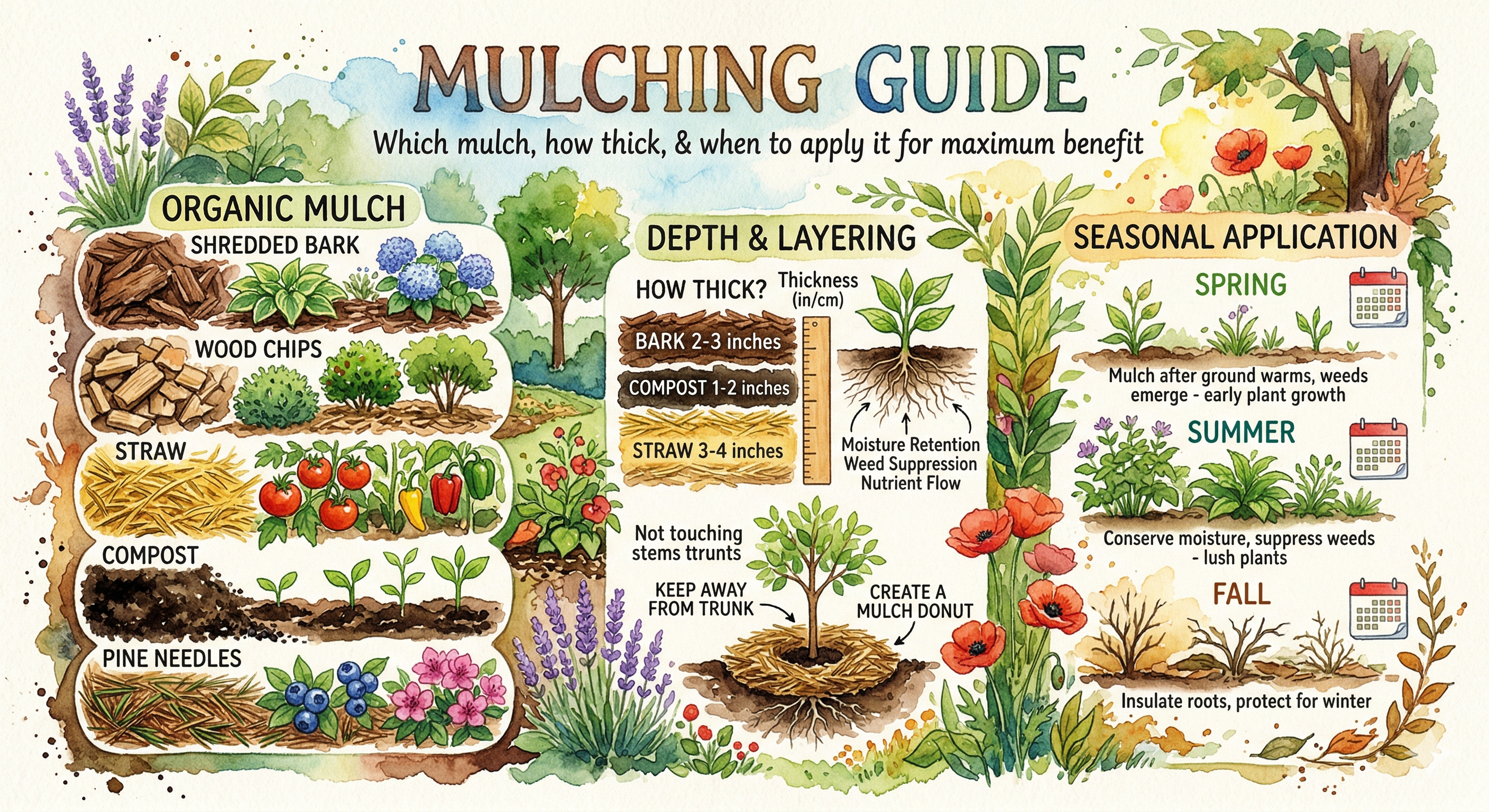
Mulching Guide
Which Mulch, How Thick, and When to Apply It for Maximum Benefit in Every American Garden
Mulch is the single most impactful thing most American gardeners do not do correctly. The right mulch at the right depth, applied at the right time, can reduce watering needs by half, eliminate most weeding, moderate extreme soil temperatures, build soil health over years, and make every garden bed look more finished and intentional. The wrong mulch — or the right mulch applied wrong — causes root rot, crown disease, pest problems, and slow decline that most gardeners never trace to the mulch sitting on top. This guide covers everything.
Why Mulch Matters
Mulch is any material placed on the soil surface to modify the growing environment beneath it. That one-line definition barely captures what a well-managed mulch layer actually accomplishes — it is simultaneously a moisture barrier, a thermal blanket, a weed suppressant, a soil builder, a habitat for beneficial organisms, and a visual design element. Understanding what mulch does at each level helps you make smarter decisions about which mulch to use and how to apply it.
Most gardeners think of mulch primarily as a weed suppressor or an aesthetic finishing touch. Those benefits are real, but they are actually secondary to mulch's most important function: moderating the soil environment to support biological activity, root growth, and water infiltration. A mulched bed and an unmulched bed in the same garden, over the same season, will have measurably different soil temperatures, soil moisture levels, compaction rates, weed seed germination rates, and organic matter content. The differences compound year over year.
The Seven Core Benefits of Mulching
| Benefit | What Actually Happens | Magnitude of Effect | Best Achieved With |
|---|---|---|---|
| Moisture retention | Mulch slows evaporation from the soil surface by creating a physical barrier between wet soil and dry air; reduces surface-air vapor exchange by 50–70% | Reduces watering frequency by 25–50% depending on mulch depth, type, and climate; most dramatic benefit in hot, dry, or windy conditions | Organic mulches 2–4 inches deep; any mulch type outperforms bare soil significantly |
| Weed suppression | Blocks light from reaching the soil surface where weed seeds require it to germinate; physically impedes seedling emergence through a dense layer | 2-inch layer reduces weed seed germination by 50–75%; 3–4 inch layer reduces it by 80–90%+; does not prevent rhizomatous perennial weeds or wind-blown seeds | Dense organic mulches (wood chips, shredded bark) outperform loose straw or thin bark nuggets for weed suppression |
| Soil temperature moderation | Insulates soil from surface temperature extremes; keeps soil cooler in summer heat and warmer in early spring and late fall; reduces freeze-thaw cycles that damage roots in winter | A 3-inch mulch layer keeps soil 10–15°F cooler than bare soil in summer; extends growing season at both ends; critical for protecting roots through freeze-thaw in Zones 3–6 | Any organic mulch at 3+ inches; straw is particularly good for soil temperature moderation in vegetable gardens |
| Soil structure improvement | Organic mulches decompose over time, adding organic matter to the upper soil layers; feeds earthworms and soil microbes; improves aggregation, aeration, and drainage/water retention simultaneously | Annual mulching over 3–5 years measurably increases organic matter content and improves soil structure; permanent no-till beds under organic mulch develop exceptional soil health | Decomposing organic mulches only — wood chips, shredded leaves, straw, compost; inorganic mulches provide no soil-building benefit |
| Erosion prevention | Absorbs the kinetic energy of raindrops before they impact soil surface; prevents splash dispersal of soil particles; maintains surface porosity that allows water to infiltrate rather than run off | Unmulched bare soil loses 10–100x more soil per rainfall event than mulched soil; critical on slopes and in high-rainfall regions | Any mulch provides significant erosion control; heavy organic mulches (wood chips, straw) are most effective on slopes |
| Soil biological activity | Creates a stable, moist, moderate-temperature habitat beneath the mulch layer that supports earthworms, beneficial fungi, bacteria, and other soil organisms; organic mulches provide food for these organisms | Mulched plots consistently show higher earthworm populations, higher fungal diversity, and more active nutrient cycling than bare soil | Coarse wood chip mulch (especially arborist chips) is exceptional for fungal development; any organic mulch significantly outperforms bare soil or inorganic mulch for biology |
| Aesthetic and design value | Provides a finished, intentional look to planting beds; creates visual contrast that makes plants stand out; reduces the weedy, neglected appearance of bare soil | Subjective but significant — mulched beds require less maintenance to look well-kept; color and texture choice affects the overall aesthetic considerably | Match mulch color and texture to design intent: dark brown for formal look; wood chips for naturalistic; gravel for Mediterranean or modern |
Mulch and Soil Ecology: The Biological Case for Organic Mulch
The most underappreciated benefit of organic mulch is its role in supporting the soil food web — the network of bacteria, fungi, nematodes, earthworms, and other organisms that make nutrients available to plants and create the soil structure that allows roots to thrive. This biology is not a bonus: it is the mechanism by which plants access most of their nutrition in natural systems.
Inorganic mulches (gravel, rubber, landscape fabric) suppress weeds and retain moisture — but they actively degrade soil biology by blocking organic matter inputs, reducing aeration, and preventing the biological activity that creates healthy soil structure. A landscape covered with rubber mulch over landscape fabric for a decade will have measurably worse soil than the same area left bare — because at least bare soil receives organic inputs from falling leaves and biological activity from rain.
- •Wood chip mulch specifically supports mycorrhizal fungi — the underground fungal networks that colonize plant roots and dramatically expand their ability to access water and nutrients; a mulched bed over several years develops a dense fungal network that a bare bed never achieves.
- •Earthworm populations under mulched soil are typically 5–10x higher than in bare soil; earthworms create the macropores and biological castings that give rich garden soil its characteristic structure and fertility.
- •The "mulch sandwich" visible when you lift a good wood chip mulch — bare decomposing material on the bottom, active fungal mycelium in the middle, and intact chips on top — is a thriving ecosystem in miniature.
Organic Mulch Types
Organic mulches are any plant-derived materials that decompose over time, improving soil as they break down. They represent the majority of mulch used in American gardens and landscapes, and they collectively offer the widest range of benefits — moisture retention, weed suppression, soil building, temperature moderation, and biological support — all in a single application. Because they decompose, organic mulches need periodic replenishment — typically annually or every other year depending on the material. This is not a flaw; it's the mechanism by which they build soil.
Wood Chips and Arborist Chips
Fresh wood chips from tree services and arborists are arguably the most ecologically valuable mulch available — and one of the most affordable (often free from local tree services). They differ from bagged wood chips in being coarse, fresh, and minimally processed. The irregular texture, mixed wood and leaf content, and active biological state of fresh arborist chips make them exceptional for soil health and mycorrhizal development.
| Attribute | Details |
|---|---|
| Best uses | Trees and shrubs; woodland garden areas; natural and informal landscapes; food forest and permaculture systems; pathways between raised beds |
| Ideal depth | 3–6 inches for trees and shrubs; 3–4 inches for perennial beds; 2–3 inches for pathways |
| Particle size | Mixed — a good arborist chip load contains everything from fine woody fines to 3–4 inch chunks; this diversity is ideal; avoid single-size chips which pack too uniformly |
| Nitrogen tie-up myth | A widely repeated but largely incorrect concern: fresh wood chips "steal" nitrogen only at the soil surface where chips contact soil, not in the root zone. Chips on top of soil do not deplete nitrogen available to roots; only if chips are tilled INTO the soil does nitrogen competition become significant. Never till fresh chips into soil; always apply them on top. |
| Decomposition rate | 1–3 years for fresh arborist chips; slower for large chunks; faster in humid conditions; replenish annually by adding 1–2 inches on top of existing decomposed layer |
| pH effect | Slightly acidic (pH 5.5–6.5 when decomposed); benefits acid-loving plants; in alkaline soils, the mild acidifying effect can be beneficial overall |
| Cost | Free to low-cost — many tree services will deliver a truckload free; ChipDrop.com connects homeowners with local arborists who need disposal sites |
| Regional notes | In humid climates (Southeast, Pacific NW), fresh chips break down faster — may need annual replenishment; in arid climates (Southwest, Mountain West) they persist longer |
Shredded Hardwood Bark and Bark Mulch
Shredded hardwood bark — the most commonly sold bagged mulch in the U.S. — is the workhorse of residential landscape mulching. It provides reliable weed suppression, attractive appearance, and reasonable longevity.
| Product Type | Description | Best For | Longevity | Weed Suppression | Notes |
|---|---|---|---|---|---|
| Shredded hardwood bark (bulk) | Coarsely shredded mixed hardwood bark; often reddish-brown; sold by the cubic yard | Large areas; trees and shrubs; general landscape beds | 1–2 years | Very good — knits together and resists wind better than nuggets | Best value for large areas; buy bulk rather than bags for significant cost savings; verify it's bark not wood (bark lasts longer) |
| Double or triple-ground hardwood | Finely ground bark and wood; very consistent texture; dark brown; popular bagged product | Ornamental beds; formal designs; vegetable garden paths | 1–1.5 years | Excellent — fine texture creates dense layer that blocks light effectively | Decomposes faster than coarser material, which means more soil benefit but more frequent replenishment |
| Bark nuggets (mini/medium/large) | Processed bark chunks; rounded; uniform size; popular in commercial landscaping | Formal and commercial landscapes; play areas; slopes | 2–3 years | Moderate — gaps between nuggets allow light through; larger nuggets are worse for weed control | Attractive and long-lasting but worst in class for weed suppression; floats in heavy rain; avoid on grades above 5% |
| Shredded cypress | Shredded cypress wood and bark; light-colored; slow to decompose; common in South | Southeast and Gulf Coast landscapes; beds needing good longevity | 2–3 years | Very good — knits together well | Sustainability concerns: bald cypress is harvested from natural swamp forests; look for certified sources or choose alternatives |
| Colored/dyed mulch | Wood material dyed red, black, or brown; very uniform color; widely sold in bags | Formal residential and commercial applications where color consistency matters | 1–2 years (color fades, especially red) | Good — depends on depth of application | Dyes are typically carbon or iron-based and are considered safe; concerns arise if wood source is unknown; look for products specifying virgin wood source |
| Cocoa shell mulch | Shells from cocoa bean processing; rich dark brown; pleasant chocolate scent initially | Ornamental beds; areas requiring fine uniform texture; acid-loving plants | 1–2 years | Very good when properly moistened | CAUTION: toxic to dogs if ingested; avoid in households with dogs. Keep at 1–2 inches maximum to prevent mold. |
Straw and Hay
Straw vs. Hay — A Critical Distinction: Straw is the hollow stem left after the grain (wheat, oat, rice, barley) has been removed — it contains minimal seeds. Hay is grass or legume foliage cut and dried for livestock feed — it is full of seeds and will germinate into a lawn of weeds in your garden. Never use hay as garden mulch unless it is extremely old, well-composted material. Always use straw. When purchasing, ask specifically for "seed-free straw."
| Straw Type | Characteristics | Best Garden Use | Weed Seed Risk | Regional Availability |
|---|---|---|---|---|
| Wheat straw | Light golden color; available in standard rectangular bales; clean and consistent quality | Vegetable gardens; strawberry beds; fall mulching; overseeding lawns; all-purpose garden mulch | Low if properly harvested; some wheat seed possible — inspect bales | Very wide — available at feed stores and garden centers nationwide; most affordable option in grain-growing regions |
| Oat straw | Similar to wheat straw; slightly finer texture; often cleaner; good quality consistent product | Vegetable gardens; berry patches; general garden mulching | Low to moderate | Wide availability; common at feed stores throughout grain-growing regions |
| Rice straw | Very fine; pale; clean; naturally low weed seed content; slower to decompose than wheat | Vegetable gardens; seed starting; soil cover for newly seeded areas | Very low | Primarily available in California and the Southeast rice-growing regions |
| Barley straw | Similar to wheat straw; releases compounds that inhibit algae growth without harming aquatic life when placed in ponds | Water features and ponds (algae control); general garden mulching | Low to moderate | Feed stores in grain belt; specialty suppliers for pond applications |
| Salt marsh hay | Very fine; light; virtually seed-free; traditional New England garden mulch | Asparagus beds; vegetable gardens; strawberry beds; traditional Northeast favorite | Extremely low — the gold standard for seed-free mulch | Primarily coastal Northeast; increasingly limited due to sustainability concerns |
- •Depth for vegetable gardens: 2–4 inches of straw is typical; 3–4 inches for maximum weed suppression; too thin and weeds push through easily.
- •Straw as insulation: 4–6 inches of straw mulch over root vegetables (carrots, parsnips, leeks) in the ground allows harvest through much of winter in Zones 5–7; the thermal insulation keeps the ground from freezing solid.
- •Fall application: Applying 4–6 inches of straw over garden beds after the last harvest protects soil over winter, prevents erosion, and can be easily removed or tilled in spring.
- •Strawberry beds: The traditional use that gives strawberries their name — straw mulched between rows prevents fruit from sitting on soil, reduces disease, and regulates soil temperature.
Shredded Leaves (Leaf Mold)
Shredded leaves are one of the finest and most underutilized mulches available — and in most American yards, they are free and abundant every fall. A leaf shredder or lawn mower run over a pile of leaves reduces their volume by 75–90% and creates a mulch that decomposes quickly, feeds soil biology effectively, and looks attractive enough for ornamental beds.
- •Why shred? Whole leaves mat together into an impermeable layer that sheds water, blocks oxygen, and creates anaerobic conditions. Shredded leaves create an open structure that retains moisture, allows gas exchange, and decomposes productively.
- •The best leaf mulch is a mix of species: Oak leaves are slow to decompose and provide long-lasting mulch; maple and birch leaves break down quickly and add nutrients fast; avoid large amounts of walnut leaves which contain juglone, a growth inhibitor that affects some plants.
- •Depth: 2–3 inches of shredded leaves for most applications; they compress after rain so the initial application looks thicker than the settled depth.
- •Leaf mold: Leaves left in a pile to decompose over 1–2 years become "leaf mold" — a partially composted material that is one of the finest soil amendments available; apply as a 1–2 inch top-dressing or soil conditioner.
- •Best uses: Perennial beds; vegetable garden paths; under trees and shrubs; woodland gardens; any area where you want a natural-looking mulch that builds soil rapidly.
Compost as Mulch
- •Best use: As a thin (1–2 inch) base layer applied directly on soil before a thicker (2–3 inch) layer of wood chips or other organic mulch goes on top; this "mulch sandwich" combines the soil-building benefit of compost with the weed suppression and moisture retention of a thicker mulch layer.
- •Weed suppression limitation: At the thin depths typical for compost application, it is not a reliable weed suppressant on its own; use it as a fertility layer beneath another mulch rather than as the primary mulch.
- •Compost quality matters enormously: Well-finished compost smells like earth and has no identifiable original materials; poorly finished compost may contain weed seeds, pathogens, or phytotoxic compounds; if in doubt, don't use it as a mulch directly around plants.
- •Best for: Vegetable gardens (1 inch top-dressed before final mulch layer); new plant establishment (worked into backfill then mulched over); lawn improvement (1/4–1/2 inch top-dressed and raked in).
Pine Needles (Pine Straw)
Pine needle mulch — called "pine straw" in the South, where it is extensively used and commercially harvested — is one of the most attractive, long-lasting, and well-performing organic mulches available. Its reputation for extreme soil acidification is largely a myth: pine needles are slightly acidic but do not significantly lower soil pH unless applied in very heavy quantities over many years.
| Attribute | Details |
|---|---|
| Best uses | Acid-loving plants (blueberries, azaleas, rhododendrons, camellias, gardenias); woodland gardens; slopes and hillsides; any ornamental bed |
| Depth | 2–3 inches for established areas; 3–4 inches for slopes; pine needles interlock and resist washing better than most other mulches on grades |
| Longevity | 1–2 years or more in most climates; in dry climates can persist 2–3 years before needing replenishment |
| pH effect reality | Fresh pine needles have a pH of 3.5–4.5, but finished pine needle mulch tests closer to 5.5–6.0 as it begins decomposing; the effect on soil pH is minimal in most soils. Do not rely on pine needles to significantly lower soil pH of alkaline soils; use elemental sulfur for true pH correction. |
| Fire risk | In fire-prone areas of the West, Southwest, and Southeast, pine needle mulch is flammable when dry; consider switching to gravel or stone mulch in Wildland-Urban Interface (WUI) zones; check with your local fire department |
| Regional availability | Extremely abundant and inexpensive in the Southeast; available in bags nationwide; free under any pine tree on your property |
Grass Clippings
- •Maximum depth: 1–2 inches applied fresh; fresh clippings in thick layers mat together, become anaerobic (smelly), and can form a water-shedding crust; keep layers thin.
- •Allow to wilt first: Drying clippings for 1–2 days before applying reduces matting and dramatically reduces the slimy decomposition smell.
- •Herbicide contamination warning: If your lawn has been treated with broadleaf herbicides (particularly aminopyralid, clopyralid, or picloram) within the past 1–3 mowings, the clippings can carry herbicide residue that damages or kills garden plants. Always let 2–3 mowing cycles pass after any lawn herbicide application before using clippings as mulch.
- •Best uses: Vegetable garden paths and between rows; thin layer around vegetables; building a sheet mulch with alternating layers of clippings and brown material.
Inorganic Mulch Types
Inorganic mulches are materials that do not decompose: stone, gravel, pebbles, rubber, crushed glass, and landscape fabric. They offer permanence and durability — once installed, they typically require far less replenishment than organic mulches. However, they provide no soil-building benefit and in some cases actively degrade soil health over time. Understanding when inorganic mulches are appropriate — and when they cause more harm than good — is essential knowledge for any gardener.
Gravel, Rock, and Stone Mulch
Gravel, crushed rock, river stone, pea gravel, and decorative boulders represent a massive category of inorganic mulching materials with genuinely excellent applications in appropriate contexts. Stone mulch is excellent for drainage, heat retention, and low-maintenance applications, but it is often misapplied in contexts where organic mulch would perform significantly better.
| Rock/Gravel Type | Size / Texture | Best Applications | Avoid Using For | Notes |
|---|---|---|---|---|
| Pea gravel (3/8 inch washed) | Small rounded; smooth; beige to tan or mixed colors | Paths and walkways; dog runs; drainage areas; decorative fill; between stepping stones | Plant beds in hot climates; areas requiring weed suppression (weeds grow through easily) | Washes and rolls under foot traffic; very poor weed suppression without landscape fabric |
| Crushed granite / decomposed granite (DG) | Angular; compacts well; ¼ inch and finer; tan to gray | Paths; desert and xeric gardens; formal driveways; fire-resistant landscapes; areas between desert-adapted plants | High-rainfall areas where it washes out; formal perennial beds where soil improvement is desired | Excellent for Mediterranean, desert, and xeric gardens in the West; drains extremely fast; does not retain moisture |
| River rock / cobble (2–4 inch) | Smooth rounded; various colors; medium to large size | Dry creek beds; rain garden inlets; drainage channels; accent areas around water features | General plant bed mulching (too heavy; hard to work around; compacts soil if walked on) | Outstanding for specific landscape applications where appearance and durability matter; poor choice for general mulching use |
| Lava rock | Lightweight; very porous; dark red to black; textured surface | Southwest and arid Western landscapes; areas with a modern or desert aesthetic; retaining walls and berm faces | Cold northern climates where freeze-thaw can break it down; high-rainfall climates | Excellent moisture retention compared to other stones (porous structure holds some water); used extensively in dry-climate residential landscapes |
| Limestone gravel / chips | Gray to white; angular; calcium carbonate content | Alkaline soil gardens; Mediterranean-style plantings; areas needing soil pH increase | Acid-loving plants; areas where soil pH is already adequate or high | Gradually raises soil pH as it weathers; intentional use around lavender, thyme, and other Mediterranean plants that prefer alkaline conditions |
| Marble chips / white stone | White to cream; decorative; available in various sizes | Formal garden designs; high-contrast aesthetic applications; Mediterranean-style gardens | Vegetable gardens (reflects heat that can stress plants); heavily shaded areas (looks dirty quickly) | Very high heat reflectance in full sun — can heat plant crowns and stems in hot climates; beautiful but requires thought about placement |
Gravel and heat in hot climates: In warm climates (Zones 7–11), gravel and stone absorb heat during the day and release it at night — significantly raising temperatures around plant crowns and roots. This benefits heat-loving Mediterranean plants (lavender, rosemary, thyme) and desert-adapted succulents, but can stress moisture-loving plants and cool-season vegetables. In cold climates (Zones 3–6), this heat-retention effect is actually beneficial for root protection.
Rubber Mulch
Shredded rubber mulch — made from recycled tires — is heavily marketed as a permanent, low-maintenance mulch with superior moisture retention. The marketing is partially accurate: rubber mulch does not decompose and does retain some moisture. However, its use in garden beds is increasingly discouraged by horticulturalists and soil scientists.
| Attribute | Rubber Mulch Reality |
|---|---|
| Soil health impact | Provides no organic matter to soil; may leach zinc, iron, and other compounds over time, particularly in hot climates; studies show elevated metal concentrations in soil under rubber mulch after several years; no evidence of benefits to soil biology |
| Plant safety | For most established landscape plants, leaching compounds appear to be at low enough concentrations to not cause immediate harm; for food plants (vegetable gardens, fruit trees) use is not recommended due to potential food safety concerns |
| Temperature | In full sun, rubber mulch heats to extremely high temperatures — sometimes 160°F+ surface temperature on hot days; this can stress or kill plant crowns and shallow roots in summer; far hotter than bare soil |
| Weed suppression | Good initially; weed seeds blown in from air germinate in the mulch surface over time, and their roots penetrate into the soil; becomes increasingly weed-filled over 3–5 years and is very difficult to weed without removing the mulch entirely |
| Fire risk | Rubber mulch is combustible and burns hotly; not appropriate near structures, in fire-prone regions, or anywhere fire safety is a concern |
| Best appropriate uses | Playground surfaces under play equipment — the original and best application (fall impact attenuation for child safety); specific non-planting areas where weed suppression and durability are the only requirements |
| Recommended alternative | For landscape beds, shredded hardwood bark or wood chips outperform rubber mulch in every category except longevity; the modest additional cost of annual replenishment is far outweighed by the soil health benefits of organic materials |
Landscape Fabric: Honest Assessment of an Oversold Product
Landscape fabric — woven or non-woven polypropylene sheeting placed on soil before mulch — is one of the most widely used and most widely regretted landscape products in America. It is sold as a permanent weed barrier that eliminates maintenance. The reality, measured in gardens after 5–10 years of use, is more complicated.
| Attribute | Reality |
|---|---|
| What it does well | Short-term weed suppression (first 1–3 years) when installed over existing weeds; prevents mulch from mixing into soil on slopes; useful under gravel paths where soil separation is the goal |
| What goes wrong over time | Weed seeds blow in and germinate in the mulch on top of the fabric; their roots grow through the fabric and anchor into the soil — now impossible to pull; organic matter accumulates on the fabric surface creating a growing medium for weeds; the fabric degrades into pieces that are nearly impossible to remove completely |
| The 5-year reality | Most landscapes with landscape fabric become increasingly weed-filled after year 3; by year 7–10, many homeowners describe the situation as worse than before fabric was installed — same weeds, plus intact fabric that can't be removed without destroying plants |
| Root restriction | Fabric restricts root growth as plants mature; trees and shrubs planted through landscape fabric frequently show root girdling, reduced growth, and premature decline; the fabric becomes physically embedded in root systems and cannot be removed later |
| When fabric IS appropriate | Under gravel or stone pathways where the goal is soil separation (not weed suppression) and no plants are growing; under driveways and hardscaping for subbase stabilization; as temporary erosion control on bare soil slopes before vegetation establishes |
| Better alternative | For planted beds: 3–4 inches of wood chip or shredded bark mulch alone outperforms fabric + mulch for weed suppression after year 3, while building soil instead of degrading it |
Biodegradable Weed Barrier Options
- •Cardboard (corrugated): The workhorse of sheet mulching and lasagna gardening; highly effective weed suppressant; completely biodegrades in 6–18 months; remove all tape and staples before use; overlap sheets by 6 inches to prevent gaps; dampen before applying mulch on top to prevent blowing and activate decomposition.
- •Newspaper (6–10 sheets thick): Similar to cardboard; works particularly well in vegetable gardens; decomposes in one season; excellent for sheet mulching new vegetable beds; avoid glossy/colored inserts.
- •Biodegradable weed barrier fabric (jute, coir, hemp): Woven natural fiber fabrics that provide 1–2 seasons of weed suppression while decomposing into the soil; excellent for erosion control on slopes; appropriate for steep grades where mulch alone would wash away.
- •Paper mulch (colored or black): Used commercially in vegetable production; black paper heats soil in spring; available in rolls for home garden use; decomposes within one season; can be used with drip irrigation punched through.
How Deep to Mulch
Mulch depth is where most home gardeners go wrong in both directions. Too thin and the mulch provides minimal weed suppression or moisture retention — a 1-inch layer is barely better than nothing. Too thick and the mulch deprives plant roots of oxygen, creates a habitat for fungal disease and rodents, and prevents rain from penetrating to the soil. The correct depth varies by application, plant type, and mulch material — but the principles are consistent.
The two cardinal rules of mulch depth: Never less than 2 inches — below this threshold, mulch provides minimal benefit. Never more than 4 inches on established beds (6 inches only for special situations). Always keep mulch 2–4 inches away from all plant stems and tree trunks.
Depth by Application Type
| Application | Recommended Depth | Rationale | Common Mistakes |
|---|---|---|---|
| Trees and large shrubs (established) | 3–4 inches over root zone; 4–6 inches in poor soils or for maximum moisture conservation | Deeper mulch provides greater moisture retention and more insulation for the extensive root systems of large woody plants; also suppresses lawn grass competition | Volcano mulching (piling against trunk); not extending the mulched area far enough — ideal is to the drip line or beyond |
| Trees (newly planted) | 2–3 inches initially; expand circle and increase to 3–4 inches after first year | Newly planted trees are establishing roots and need moisture retention and temperature moderation; keep circle small initially (3 ft diameter) and expand as tree establishes | Applying too much too soon; piling against trunk; not watering through the mulch adequately in the first growing season |
| Shrubs and hedges | 2–3 inches | Shrubs typically have shallower root systems than trees; 2–3 inches provides good moisture retention and weed suppression without oxygen deprivation risks | Letting mulch touch the base of shrubs (causes crown rot on many species, particularly evergreen azaleas, boxwood, and other susceptible plants) |
| Perennial flower beds | 2–3 inches | Perennials need their crowns to breathe; 2–3 inches balances weed suppression and aeration needs; some perennials are sensitive to mulch contact at the crown | Mulching over dormant crowns in fall before they are fully dormant; using fine materials that compact and prevent spring emergence |
| Annual flower beds | 1.5–2 inches | Annuals are shallower-rooted and often need to self-sow for the following season; thinner layer allows easy transplanting and soil warmth | Over-mulching thin-stemmed annuals; preventing self-seeding of desired annuals |
| Vegetable gardens (between rows) | 2–4 inches straw or shredded leaves | Deeper mulch needed in vegetable gardens to manage moisture through hot summer production months; straw at 3–4 inches provides excellent performance | Using fine mulch that compacts; applying before soil has warmed in spring (delays planting season) |
| Vegetable gardens (around plants) | 1–2 inches close to stems; 3–4 inches between plants | Keep thin near stems to prevent disease; thicker between plants for weed and moisture management | Over-mulching around tomato, squash, and cucumber stems — dramatically increases disease pressure from soil splash and crown moisture |
| Vegetable seed rows | None until seedlings are 3+ inches tall | Mulch prevents light from reaching germinating seeds and physically impedes emergence of small seedlings | Mulching over newly seeded areas — a very common mistake that dramatically reduces germination rates |
| Strawberries | 2–3 inches between rows; 1 inch under and around plants | Keeps fruit off soil; moderates temperature; reduces disease from soil splash | Too deep under plants smothers crowns; too thin between rows allows weeds to overtake during fruiting |
| Roses | 2–3 inches; keep clear of bud union and canes | Moisture retention helps roses through drought; insulation of roots in winter; disease prevention from reduced soil splash | Mulching over the bud union on grafted roses, especially in cold climates; using fresh wood chips or manure that may introduce pathogens |
| Pathways and non-planted areas | 3–6 inches; can go deeper with no plant health concerns | Deeper mulch on pathways provides better weed suppression and lasts longer; comfort underfoot with deeper material | Not edging pathways properly, leading to mulch spreading into planted areas |
| Hillsides and slopes (erosion control) | 3–4 inches; use coarse material that anchors | Deeper needed for erosion control; coarse or interlocking material (pine needles, wood chips, straw with erosion blanket) resists washing in rain events | Using fine or loose material (bark nuggets, gravel) that washes off slopes easily |
Fine-Tuning Depth by Mulch Material
| Mulch Material | Apply At | Settles To | Notes on Depth |
|---|---|---|---|
| Shredded hardwood bark | 3–4 inches | 2–3 inches after rain and settling | Standard benchmark depth; the basis for most mulch depth recommendations |
| Wood chips (coarse arborist chips) | 4–5 inches | 3–4 inches settled | Coarser material requires slightly more initial depth to achieve equivalent settled density |
| Bark nuggets (medium) | 4 inches | 3.5 inches settled — gaps between nuggets persist | Because gaps allow light penetration, bark nuggets need to be slightly deeper than shredded materials to achieve equivalent weed suppression |
| Pine needles / straw | 3–4 inches | 2.5–3 inches settled | Both materials are lightweight and settle significantly; apply generously knowing they will compress |
| Shredded leaves | 3–4 inches | 1.5–2 inches after decomposition begins | Leaves compact dramatically, especially when wet; apply generously to account for rapid settling and early-season decomposition |
| Compost (as mulch) | 1–2 inches (used as base layer) | 0.75–1.5 inches settled | Should be used as a base under another mulch, not as the primary mulch layer; apply before topping with 2–3 inches of another material |
| Gravel / rock (1.5 inch) | 2–3 inches | 2–3 inches — minimal settling | Inorganic; does not settle; apply at final depth; very difficult to adjust once in place |
| Grass clippings | 1–1.5 inches (maximum) | 0.75 inch after settling and initial decomposition | Apply thin; thicker layers mat and create anaerobic conditions; this is one material where less is genuinely more |
The Volcano Mulch Problem: What Happens When You Go Too Deep
Over-mulching is at least as common and as damaging as under-mulching. The problems caused by excessive mulch depth and mulch contact with plant stems are well-documented and affect millions of American landscapes every year.
| Problem | Caused By | Affects | Signs | Solution |
|---|---|---|---|---|
| Crown and collar rot | Mulch piled against stems keeps moisture in contact with bark; creates conditions for Phytophthora and other fungal pathogens to attack the stem at ground level | All woody plants; most severe in arborvitae, yews, boxwood, roses, young fruit trees, and grafted plants | Discoloration and softening of bark at soil line; leaves yellow and die suddenly in summer; plant declines rapidly | Pull mulch back immediately; create a 3–4 inch gap from stems; in severe cases, remove all mulch and allow the crown to dry before replacing properly |
| Root suffocation | Mulch deeper than 6 inches significantly restricts oxygen diffusion to the root zone | Trees and shrubs with deep applications (6–12 inches is not uncommon in commercial landscapes) | Gradual decline; poor leaf color; smaller than normal leaf size; dieback of branch tips; bark softening at base | Remove and thin to proper depth immediately; aerate soil if compacted; roots may recover if caught early |
| Rodent habitat and girdling | Deep mulch piled against trees creates ideal habitat for voles, mice, and gophers that chew bark while hidden under the mulch layer | Trees and shrubs; particularly vulnerable: young fruit trees, newly planted specimens, thin-barked trees | Bark missing from trunk at the mulch line; sudden death of otherwise healthy tree in late winter/early spring | Pull mulch back from trunk; install physical trunk guards (hardware cloth cylinders) as prevention |
| Anaerobic soil conditions | Very thick mulch layers prevent normal gas exchange; CO2 builds up and oxygen depletes in the soil | Established plantings under years of accumulated mulch without removal of old layers | Sulfur smell from soil under mulch; wilting despite adequate moisture; root rot without visible crown disease | Remove top layer of mulch entirely; let soil breathe; reapply at correct depth after 1 week |
| Stem/graft union disease | Mulch in contact with graft unions allows moisture to wick into the union, causing rot and loss of grafted top | All grafted plants: roses (bud union), fruit trees (graft union), ornamental trees | Top of grafted plant dies; suckers emerge from rootstock below union; visible rotting at union when inspected | Expose the union completely; it should always be above the mulch line |
When to Apply Mulch
The timing of mulch application is almost as important as the type and depth. Applied at the right moment, mulch locks in moisture before summer heat arrives, insulates roots before winter freezes, or suppresses spring weeds before they establish. Applied at the wrong time, mulch traps cold in spring soil when you want warmth, delays summer soil heating in vegetable gardens, or covers crown diseases that should be exposed and treated.
Seasonal Timing by Region and Climate
| Season / Timing | What to Do | Why | Regions Where This Matters Most |
|---|---|---|---|
| Early Spring (soil warmup) | Wait until soil has warmed before applying mulch to vegetable gardens and annual beds; pull mulch back from perennial crowns to allow emergence | Cold soil delays planting and germination; mulch insulates soil from warming; premature mulching can delay the growing season by 1–2 weeks in cold climates | Critical in Zones 3–6; less important in Zones 7–11 where soil rarely needs time to warm |
| Mid-Spring (pre-heat season) | Best time for most landscape mulch application; apply after soil has warmed but before summer heat and weed seed germination peaks; refresh or reapply as annual application | Captures full moisture-retention benefit for the summer ahead; prevents the main flush of annual weed germination; gives maximum benefit for the entire growing season | Universal best timing for all U.S. regions; typically April–May in Zones 5–7; February–March in Zones 8–10; May–June in Zones 3–4 |
| Late Spring / Early Summer (before heat) | Apply or reapply mulch before summer heat peaks if missed in spring; last practical window for full summer benefit | Soil that has been warm and dry in May/June benefits greatly from mulch that will slow evaporation through July–August; water deeply before applying over dry soil | Particularly important in hot summer climates (Southwest, Great Plains, Southeast) |
| Midsummer | Generally avoid adding new mulch layers in full summer; if needed, apply only 1 inch as a top-up; ensure soil is moist before applying | Adding thick mulch over dry soil in summer traps the dry condition; ensure soil is moist and water deeply before summer mulch application | Drought-prone regions where summer mulching seems most needed but can be counterproductive if soil is already dry and hard |
| Fall (pre-winter) | Apply winter mulch after the first few hard freezes but before the ground freezes solid; do not mulch too early before plants have hardened off | Goal: insulate frozen soil to prevent damaging freeze-thaw cycles, not prevent initial freezing; premature fall mulch can delay plant hardening off and extend disease pressure | Critical in Zones 3–6 for overwintering perennials, roses, root vegetables, and marginally hardy plants |
| Winter (mild climates) | In Zones 8–11, apply mulch throughout winter as needed since growing continues; protect tender plants with extra mulch before expected cold snaps | Mild-climate winters have active growth in some seasons; mulch management continues year-round rather than following a seasonal cycle | Gulf Coast, Florida, Pacific Coast, Desert Southwest where winter is a legitimate growing season |
| After heavy rain / storms | Replace mulch that has washed away; do not add new mulch over waterlogged soil — allow drainage first; check that mulch has not redistributed to cover plant crowns | Mulch integrity is compromised by heavy rain; storm redistribution can pile mulch against plant stems causing unseen crown rot | High-rainfall regions (Pacific NW, Southeast, Gulf Coast, Mountain West during monsoon season) |
The Spring Perennial Bed Timing Question
- •In late winter / very early spring: Pull back or lightly stir existing mulch from plant crowns; check for signs of disease or pest damage; allow crowns to be exposed to drying air briefly.
- •After crowns are visible but before leaf expansion: Apply or refresh mulch around plants — not on top of them; 2–3 inches between plants, kept clear of crowns by 2–4 inches.
- •Timing window: Typically after the last hard freeze is likely but before consistently warm temperatures bring weed seed germination — a 2–3 week window in late March–April (Zones 5–6), mid-March (Zones 7–8), or February (Zones 9–10).
- •Do not wait for full emergence before mulching: If you wait until perennials are fully leafed out, weeds have already germinated in the bare soil between plants; the goal is to mulch while you can still navigate between emerging but not-yet-expanded plants.
Vegetable Garden Timing: Maximizing Soil Temperature
- •Cool-season vegetable beds (spring): Do NOT mulch cool-season beds early in spring; allow the soil to warm as fast as possible; light-colored or black plastic mulch can be used to pre-warm soil before planting in cold climates.
- •After warm-season transplants are established (2–4 weeks after transplanting): Apply 3–4 inches of straw or shredded leaves; soil is warm, plants are established, and the summer moisture retention benefit is about to become critical.
- •Do not mulch around direct-seeded crops until seedlings are 3–4 inches tall: mulch prevents germination and impedes seedling emergence; thin carefully around seedlings before applying mulch between rows.
- •Fall vegetable garden: After fall harvest, apply 4–6 inches of straw or shredded leaves over the entire bed to protect soil over winter, prevent erosion, and provide organic matter for spring incorporation.
Winter Mulching for Plant Protection
In Zones 3–7, winter mulch applied specifically for plant protection is fundamentally different in purpose from regular landscape mulch. Its goal is to insulate already-frozen soil from the repeated freeze-thaw cycles that damage plant roots — not to prevent freezing in the first place.
- •Timing is critical: Apply winter protection mulch after plants have entered full dormancy and after the soil has experienced several hard freezes (typically late November–December in Zones 5–6; October–November in Zones 3–4). Applying too early in Zones 5–7 can delay plant hardening off.
- •Roses: Mound 10–12 inches of compost, bark, or soil over the base of hybrid tea and grandiflora roses in Zones 5 and colder; remove in spring when forsythia blooms. With own-root roses and hardy shrub roses, a standard 3-inch mulch layer is typically sufficient.
- •Marginally hardy perennials: Add an extra 2–3 inches of straw, shredded leaves, or evergreen boughs over plants rated 1 zone colder than your actual zone; this can extend survival of borderline plants significantly.
- •Root vegetables in ground: In Zones 5–7, 6–8 inches of straw mulch over carrots, parsnips, leeks, and other root vegetables allows harvest through much of winter as the mulch prevents the ground from freezing solid in moderate winters.
- •Removal timing: Remove winter protection mulch in spring before new growth is forced under the mulch; typically when forsythia blooms or when ground temperatures are consistently above 40°F.
Mulching by Plant Type
Different plants have fundamentally different relationships with mulch. A tree benefits from deep mulch extending to the drip line — mimicking the natural leaf litter layer of a forest floor. A tomato plant wants warmth and air around its base. A newly seeded lawn needs no mulch at all in some situations or very fine straw in others. This section gives plant-specific guidance for every major garden category.
Trees: The Most Important Mulching You'll Ever Do
Mulching trees properly is the highest-impact maintenance decision you can make for their long-term health — and yet volcano mulching (piling mulch against trunks) is so common that it kills thousands of otherwise-healthy trees every year in America. Done correctly, mulching trees is transformative; done wrong, it's slowly lethal.
- •Extend the mulched area as far as possible: The tree's feeder roots extend well beyond the drip line; the larger the mulched area, the greater the benefit; minimum is the drip line area, but mulching further is always better.
- •The "donut" shape: The mulched area should look like a donut from above — full coverage from about 6 inches out from the trunk to the edge of the drip line, with a gap of 2–4 inches immediately around the trunk; this gap is not optional.
- •Depth: 3–4 inches of shredded hardwood bark or wood chips; for trees on poor soils or in high-stress urban environments, 4–6 inches away from the trunk.
- •Best mulch for trees: Arborist wood chips — the coarser the better; they support the mycorrhizal fungi that directly improve tree health and root function; do not use fine mulch against tree trunks where it holds moisture.
- •Replacing lawn around trees: Lawn grass competes aggressively for water and nutrients, and mowing/string-trimmer damage to bark is a major source of stress and disease entry; removing lawn and replacing with mulch is one of the single best things you can do for a tree's long-term health.
- •Young tree establishment: Mulch rings of 3–4 feet diameter and 3-inch depth around newly planted trees can reduce transplant stress significantly — mulched trees establish 2–3x faster than unmulched trees in the same conditions.
Shrubs and Hedges
- •Depth: 2–3 inches across the root zone of individual shrubs; 3–4 inches in hedge rows where weeds compete heavily.
- •Maintain clearance from ALL stems: In multi-stemmed shrubs, check carefully that no stems are in contact with mulch, especially at the soil line where bark is most vulnerable.
- •Acid-loving shrubs (azaleas, rhododendrons, blueberries, camellias): Pine needles, shredded oak leaves, or acidified wood chip mulch; the slight acidifying effect and moisture retention is critical for their shallow, fibrous root systems; never use alkaline materials (wood ash, crushed limestone) around these plants.
- •Boxwood specifically: Pull mulch back completely from boxwood crowns; boxwood is extremely sensitive to crown moisture and one of the plants most commonly killed by over-mulching or mulch-against-stem situations.
Roses
| Rose Type | Recommended Mulch | Depth | Key Considerations |
|---|---|---|---|
| Hybrid tea and grandiflora (grafted) | Shredded bark or wood chips; avoid fine materials around crowns | 2–3 inches; keep 4–6 inches away from canes at soil line; in Zones 5 and colder, mound 8–12 inches over bud union for winter | Bud union must be kept dry; mulch reduces black spot from soil splash significantly; bud union should be protected with mounded winter mulch in Zones 5–6 |
| Shrub roses (own-root) | Any organic mulch; wood chips preferred | 2–3 inches; 2-inch gap from cane bases | More forgiving than grafted roses; own-root roses in Zones 4–6 can be reliably overwintered with standard 3-inch mulch; they regenerate from the base even if top-killed |
| Climbing roses | Shredded bark or wood chips at base | 2–3 inches at base; for winter protection tie canes and wrap with burlap before applying insulating mulch over base | Keep mulch off wooden structures or walls to which canes are attached to prevent rot |
| Miniature roses | Fine-textured bark mulch or shredded leaves | 1.5–2 inches; very careful clearance from tiny stems | Scale matters — a 2-inch mulch application appropriate for a full-size rose can be proportionally overwhelming for a miniature; use fine material |
Vegetable Gardens
| Vegetable Category | Best Mulch | Depth / Method | Special Considerations |
|---|---|---|---|
| Tomatoes, peppers, eggplant (warm-season fruiting) | Straw, shredded leaves, or plastic mulch | 3–4 inches straw between plants; 1 inch around stems; alternatively black plastic pre-warms soil and manages moisture exceptionally well | Mulch significantly reduces early and late blight, Septoria, and Anthracnose in humid climates; allow soil to warm to 65°F before mulching in cool climates |
| Cucumbers, squash, melons (cucurbits) | Black plastic (pre-warming) then straw after establishment; or straw alone once soil is warm | Black plastic at planting then 3–4 inches straw when plants are established | Cucurbits are extremely temperature-sensitive; pre-warming with black plastic can extend harvest window significantly in cool climates |
| Beans and peas (legumes) | Straw or shredded leaves | 2–3 inches between rows | Legumes are nitrogen-fixers and don't need nitrogen-rich mulches; peas prefer cool soil — mulch early to keep soil cool for extended harvest |
| Corn | Straw or grass clippings | 2–3 inches between rows after plants are 6+ inches tall | Corn needs warm soil to germinate; don't mulch until plants are established; focus on keeping straw between rows, not around plant bases |
| Root vegetables (carrots, beets, radishes) | Light straw or shredded leaves | 1–2 inches — very light application; keep clear of emerging greens | Heavy mulch prevents the even soil moisture needed for uniform root development; use light application primarily for moisture retention |
| Brassicas (broccoli, cabbage, kale) | Straw, shredded bark, or arborist chips | 2–3 inches | Brassicas prefer cool soil — mulch early to keep roots cool in summer; check for slugs and earwigs sheltering under mulch |
| Lettuce and salad greens | Fine straw or shredded leaves | 1–2 inches light application | Delicate stems are easily smothered or damaged by heavy mulch; light application keeps soil moist and prevents splash on edible leaves |
| Garlic and onions | Straw mulch | 4–6 inches over garlic after fall planting; remove in spring when shoots emerge; 2–3 inches around growing onions | Fall-planted garlic benefits enormously from deep straw mulch; do not mulch onion bulbing area in summer (needs heat and drying) |
Fruit Trees and Berry Bushes
- •Fruit trees: 3–4 inches of wood chips or shredded bark extending to the drip line; CRITICAL — maintain a completely clear area of 12+ inches from the trunk; this prevents rodent habitat and disease entry that are especially problematic in fruit trees.
- •Fire blight management (apples, pears): Avoid excessive nitrogen from composted mulch immediately around fire-blight-susceptible trees; nitrogen promotes the succulent growth that fire blight most readily attacks; use wood chips rather than compost under susceptible apples and pears.
- •Blueberries: 3–4 inches of wood chips, pine needles, or shredded oak leaves; blueberries have very shallow, fibrous roots that are extremely sensitive to soil temperature and moisture swings; the mild acidifying effect of pine needles and oak leaves is beneficial.
- •Strawberries: 2–3 inches of weed-free straw between rows; keep mulch thin around crowns; replace after harvest to protect over winter in Zones 4–6.
- •Raspberries and blackberries: 2–3 inches of wood chips or straw between rows; keep mulch thin at cane bases; excellent for moisture retention and weed suppression in the vigorous-growing canes.
Lawn Areas: When and How to Mulch Grass
- •New seeding: When overseeding bare areas or establishing a new lawn from seed, a very thin layer (1/4–1/2 inch) of weed-free straw over the seed prevents desiccation and bird predation; keep it thin enough that 50–75% of the soil surface is still visible.
- •Sod seams: After laying sod, topdressing seams between sod pieces with a thin application of sandy loam or compost helps them knit together faster.
- •Grass clipping mulching: Leaving mowed grass clippings on the lawn (mulching mowing) is one of the simplest and most beneficial lawn care practices; clippings contain 4% nitrogen and return nutrition to the lawn with each mowing.
- •Tree rings: Removing grass from under trees and replacing with a 3–4 inch wood chip mulch ring is one of the most beneficial practices for tree health; the grass-to-mulch transition should be clean and clearly edged for aesthetic coherence with the lawn.
Regional Mulching Guide
The ideal mulch strategy varies significantly by climate. What works beautifully in the cool, rainy Pacific Northwest may decompose too rapidly in the humid South or fail to provide adequate moisture retention in the arid Southwest. This section gives region-specific guidance that accounts for local rainfall patterns, temperature extremes, soil types, locally available materials, and the specific challenges each climate presents.
| Region | Primary Climate Challenge | Best Organic Mulches | Best Inorganic Mulches | Depth Guidance | Key Regional Notes |
|---|---|---|---|---|---|
| New England & Upper Northeast (ME, NH, VT, MA, RI, CT, upstate NY) | Long cold winters; freeze-thaw cycles; short growing season; adequate summer moisture; heavy leaf fall | Shredded leaves (free and abundant); wood chips; shredded bark; pine needles under conifers | Gravel for paths; limited appropriate applications | Standard 2–3 in for beds; 4–6 in fall protection mulch in Nov–Dec; extend to drip line on trees | Leaf shredding in fall is the keystone of a good mulch program; the region's abundant deciduous trees produce more mulch material than most gardens can use; shred and stockpile for year-round use; freeze-thaw protection particularly important for root vegetables and marginally hardy perennials |
| Mid-Atlantic (NY metro, NJ, PA, MD, DE, VA, DC) | Hot humid summers; cold winters in north; moderate rainfall; heavy clay soils in Piedmont region | Shredded hardwood bark; wood chips; shredded leaves; straw for vegetable gardens | Gravel and crushed stone for formal applications; limited use otherwise | 3 in standard; 4 in around trees extending to drip line; 3–4 in straw in vegetable gardens | Hot humid summers make mulch-based disease management critical — keeping mulch off stems is especially important where fungal disease pressure is high; Chesapeake Bay watershed homeowners should prioritize organic mulch for stormwater quality |
| Southeast & Gulf Coast (NC, SC, GA, FL, AL, MS, LA) | Hot humid summers; intense rainfall events; mild winters; heavy weed pressure year-round; high organic matter decomposition rate | Pine straw (regionally abundant and traditional); shredded bark; wood chips; pine bark nuggets in drier spots | Gravel in formal applications; lava rock in dry spots | Standard 3 in; replenish every 6–9 months due to rapid decomposition; pine straw at 3–4 in holds together well in heavy rain | Pine straw is the dominant regional product and performs excellently — it knits together, resists washing in rain events, and decomposes at an appropriate rate; tropical heat and humidity decompose organic mulches 2–3x faster than in northern climates — budget for more frequent replenishment |
| Midwest & Great Lakes (OH, IN, IL, WI, MI, MN, IA) | Four distinct seasons; cold winters with freeze-thaw; warm humid summers; abundant rainfall; excellent native soils | Shredded bark (dominant regional product); wood chips (plentiful from urban tree services); shredded leaves; straw | Gravel; stone; limited applications | 3 in standard; 4–5 in in fall for winter protection; extend tree mulch rings generously | Great Lakes region has an abundance of urban tree service wood chips — one of the best mulch sources and often free; prairie-origin soils respond well to organic mulch additions; invest in an annual mulch refresh program for best results across four distinct seasons |
| Great Plains (KS, NE, ND, SD, OK, eastern CO) | Wide temperature range; limited rainfall (15–25 in in many areas); high winds; alkaline soils; periodic drought | Shredded bark; wood chips; straw (locally produced and inexpensive in grain belt) | Gravel and decomposed granite in drier western areas; stone in formal applications | 3–4 in standard; deeper under trees (4–5 in); weighted or interlocking materials needed in windy areas | High winds make light mulch materials (straw, bark nuggets) problematic in exposed areas — wood chips that interlock are more wind-resistant; alkaline soils benefit from slightly acidifying organic mulches; water conservation is paramount — invest in the full recommended depth |
| Mountain West (CO, UT, WY, ID, MT, NM mountains) | Short growing seasons at altitude; intense UV; dramatic temperature swings; limited moisture; alkaline soils; wildfire risk | Wood chips; shredded bark; native materials where appropriate; straw at lower elevations | Decomposed granite; river gravel; crushed rock in arid areas; fire-resistant gravel near structures | 3–4 in standard; fire-resistant gravel or stone within 5 feet of structures in WUI zones; organic mulch beyond the fire-safe zone | Wildfire risk significantly affects mulch choices in WUI areas — consult local fire department guidance; organic mulch dries rapidly in low humidity; intense UV at altitude breaks down mulch faster than at lower elevations |
| Pacific Northwest (WA, OR, northern CA coast) | Very wet mild winters; dry summers; high rainfall (35–80+ in); excellent growing conditions; mild temperatures | Wood chips (extremely abundant from regional arborist operations — often free); shredded bark; shredded leaves | Gravel for paths; stone for water features and naturalistic gardens | 2–3 in standard — in the wet PNW, deeper mulch can stay too wet and promote disease; 3 in is the practical maximum for most applications | The Pacific NW has the most abundant arborist chip availability of any U.S. region — free chips are available constantly; the challenge is avoiding over-mulching in a climate that is already very moist through winter; slug management under mulch is an ongoing concern |
| California (inland and central) | Mediterranean climate: wet winters, very dry summers; fire risk; diverse soil types; water conservation critical | Wood chips (excellent for water conservation and soil biology); shredded bark; compost as base layer; straw in vegetable gardens | Decomposed granite; gravel; fire-resistant choices near structures | 3–4 in for maximum summer water conservation — this is the region where mulch depth pays the most direct dividends on water bills; fire-resistant gravel within 5 feet of structures | Mulch water conservation benefit is most economically significant where water costs are high and summer droughts severe; a 4-inch wood chip mulch can reduce supplemental irrigation by 30–50% compared to unmulched soil |
| Desert Southwest (AZ, NM, southern NV, southern CA desert) | Very arid (5–15 in rainfall); extreme summer heat; alkaline soils; intense UV; limited organic material; summer monsoon season | Wood chips as "oasis" mulch around water-reliant plants near irrigation; compost for vegetable gardens; gravel and rock as the primary landscape surface | Gravel; decomposed granite; lava rock; flagstone — all widely appropriate in desert climate | 2–3 in organic mulch around irrigated plants; 3–4 in gravel or DG in xeric landscape areas; do not apply deep organic mulch without irrigation support | The desert Southwest is the one U.S. region where gravel and rock mulch is often the most ecologically appropriate choice for native desert plantings — it mimics natural desert soil surface conditions; organic mulch decomposes rapidly in desert heat and UV |
Application Techniques
Correct mulch application technique is more important than most gardeners realize. The same material at the correct depth, applied correctly, performs dramatically better than the same material applied carelessly.
Standard Mulch Application
- •Prepare the bed: Remove existing weeds by hand (or smother with cardboard — see Sheet Mulching below); cut or pull rather than tilling, which brings weed seeds to the surface.
- •Edge the bed clearly: Define the boundary between mulched bed and lawn or walkway with a flat spade or bed edger; a clean edge makes the finished result look intentional and prevents grass from growing into the mulch.
- •Water the soil: If soil is dry, water thoroughly before applying mulch; applying mulch over very dry soil traps the dry condition; soil should be moist 2–3 inches down.
- •Apply base layer of compost (optional): A 1-inch layer of compost applied directly on soil before the main mulch material provides a fertility boost and inoculant layer; particularly beneficial when establishing new beds or on poor soils.
- •Apply mulch to correct depth: Distribute material evenly using a rake or by hand; check depth at multiple points — aim for 3 inches after minor settling.
- •Maintain gaps at plant bases: Work carefully around the base of every plant to maintain a 2–4 inch gap for stems (more for shrubs and trees); this step is not optional and should be done plant by plant.
- •Do not disturb soil surface when raking: Rake gently on the mulch surface; vigorous raking disturbs the mulch layer and may bring weed seeds from below; use a light touch when leveling.
- •Water in: Water lightly after application to settle the mulch, reduce wind movement, and begin decomposition of the bottom layer.
Sheet Mulching (Cardboard Method) — For New Beds and Severe Weed Problems
Sheet mulching — using cardboard or newspaper as a base layer under organic mulch — is the most effective non-herbicide approach for converting grass or weed-covered ground to a planting bed. It smothers existing vegetation without digging, enriches soil as the cardboard decomposes, and provides 6–18 months of excellent weed suppression.
- •Mow or cut existing vegetation as short as possible: The less vegetation mass under the cardboard, the faster it breaks down and the better the coverage.
- •Water the ground thoroughly: Wet soil under the cardboard is essential for decomposition to begin and for maintaining worm activity.
- •Lay cardboard with generous overlaps: Overlap sheets by at least 6 inches; weed growth will find and exploit every gap; cover the entire area plus 6 inches beyond the intended bed boundary.
- •Remove all tape, staples, and labels from cardboard: Tape does not decompose; it creates a persistent barrier and should not be added to the garden.
- •Wet the cardboard: Saturate the cardboard after laying; this activates decomposition and weights it down against wind.
- •Apply 3–4 inches of wood chips or shredded bark over the wet cardboard immediately: The mulch weighs down the cardboard, maintains moisture beneath it, and begins the long decomposition process.
- •Plant through the layer: To plant into a sheet mulched area, simply push aside the mulch, cut through the cardboard with a knife, and plant into the soil below; the surrounding cardboard continues suppressing weeds while the plant establishes.
Sheet mulching timeline: Cardboard takes 6–18 months to fully decompose, depending on moisture and temperature. During this time it provides excellent weed suppression. After the cardboard decomposes, the layer of wood chips above becomes the standard mulch layer requiring periodic replenishment. The soil below a sheet-mulched area is significantly improved by earthworm activity and decomposition.
Maintaining Existing Mulch
- •Assess existing depth first: Use a ruler or pencil to measure the actual depth of mulch in several spots; do not estimate by looking from above.
- •If existing mulch is decomposed and 1 inch or less: The existing material has become soil amendment — this is a good thing; apply 2–3 inches of new mulch on top.
- •If existing mulch is intact at 2 inches: Top up with 1 inch of fresh mulch to restore to 3 inches depth; stir or fluff the existing layer with a fork first to restore air pockets and prevent packing.
- •If existing mulch is at 3+ inches already: Do not add more mulch this season; adding more mulch on top of adequate-depth existing mulch is one of the most common ways volcano mulch depths accumulate over years of "annual mulching."
- •Clear and re-do when depth exceeds 6 inches: In beds where annual mulching has accumulated layers without evaluation, rake away the excess; the decomposed base material may be useful compost for other areas.
Mulch Troubleshooting: Common Problems and Solutions
| Problem | Cause | Is It Harmful? | Solution |
|---|---|---|---|
| Artillery fungus (dark specks on surfaces) | Certain Basidiomycete fungi in shredded hardwood mulch that "shoot" spores; spores appear as black specks on house siding, cars, and other surfaces | Not harmful to plants or people; but the spores are nearly impossible to remove from surfaces — they bond permanently | Replace hardwood bark mulch with wood chips, pine bark, or pine needles; keep mulch beds away from house siding; no effective treatment after spore attachment |
| Slime mold (bright yellow or orange blob) | Physarum polycephalum and related organisms; appear after rain; temporary; naturally occurring | Not harmful to plants or people; temporary; unattractive | No action needed; slime mold will dry out and disappear within 1–2 weeks; if aesthetically problematic, break it up with a stick or shovel |
| Sooty mold (black coating on mulch surface) | Fungal growth on decomposing mulch surface; common in humid conditions; associated with insects producing honeydew above | Not harmful to plants; indicates adequate biological activity; if coating entire surface, suggests too-deep mulch preventing aeration | Stir the mulch surface to introduce air; check for insect infestations in plants above (scale, aphids, whiteflies) producing honeydew; thin mulch if too deep |
| Mulch is waterproof (water runs off surface) | "Hydrophobic mulch" — finely ground wood fiber mulch that dries to a hard crust that actually repels water; common with some bagged double-ground products | Harmful — water that runs off mulch does not reach plant roots; creates drought stress in mulched plants | Break up the surface crust with a rake or hand fork; water slowly to allow penetration; switch to coarser mulch that does not develop this characteristic |
| White fungal mycelium in mulch | Decomposer fungi breaking down the mulch organically; visible as white strings or plates in and beneath the mulch layer | Generally beneficial — these are the organisms doing the work of decomposition and building soil biology | Leave in place; this is healthy decomposition; if near the base of a stressed tree, monitor the tree's health and consult an arborist if concerned |
| Mulch compacting to solid mat | Fine-textured mulch (double-ground, grass clippings, or fine straw) has matted into an impermeable layer; water runs off; oxygen cannot penetrate | Harmful — restricts water penetration and gas exchange to roots | Fork or rake the entire surface to break up the mat; add coarser material on top; switch to coarser mulch material; reduce depth slightly |
| Weeds growing through mulch | Wind-blown seeds germinating in mulch surface; insufficient depth; persistent rhizomatous weeds pushing through | Weed competition reduces plant health; aesthetically poor | Pull weeds before they set seed; add 1 inch of fresh mulch if depth has fallen below 2 inches; for persistent rhizomatous weeds (nutsedge, bindweed, Bermudagrass) mulch alone may not be sufficient — sheet mulching needed |
| Mulch movement in rain or wind | Light or loose material (bark nuggets, fine straw, pea gravel) washing or blowing out of beds; sloped areas particularly affected | Reduces coverage and effectiveness; creates unsightly displacement | Switch to interlocking materials (wood chips, shredded bark) that resist movement; on slopes, use coarse chips and consider biodegradable erosion blankets; edging boards can contain mulch in high-wind situations |
Mulch Economics & Sourcing
Mulch is one of the most cost-variable garden inputs — the same cubic yard of shredded hardwood bark costs $8–15 purchased in bulk but $40–60 if purchased in individual 2-cubic-foot bags. Understanding how to calculate what you need, where to find free or low-cost material, and how to buy smart can reduce your mulching costs by 50–75% or more.
How Much Mulch Do You Need? The Calculation
Mulch volume formula: Square footage of area ÷ 12 × desired depth in inches = cubic feet needed. Cubic feet ÷ 27 = cubic yards needed. Example: 500 sq ft bed at 3 inches deep = 500 ÷ 12 × 3 = 125 cubic feet = 4.6 cubic yards.
| Area (square feet) | 2-inch depth | 3-inch depth | 4-inch depth | Cubic yards needed (at 3 in) |
|---|---|---|---|---|
| 100 sq ft | 0.6 cu yd | 0.9 cu yd | 1.2 cu yd | ~1 yard (order 1) |
| 250 sq ft | 1.5 cu yd | 2.3 cu yd | 3.1 cu yd | ~2.5 yards (order 3) |
| 500 sq ft | 3.1 cu yd | 4.6 cu yd | 6.2 cu yd | ~5 yards (order 5–6) |
| 1,000 sq ft | 6.2 cu yd | 9.3 cu yd | 12.4 cu yd | ~9–10 yards (order 10) |
| 2,000 sq ft | 12.4 cu yd | 18.5 cu yd | 24.7 cu yd | ~18–20 yards (order 20) |
| 5,000 sq ft | 30.9 cu yd | 46.3 cu yd | 61.7 cu yd | ~46 yards — order in semi-truck quantities |
Bags vs. bulk — the cost reality: A 2-cubic-foot bag of shredded hardwood bark typically costs $4–7 = $54–94 per cubic yard. Bulk delivery of the same material typically costs $25–45 per cubic yard delivered. For anything more than 2–3 cubic yards, bulk is dramatically more economical. If you need more than 6 bags (0.44 cubic yards), call a landscape supply yard for a bulk quote. Most will deliver with a minimum order of 1–3 cubic yards.
Free and Low-Cost Mulch Sources
- •Arborist wood chips (ChipDrop): ChipDrop.com connects homeowners with local arborists who need to dispose of wood chips; a full truck load (10–15 cubic yards) is delivered free or for a small tip; requires advance notice and flexible acceptance timing; the best deal in mulch for anyone who can use that quantity.
- •Municipal leaf and yard waste programs: Most American cities and counties offer free or low-cost compost, wood chips, or shredded mulch from municipal leaf and yard waste collection; check your city's Public Works or Parks Department website; quality varies but is generally good.
- •Your own trees (if you have a chipper): A wood chipper rental ($100–200/day) processes branches from tree trimming into excellent mulch on-site; or hire a tree service to chip while they're already doing trimming work.
- •Fall leaves (free with a mower): Run a lawn mower over fallen leaves to shred them; 6 passes of accumulated leaves in fall produces enough shredded leaf mulch for substantial garden coverage; store in a pile or bags to use throughout the season.
- •Landscape company overstock: Landscape contractors often have leftover mulch at the end of projects; calling local companies and asking if they have excess material sometimes yields free or very low-cost material.
- •Coffee grounds from cafes: Many coffee shops give away used coffee grounds; grounds can be used as a thin mulch layer (1 inch maximum) and are particularly good as a nitrogen-rich amendment mixed into compost.
- •Co-op buying with neighbors: Splitting a bulk delivery with neighbors can help meet minimums and qualify for volume discount pricing; a joint order of 6–10 yards often achieves better per-yard pricing.
Cost Comparison by Mulch Type
| Mulch Type | Bags (per cu yd equivalent) | Bulk (per cu yd) | Free / Low-Cost Sources | Annual Cost per 1,000 sq ft (3 in) |
|---|---|---|---|---|
| Shredded hardwood bark | $60–90 | $25–50 delivered | Municipal programs; some utility company programs | $235–460 bulk; replenish ~half annually = $120–230/yr ongoing |
| Wood chips (arborist) | Not typically bagged | $0–20 (often free) | ChipDrop; local arborists; municipal programs; tree trimming | $0–60 with free source; $0–185 with low-cost delivery |
| Pine straw (regional) | $30–50 per bale (1 bale ≈ 40 sq ft at 3 in) | N/A — sold by bale in Southeast | Under your own pine trees; farm/timber operations in SE | $75–120 per 1,000 sq ft in the Southeast where abundant |
| Straw (vegetable garden) | $7–12 per bale (1 bale ≈ 80–100 sq ft at 3 in) | $120–200 per ton | Local farms; feed stores; grain elevator overstock | $80–150 per 1,000 sq ft; annual replenishment of vegetable garden |
| Shredded leaves | Free (generate yourself) | Free (municipal programs) | Your own yard; neighbor collaboration; municipal leaf programs | $0 — purely time cost for collection and shredding |
| Rubber mulch | $80–120 | $80–120 (not widely sold in bulk) | Not available free | $740–1,100 installed; may last 5+ years = $150–220/yr amortized; not recommended for plant beds |
| Gravel/river rock | $60–120 | $45–80 delivered | Construction site cleanup (limited) | $415–740 installed; permanent — minimal ongoing cost; not recommended for most plant beds |
| Colored mulch (bagged) | $70–95 | $30–55 | Rarely available free | $275–510 bulk; replenish ~half annually |
Special Applications & Quick Reference
Beyond standard landscape mulching, there are specialized applications of mulch that address specific challenges or goals — from fire-resistant landscaping near structures to deep mulch food forest systems that build extraordinary soil over years.
Mulching for Wildfire Safety (Defensible Space)
For millions of Americans living in the Wildland-Urban Interface (WUI), mulch choice directly affects fire safety. Many conventional mulches are highly combustible and should not be used within the "Zone 0" and "Zone 1" fire defensible spaces around structures.
| Zone | Distance from Structure | Mulch Guidance | Recommended Materials |
|---|---|---|---|
| Zone 0 (Ember-resistant zone) | Within 5 feet of any structure | No combustible mulch at all in this zone; use non-combustible materials only | Gravel; crushed stone; concrete; pavers; flagstone; decomposed granite; no organic mulch regardless of type |
| Zone 1 (Lean, Clean, Green zone) | 5–30 feet from structures | Organic mulch allowed but only at reduced depths with specific materials; avoid thick applications | Composted wood chips (moist; less flammable than dry); irrigated ground covers; low-growing fire-resistant plants; 2-inch maximum depth; no rubber mulch |
| Zone 2 (Reduced fuel zone) | 30–100 feet from structures | Standard mulch practices appropriate; some fire safety awareness still important | Standard organic mulches appropriate; maintain good moisture; avoid large accumulations against anything combustible |
The most dangerous mulch near structures: Rubber mulch burns intensely and is nearly impossible to extinguish with water alone — never use it in fire-prone areas or near any structure. Dry pine needles, dry bark nuggets, and dry shredded hardwood are all significantly combustible when dry. Moist wood chip mulch is one of the least flammable organic options. Check with your local fire department for specific guidance for your area.
Deep Mulch Food Forest Systems
- •The approach: Apply 6–12 inches of arborist wood chips (not processed bark) over a cardboard sheet mulch base around trees and perennial food plants; do not till into soil; allow to decompose in place over years.
- •Who this works for: Established orchards and food forests with permanent plantings; systems being converted to low-input management; situations where abundant free wood chip material is available.
- •Critical requirement: Plants must be established before applying deep mulch; never apply 6–12 inches of chips around newly planted or young trees; wait 1–2 growing seasons after planting before transitioning to deep mulch.
- •What happens over time: Within 1–2 seasons, the bottom layer of chips decomposes into dark, rich soil amendment; within 3–5 years, the soil beneath a deep chip system is measurably improved in organic matter, structure, and biological activity.
- •Nitrogen concern management: Deep chip mulch is the application where nitrogen tie-up is a real (though temporary) concern; address by adding a nitrogen source annually — a thin layer of compost, alfalfa meal, or blood meal on top of the chips before each new layer.
Mulching for Water Harvesting in Arid Climates
- •Mulch in planted basins (waffle garden technique): Sunken planting basins surrounded by low earthen berms collect and concentrate rainfall; filling basins with 3–4 inches of organic mulch or gravel dramatically increases water infiltration and reduces evaporation.
- •Mulched berms and swales: The upslope edge of swales planted and mulched with appropriate materials captures and infiltrates runoff; mulch prevents evaporation from infiltrated water that would be lost from bare soil berms.
- •Traditional practices: Native American farming traditions in the Southwest — Zuni waffle gardens, Hopi dry farming, and O'odham ak chin farming — used organic mulch and earthworks to grow crops in regions with 8–12 inches of annual rainfall.
- •Material choice for arid water harvesting: Rock mulch and gravel are appropriate in xeric landscape areas; organic wood chip mulch should be concentrated around irrigated or basin-planted areas where it provides its maximum moisture-conservation benefit.
Mulching Slopes and Erosion Control
- •Best materials for slopes: Pine needles (interlock and resist movement); coarse wood chips (heavy enough to resist moderate rain; interlock slightly); jute or coir erosion netting over mulch (anchors material during establishment); hydroseed with wood fiber mulch for large-scale slope revegetation.
- •Worst materials for slopes: Bark nuggets (roll and wash away rapidly); fine bark (washes as a slurry); pea gravel (flows in water); straw without anchoring (blows and washes).
- •Anchoring techniques: On moderate slopes (15–25%), install biodegradable wooden stakes across the slope every 4–6 feet to create miniature berms that catch washing mulch; drive stakes at 45 degrees into the slope face.
- •Vegetation is the long-term solution: No mulch alone provides permanent slope erosion control; the goal of mulching slopes is to protect soil while vegetation establishes; once deeply rooted plants anchor the slope, mulch becomes secondary to root structure.
Quick Reference: Mulch Selection Guide
| If You Need... | Best Choice | Acceptable Alternatives | Avoid |
|---|---|---|---|
| Maximum soil building for trees and shrubs | Fresh arborist wood chips (3–4 in) | Shredded hardwood bark; double-ground bark | Rubber mulch; landscape fabric; large bark nuggets |
| Best weed suppression for landscape beds | Shredded hardwood bark (3 in) on wet cardboard base | Double-ground hardwood; pine straw (3–4 in) | Bark nuggets; straw; any material under 2 in depth |
| Vegetable garden moisture retention and disease prevention | Straw (3–4 in between rows) | Shredded leaves; grass clippings (thin); plastic mulch | Wood chips against vegetable stems; rubber mulch; fresh manure |
| Acid-loving plants (blueberries, azaleas, rhododendrons) | Pine needles (3–4 in); shredded oak leaves | Wood chips (slightly acidifying when decomposed) | Alkaline materials (wood ash, crushed limestone); rubber mulch |
| Formal, aesthetically refined appearance | Colored hardwood bark (double-ground black or brown) | Shredded hardwood bark; pine bark nuggets | Fresh arborist chips (inconsistent appearance); straw |
| Fire-resistant near structures (WUI zones) | Gravel; decomposed granite; crushed stone (Zone 0–1) | Moist wood chips at reduced depth (Zone 1) | Rubber mulch (extremely flammable); dry pine needles; bark nuggets near structures |
| Maximum cost-effectiveness for large areas | Free arborist chips (ChipDrop or local tree service) | Municipal wood chip programs; bulk hardwood bark | Bagged retail mulch (3–5x more expensive than bulk) |
| Winter plant protection in cold climates (Zones 3–6) | Straw (6–8 in applied after hard freeze); shredded leaves | Wood chips; pine straw | Applying too early (before dormancy); fine material that compacts and traps moisture |
| Erosion control on slopes | Pine needles (interlock best); coarse wood chips with erosion netting | Straw with erosion blanket; wood fiber hydromulch | Bark nuggets; pea gravel; fine bark; any loose material without anchoring |
| Paths and walkways between beds | Wood chips (3–6 in); decomposed granite; shredded bark | Pine straw; straw; pea gravel (for drainage) | Landscape fabric + gravel (long-term maintenance problem) |
| Water conservation in arid/drought-prone climates | Wood chips (4 in — maximum moisture retention of any organic mulch) | Shredded bark; pine straw; gravel for xeric areas | Thin applications (under 3 in provide minimal water conservation) |
| Strawberries and berry patches | Straw (2–3 in; keep thin around crowns) | Pine straw; shredded leaves | Wood chips (too heavy for strawberry crown management); fine bark that mats |
| Rose beds | Shredded bark or wood chips (2–3 in; 4–6 in gap from stems) | Pine straw; compost top-dressed then bark | Cocoa shell (risk of dogs); fresh unaged wood chips near disease-susceptible roses |
| Under fruit trees | Coarse wood chips (3–4 in; 12 in clear from trunk) | Shredded bark; compost plus bark layer | Ground covers and grass under drip line; fine materials against trunk |
| Natural/woodland garden aesthetic | Shredded leaves; coarse arborist chips; pine straw | Any natural-appearing organic material | Colored/dyed bark; rubber mulch; decorative stone (inappropriate for woodland context) |
| Container gardens and pots | Shredded bark or decorative gravel (1 in) | Small stone; coco coir | Deep mulch that covers soil surface completely (prevents monitoring of moisture) |
The Mulching Commitment: A Long-Term Investment
Mulching is not a one-time event — it's a commitment to a better-managed soil system. A single application improves your garden this season. A consistent program of appropriate mulching maintained over years creates something qualitatively different from what any single application can achieve: deep, biologically active soil with exceptional structure, water retention, and fertility that supports healthier plants with less effort and less supplemental input each year.
The compound effect of annual organic mulching is measurable. A garden bed properly mulched with 2–3 inches of organic material every year for five years has measurably higher organic matter content, higher earthworm populations, better drainage and water retention, and lower weed pressure than the same garden unmulched. These differences don't just persist — they accelerate. Healthy soil grows healthier plants, which contribute more organic matter, which builds better soil further.
Healthy soil is not inherited. It's built — one layer at a time. A 3-inch layer of good mulch costs less than an hour's wages and does more for your garden's long-term health than almost anything else you can do. Do it consistently, do it correctly, and watch what happens to your soil over years. Start with the right mulch, at the right depth, at the right time — and let the compounding work in your favor.