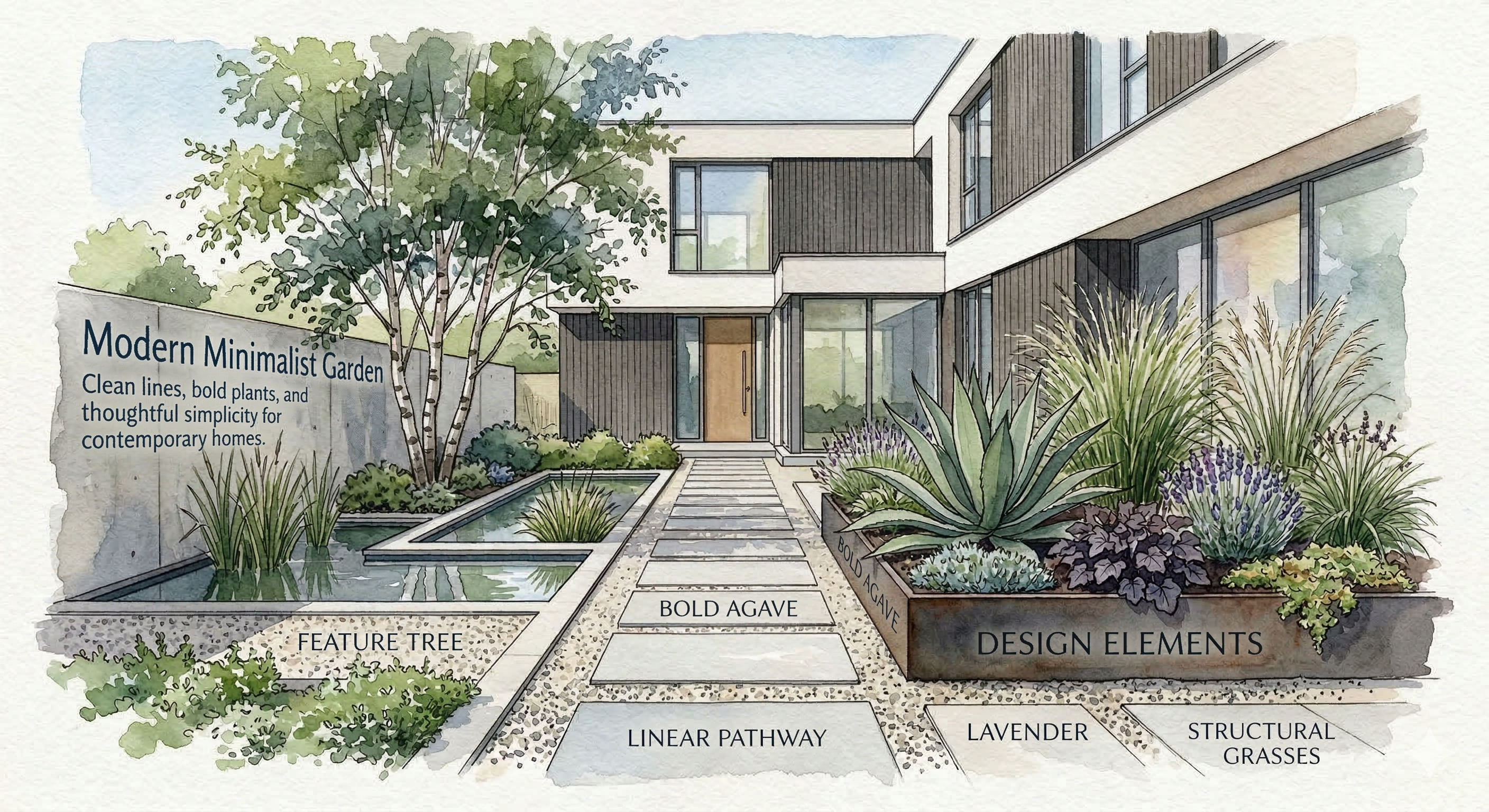
Modern Minimalist Garden
Clean Lines, Bold Plants & Thoughtful Simplicity for Contemporary Homes
Minimalism is not the same as emptiness, and it is not the same as having fewer plants. A minimalist garden is a garden in which every element has been deliberately chosen and precisely placed — where nothing is present without earning its presence, and where the space between elements is as intentionally designed as the elements themselves. Done well, the modern minimalist garden is one of the most beautiful and most livable outdoor environments available: it prioritizes the experience of space itself, uses materials and plants whose individual quality matters more than their quantity, and achieves a quality of calm that gardens cluttered with color, species, and ornament cannot.
What Makes a Garden Truly Minimalist?
The minimalist garden has been one of the dominant forces in contemporary landscape design for the past three decades, driven by the same cultural currents that produced modernist architecture, Scandinavian interior design, and the broader shift toward quality over quantity in how people want to inhabit their homes. It pairs naturally with contemporary architecture — the flat-roofed house, the glass-walled room, the industrial-material exterior — but its principles apply equally to traditional homes whose owners want an outdoor space that feels curated, calm, and under control.
Done poorly, it is just sparse. The difference between a minimalist garden and a bare one is the quality of attention brought to what remains after everything unnecessary has been removed. This guide covers the complete framework for designing, building, and maintaining a modern minimalist garden — from the core design principles through material selection, plant palette, hardscape, water, lighting, containers, and region-by-region adaptation.
The minimal garden rewards patient, iterative design. The instinct, when starting with a blank or cluttered outdoor space, is to add things. The minimalist discipline is to start by removing: removing what does not belong, removing what competes with what does, removing what was placed by habit rather than intention. What remains after that editing process is the raw material of the minimalist garden. What goes back in is chosen with precision.
The Six Design Principles of the Modern Minimalist Garden
| Principle | What It Means in Practice | Common Mistake to Avoid |
|---|---|---|
| Reduction | Every element present earns its presence. If you cannot articulate why something is in the design, it is not there. The garden is edited to its essential components. | Adding decorative elements to 'fill' a space that reads as 'too empty.' Empty space is not a failure of design; it is the design. |
| Repetition | Repeating a single plant species, material, or form throughout the garden creates unity and visual power. A single species of grass massed in a long linear planting is more powerful than five different grass species each represented by one plant. | Variety for its own sake. The minimalist palette is intentionally narrow. Three species done well outperforms twelve species done adequately. |
| Geometry | Clear geometric forms — squares, rectangles, circles, and their relationships — provide the structural logic of the design. Curves in a minimalist garden are precise arcs, not informal wiggles. Lines align with the architecture. | Informal, irregular edges and shapes that read as indecisive rather than naturalistic. In minimalist design, curves are deliberate; organic forms are either embraced fully or avoided. |
| Material Quality | With fewer elements present, the quality of each element is supremely visible. A concrete wall in a minimalist garden must be good concrete. A steel planter must be well-proportioned steel. The material speaks for itself without distraction. | Using substitute materials that imitate but do not achieve the quality of the real thing. Faux stone, cheap powder-coat finishes, and thin concrete all read as compromised in a composition where every surface is scrutinized. |
| Continuity | The garden and the architecture share a visual language. Materials, colors, proportions, and details from the interior and exterior of the house extend into the garden. The garden feels like a designed room, not a separate space tacked onto the property. | A disconnect between the garden's character and the house's character. A sleek contemporary house with a fussy, cottage-style garden creates a jarring discontinuity that neither half can resolve. |
| Seasonal Constancy | A minimalist garden must perform across all four seasons because it has too few elements to hide behind seasonal change. Choose plants that offer year-round structure: strong winter silhouette, interesting bark or stem, or evergreen form. | Over-relying on spring and summer flowering plants whose winter absence leaves the garden empty. Every plant in a minimalist design should earn its square footage in every month of the year. |
Before designing anything, spend one week observing your space: where the light falls at different times of day, which views from the interior are most important, what existing elements deserve to stay and what should go. The minimalist garden begins with subtraction, not addition.
Section 1: Design Foundations — Space, Light & Architecture
Every successful minimalist garden begins with the same two questions: What is the architecture saying, and what does the space need to do? These questions come before any decision about plants, materials, or features. The minimalist garden is the architectural exterior extended into the landscape; it cannot be designed in isolation from the building it serves.
Reading the Architecture
The garden should speak the same visual language as the house. This does not mean slavish matching — a garden of concrete and steel attached to a concrete-and-steel house can be boring; contrast within a shared language is more interesting. But the garden's geometry, material character, color range, and level of formality should be in dialogue with the architecture, not in conflict with it.
- •Contemporary flat-roof or shed-roof homes: These pair naturally with horizontal emphasis, strong geometric ground planes, massed planting in linear arrangements, and materials like board-formed concrete, weathered Corten steel, and large-format pavers. The garden becomes an extension of the interior through glass walls and uninterrupted sight lines.
- •Mid-century modern (1950s–1970s): The original minimalist residential architecture. Gardens that reference this period use clean geometry and integration of indoor-outdoor space: low horizontal plantings, specimen trees with bold form, warm wood and stone materials, and the swimming pool as a central design element. Knife-edge coping, exposed aggregate concrete, and classic ornamental grasses all read as authentically mid-century.
- •Industrial loft conversions and urban row houses: The urban context calls for spatial efficiency, vertical interest, and materials that reference the industrial surround — weathered steel, concrete, gravel, and plant palettes that work in low light or full shade. The rooftop garden and the courtyard garden are the primary forms.
- •Traditional homes with contemporary interiors: The most common and most challenging context. The resolution is usually a garden that simplifies and regularizes the traditional forms rather than replacing them: precise hedging in geometric shapes, a restrained plant palette, quality hardscape materials, and the elimination of the fussy, accumulative planting that characterizes traditional residential gardens.
Site Analysis for Minimalist Design
Minimalist design is unforgiving of site problems that a more complex garden would obscure. A poorly drained area, a utility box, an awkward grade change — all of these must be resolved in the design rather than hidden behind planting. The site analysis process for a minimalist garden is the same as for any garden, but the stakes for getting it right are higher.
- •Sun mapping: Trace shadow patterns from sunrise to sunset at the summer and winter solstice. Minimalist gardens are often composed primarily of hard material with limited planting; accurate sun mapping determines where plants will actually thrive and where the primary living areas should be positioned.
- •Sight lines: Identify the primary views into and out of the garden from inside the house — particularly through large windows and glass walls. The minimalist garden is often designed primarily to be seen from the interior. These sight lines are the equivalent of the viewpoints in a Zen garden: the composition is arranged for them.
- •Grade and drainage: Address all drainage issues before designing the surface. Minimalist gardens typically have more hardscape than conventional gardens; impermeable surfaces concentrate drainage challenges. Design for drainage first, then design the surface above it.
- •Utilities and infrastructure: Locate and map all utilities before designing. A minimalist garden's clean ground plane cannot accommodate unexpected utility access issues after the garden is installed. Work with your utility companies to understand easements and access requirements.
Spatial Proportions: The Design Grid
Most successful minimalist garden designs are organized on a grid — a modular spacing system derived from the architecture of the house that determines the dimensions of all major elements. The grid might be 2 feet, 3 feet, or 4 feet on center; the key is that all major dimensions in the garden — paving unit sizes, planting bed widths, path widths, wall heights — are multiples of the grid module. This creates the unconscious sense of order and proportion that characterizes a well-designed minimalist space.
- •Deriving the grid: Look at the house's window and door spacing, the structural column spacing, or the exterior cladding module. These dimensions often suggest a natural garden grid. A house with 4-foot window modules suggests a 4-foot or 2-foot garden grid; a house with 3-foot brick courses suggests a 3-foot module.
- •The golden rectangle: The ratio of approximately 1:1.618 (the golden ratio) has been used in architectural proportion for millennia because it produces a rectangle that feels naturally balanced. In garden design, using this proportion for bed widths, paving panel sizes, and the relationship of planted to paved areas produces a quality of visual rightness that is difficult to achieve by eye alone.
- •Negative space as positive design: In minimalist design, the proportion of empty space to filled space matters as much as what is in the filled areas. A garden that is 60% hardscape and 40% planting will feel different from one that is 40% hardscape and 60% planting, independent of what those elements are. Decide this proportion consciously as part of the design process rather than arriving at it by default.
Start your site analysis with a single sheet of graph paper scaled to your plot. Draw the house footprint, mark all windows and doors, trace the shadow lines at 9am, noon, and 3pm on a midsummer day. The grid that emerges from those shadow lines and the house's own geometry is the foundation of your garden's design.
Section 2: Hardscape — Materials, Surfaces & Structure
Hardscape is the skeleton of the minimalist garden, and in minimalist design it is often the dominant element by surface area. Where a traditional residential garden might be 20% hardscape, a contemporary minimalist garden is frequently 50–70% hardscape. This means the quality, detail, and finish of every hard material matters enormously. The hardscape is not the background; it is the foreground.
Primary Paving Materials
| Material | Aesthetic Character | Cost Range | Key Strengths | Limitations & Notes |
|---|---|---|---|---|
| Large-format concrete pavers (24×24" and larger) | Monolithic, contemporary, architectural; large format reduces the visual busyness of smaller unit paving | $$–$$$ | Excellent durability; wide range of finishes (smooth, brushed, exposed aggregate, sandblasted); consistent sizing enables precise joint alignment; can be cut accurately for complex layouts | Requires stable compacted base; individual units are heavy and require machinery for large sizes; frost heave in cold climates requires deeper base preparation |
| Poured-in-place concrete | The most architectural of all paving materials; seamless; can be shaped to any form; accepts various finishes and textures | $$$–$$$$ | No visible joints; can integrate drains invisibly; highest design flexibility; broom-finished, exposed aggregate, polished, or form-marked options | Cracks over time, especially in freeze-thaw climates (Zones 5 and colder); requires control joints that become a design element; professional installation essential for quality results |
| Large-format porcelain tile (outdoor rated) | Ultra-smooth, precise, contemporary; often used to extend interior tile finishes outdoors | $$$–$$$$ | Extremely consistent appearance; low maintenance; frost-resistant options available; can match interior flooring exactly for seamless indoor-outdoor continuity | Can be slippery when wet — specify anti-slip finish (≥R11 rating) for outdoor use; requires precise, stable substrate; fewer recycled content options than concrete |
| Corten (weathering) steel edging and panels | Warm, rust-toned, industrial-organic; one of the most distinctive contemporary garden materials | $$–$$$ | Weathers to a stable, beautiful patina over 2–3 years; extremely durable once patinated; crisp knife-edge profile ideal for minimalist planting bed edges; works with any plant palette | Initial rust runoff stains adjacent light-colored materials during weathering period; not appropriate near salt water; avoid contact with concrete or masonry (galvanic staining) |
| Decomposed granite (stabilized) | Natural, warm, informal; the most naturalistic hard surface in contemporary gardens; moves the design toward a desert or California aesthetic | $–$$ | Permeable (excellent for stormwater); low cost; wide availability in warm tones from tan to rust; pairs beautifully with ornamental grasses and Mediterranean plants | Requires edging to contain; can track into the house; not suitable for level changes; less appropriate in wet climates where it becomes muddy and unstable |
| Ipe or hardwood decking | Warm, natural, architectural; brings the material language of the interior outdoors; coordinates naturally with timber and concrete | $$$–$$$$ | Extremely durable when maintained (25+ year lifespan); natural warmth contrasts beautifully with concrete and steel; can span grade changes economically | Requires annual oiling to maintain color; will weather to gray without maintenance; look for FSC-certified sources or domestic alternatives (black locust, white oak, thermally modified wood) |
| Gravel and pea stone | Casual, textural, permeable; the most affordable contemporary surface; used extensively in dry gardens and low-maintenance designs | $ | Fully permeable; lowest cost; easiest to install; self-draining; wide range of stone types and colors from white marble to dark basalt | Requires quality weed barrier beneath; can migrate into adjacent planting areas without containment; not ADA-compliant for accessible paths; tracks into the house |
Walls, Screens & Vertical Elements
Vertical elements in the minimalist garden serve multiple purposes simultaneously: they define space, create privacy, block unwanted views, support plants, and provide the composition's vertical dimension. In a minimalist design, the wall or screen is a major design element rather than a background feature, and its material, finish, height, and proportion are as carefully considered as any other element.
- •Board-formed concrete walls: Concrete cast against horizontal boards produces a lined texture that has become one of the signature elements of contemporary landscape design. The board marks make the material's history visible and add warmth to what would otherwise be a cold, industrial surface. Heights of 18–36 inches work as seat walls; 48–72 inches provide privacy screening. Requires professional formwork for consistent results.
- •Corten steel panels: Freestanding or post-supported weathering steel panels are one of the most architecturally powerful privacy and screening elements in contemporary garden design. A single 6-foot Corten panel can anchor an entire garden composition. The warm rust tone ages beautifully and pairs with almost every plant palette. Available in custom sizes from steel fabricators.
- •Gabion walls: Wire cages filled with stone — river rock, granite, or recycled concrete aggregate — create a wall that is simultaneously structural, textural, and ecological. An increasingly popular contemporary garden element that pairs well with natural plant palettes. The stone fill can be chosen to match or contrast with the garden's other materials.
- •Horizontal timber screens: A cedar, ipe, or thermally modified wood screen of horizontal boards with precise gaps creates privacy while allowing light and air movement. The horizontal emphasis reinforces the low, grounded character of minimalist design. Often used as a backdrop to planting beds, where the vertical stems of grasses or the architectural form of a specimen plant read against the horizontal rhythm.
- •Living walls and green screens: A steel or timber frame supporting climbing plants or modular planted panels creates a screen that is both structural and planted. In minimalist design, the green wall works best when a single plant species is used — climbing hydrangea, creeping fig, Virginia creeper — rather than a mixed tapestry.
Steps, Levels & Grade Change
Grade changes in a minimalist garden are resolved with clean, architectural precision rather than the informal sloping paths and cascading rock gardens of traditional design. Steps are wide, simple, and part of the spatial composition; retaining walls are straight or gently curved with clean tops; grade transitions are crisp.
- •Step proportions: The classical outdoor step proportion is a riser of 5.5 to 7 inches and a tread of 14 to 18 inches — the product of riser + tread should equal approximately 26. For minimalist gardens, the lower end of the riser height (5–6 inches) with deeper treads (16–20 inches) creates a more gracious, flowing quality appropriate to contemporary residential design.
- •Floating steps: Concrete or stone slabs cantilevered from a supporting structure or embedded in a bank, with open gaps between them rather than solid risers, create a dramatic, contemporary stair that allows light to pass through and planting to grow between the steps. One of the signature elements of contemporary landscape design.
- •Retaining walls as design features: A retaining wall that becomes a seat wall, or that integrates planters in its top surface, or that creates a terrace with a defined purpose transforms a utilitarian necessity into a positive design element.
Spend proportionally more on hardscape materials than feels comfortable — in a minimalist garden, every surface is visible and scrutinized. A smaller area of excellent concrete or stone is always better than a larger area of mediocre material. Quality hardscape installed correctly lasts 30–50 years; poor hardscape looks poor from day one.
Section 3: Plants — The Minimalist Palette
Plant selection in the minimalist garden operates on the principle of deliberate restraint and strategic repetition. The question for each plant is not 'do I like this?' but 'what job does this do in the design, and does it do that job in every season?' A plant that provides spectacular spring flowers but nothing else offers a 10% return on its square footage in the minimalist design; a plant that provides bold foliage texture from spring through fall, an interesting winter silhouette, and structural presence throughout earns full-time residency.
The Four Categories of Minimalist Plants
A minimalist plant palette is typically organized around four functional categories, each performing a distinct role in the composition. The simplest and most successful minimalist gardens use one or two species per category, not five or six.
| Category | Role in Design | Selection Criteria | Typical Number of Species |
|---|---|---|---|
| Structural Anchors | Trees and large shrubs that define the garden's vertical dimension and provide the primary three-dimensional form | Year-round interest (evergreen, or outstanding winter silhouette); bold, distinctive form; scale appropriate to the space; slow growth to maintain proportions long-term | 1–2 species; often just one |
| Mass Planting Ground Layer | The primary ground plane material between and beneath structural plants; the single largest surface area by plant coverage | Consistent texture; year-round cover; low height; spreads to fill space; low maintenance once established; tolerates site conditions precisely | 1–2 species; repetition is the point |
| Seasonal Accents | Plants that provide punctuation: a moment of bloom, a textural contrast, a seasonal color shift. Used sparingly and in specific, deliberate locations. | Outstanding performance in their primary moment; structural interest outside that season; should not dominate the composition at any time | 1–3 species; used in small, deliberate quantities |
| Edge & Boundary Plants | Plants that define the garden's edges, screen unwanted views, create privacy, or establish enclosure | Fast enough to achieve screening purpose within 3–5 years; tolerant of boundary conditions (wind exposure, adjacent paving); columnar or strongly vertical for spatial efficiency in narrow positions | 1–2 species; consistent species for long boundaries creates unity |
Structural Anchor Plants
| Plant | Zones | Size at Maturity | Character & Value | Notes |
|---|---|---|---|---|
| Japanese Maple (Acer palmatum) | 5–9 | 10–25 ft | The most versatile minimalist specimen tree: refined leaf texture, sculptural branching, outstanding fall color, elegant winter silhouette. Multiple varieties for different sizes and sun exposures. | Weeping varieties ('Tamukeyama,' 'Crimson Queen') for water-edge and container planting. Upright varieties ('Bloodgood,' 'Emperor I') for vertical emphasis. Position as a single focal specimen in the primary view. |
| Magnolia (Magnolia spp.) | 4–10 (varies) | 15–40 ft | Bold, architectural leaves; spectacular spring bloom; strong winter silhouette in deciduous types; dramatic year-round in evergreen types. The southern magnolia is one of the great minimalist garden trees. | M. grandiflora (Zones 6–10): 'Little Gem' for smaller spaces (15–20 ft). Saucer magnolia (M. × soulangeana, Z4–9): spectacular spring bloom, fine winter branch. 'Ann' and 'Jane' for compact bloom. |
| Columnar Hornbeam (Carpinus betulus 'Fastigiata') | 4–8 | 20–40 ft tall; 15–25 ft wide at maturity | One of the finest formal trees for contemporary gardens: dense, upright-oval form; muscular ribbed bark; excellent fall color; leaf retention into winter in some climates. | Often planted as a bosque — a grove of multiple specimens in a grid arrangement, one of the most powerful minimalist tree arrangements. Tolerates urban conditions and clay soils. |
| Quaking Aspen (Populus tremuloides) | 1–7 | 20–50 ft | White bark of extraordinary beauty; trembling leaves in any breeze (the sound of aspens is itself a design element); golden fall color; native across much of northern and western North America. | Best used in groups of 3 or more for naturalistic planting in western and northern regions. More persistent in groups and in appropriate soil and climate than as single specimens. |
| Crape Myrtle (Lagerstroemia indica) | 6–10 | 10–30 ft | Exquisite mottled, peeling bark in cream, tan, and cinnamon; long summer bloom in white, pink, red, or purple; excellent fall color; the defining southern minimalist garden tree. | Avoid severe annual pruning ('crape murder') — it destroys the tree's natural form. Select varieties whose mature size fits the space: 'Natchez' (white, large); 'Dynamite' (red, medium); 'Acoma' (white, semi-dwarf). |
| Pacific Coast Natives (Arbutus menziesii, Olea europaea) | 7–10 | Varies | In California and the Pacific Coast, native trees with extraordinary year-round character offer minimalist design opportunities that no imported species can match. | Pacific madrone: extraordinary peeling red bark; white spring flowers; red fall berries (Zones 7–10). Olive ('Arbequina' or 'Swan Hill' fruitless): silver foliage; gnarled ancient form; no water once established (Zones 8–11). |
Mass Planting Ground Layer
| Plant | Zones | Height | Character | Best Climate / Use |
|---|---|---|---|---|
| Karl Foerster Feather Reed Grass (Calamagrostis × acutiflora) | 4–8 | 4–5 ft | Upright, architectural form; feathery plumes from June through winter; one of the great minimalist garden plants for massed repetition in linear arrangements. | Adaptable across most of the US; tolerates clay; plant in masses of 7, 11, or more for maximum effect in a linear arrangement along a path or wall. |
| Blue Oat Grass (Helictotrichon sempervirens) | 4–8 | 2–3 ft | Striking blue-silver foliage year-round; rounded, fountain form; outstanding in contrast with dark hardscape materials. | Full sun; excellent drainage; superb in dry climates and contemporary gravel gardens; plant in masses of 5–11 for a strong ground-level visual field. |
| Pennsylvania Sedge (Carex pensylvanica) | 3–8 | 6–10 in | Fine-textured, arching, native; the finest no-mow lawn alternative in shaded and part-shade minimalist gardens; rich green through most of the year. | Native to eastern North America. Shade-tolerant; low maintenance once established; mow once in early spring if desired or leave unmowed. The best sustainable lawn replacement for shaded contemporary gardens. |
| Mexican Feather Grass (Nassella tenuissima) | 5–9 | 18–24 in | Extraordinarily fine, silky, cascading texture; moves in the slightest breeze; warm gold in fall; one of the most beautiful minimalist ground layer plants. | Note: invasive in some western states — verify before planting. Spectacular in California and Southwest desert gardens. Where invasive, substitute Prairie Dropseed (Sporobolus heterolepis). |
| Mondo Grass / Black Mondo (Ophiopogon spp.) | 6–10 | 4–8 in | Extremely fine-textured, dense; black mondo (O. planiscapus 'Nigrescens') has deep purple-black foliage that is outstanding against pale gravel or concrete. | Shade to part shade; excellent in warm climates; extraordinarily beautiful in a contemporary gravel garden or around dark concrete pavers. |
| Prairie Dropseed (Sporobolus heterolepis) | 3–9 | 18–24 in | Native prairie grass; extraordinarily fine texture; fragrant flowers in late summer (coriander scent); brilliant golden fall color; the finest native grass for minimalist design. | Native across central US; extremely drought-tolerant once established; provides four-season interest. A model minimalist plant — beautiful in every season without demanding attention in any of them. |
| Blue Fescue (Festuca glauca) | 4–8 | 8–12 in | Dense, rounded, hedgehog-like tufts of blue-gray foliage; the most widely used low blue-foliage grass in contemporary design. | Full sun; excellent drainage; performs best in cool-season climates; can go dormant in hot, humid summers. Best in Pacific Northwest, mountain West, and northern states. |
Seasonal Accents: Bloom, Texture & Drama
| Plant | Zones | Primary Season | Character | Minimalist Use |
|---|---|---|---|---|
| Agave (Agave spp.) | 5–11 (varies) | Year-round | Architectural rosette form of extraordinary presence; blue-gray or green; spines add texture; the defining plant of southwestern minimalist gardens. | Use as a singular focal point or in precise geometric arrangements of 3 or 5. A single large agave in gravel or decomposed granite needs nothing else around it. |
| Ornamental Allium (Allium spp.) | 4–9 | Late spring – early summer | Spherical purple or white flower heads on tall stems; extraordinary geometric form at bloom; seed heads remain attractive well into summer. The flower heads are perfect for minimalist design: bold, simple, repeating form. | Plant in drifts beneath deciduous plants or emerging through a grass ground layer. 'Gladiator,' 'Purple Sensation,' A. giganteum. |
| Russian Sage (Perovskia atriplicifolia) | 3–8 | Summer – fall | Lavender-blue flowers on silver-white stems; creates a blue haze effect in mass; silver winter stems; strongly fragrant. | Plant in large, simple masses rather than single plants. Works beautifully as a middle-layer accent in front of a dark screen or wall. Outstanding with ornamental grasses and against Corten steel. |
| Muhly Grass (Muhlenbergia capillaris) | 5–10 | Fall (September–November) | Native grass with extraordinary pink-mauve fall flower plumes that appear almost luminous at low angles of light; the finest native grass for fall drama in the minimalist garden. | Mass plant in a single field for maximum effect — individual plants read as modest; a mass of 20–50 plants in fall is spectacular. Plant in full sun in the garden's foreground position. |
| New Zealand Flax (Phormium tenax) | 7–11 | Year-round | Bold strap leaves in bronze, red, or green-striped; architectural rosette; strong vertical accent; one of the definitive plants of contemporary California and Pacific Coast design. | Use as a singular accent in gravel or in containers flanking an entry. Varieties range from 2–3 feet to over 6 feet tall; choose the size appropriate to the composition. Not cold-hardy north of Zone 7. |
| Lilyturf (Liriope muscari) | 5–10 | Late summer (flowers); year-round (foliage) | Dense, grass-like evergreen foliage; purple flower spikes in late summer; reliable year-round ground cover in shaded or part-shaded contemporary gardens. | Mass plant as a border along a path edge or beneath a tree. 'Big Blue' is the standard; 'Silvery Sunproof' for striking variegated foliage. More formal in character than ornamental grasses. |
Hedges & Edge Plants for Minimalist Enclosure
- •European hornbeam (Carpinus betulus): Zones 4–8. One of the finest formal hedge plants in contemporary landscape design. Takes shearing well; holds a tight, crisp profile; retains brown leaves in winter (marcescence) that add texture to an otherwise bare garden. Tolerates sun and part shade.
- •Boxwood (Buxus sempervirens and cultivars): Zones 4–9. The most widely used formal hedge plant in America. 'Green Mountain' for upright forms; 'Green Velvet' for rounded; 'Fastigiata' for narrow columnar. Note: boxwood blight has become a significant disease problem in the eastern US — consider Japanese holly (Ilex crenata) or inkberry (Ilex glabra) as alternatives.
- •Italian cypress (Cupressus sempervirens 'Stricta'): Zones 7–11. The definitive Mediterranean columnar accent — narrow, very tall (to 70 feet at maturity), deep green. A row of Italian cypress flanking an entry drive or defining a garden boundary is one of the most powerful minimalist landscape gestures. Widely used in California, the Southwest, and the Southeast.
- •Arborvitae (Thuja occidentalis 'Emerald' and similar): Zones 3–8. The workhorse privacy screen of American gardening. 'Emerald' maintains a narrow, upright form without shearing. Use in odd-numbered groups or in a linear screen. Consider Thuja 'Green Giant' (deer-resistant) for problem areas.
- •Muhly or switchgrass screens: For a less formal alternative to sheared hedges, a mass planting of tall ornamental grasses — switchgrass (Panicum virgatum) or muhly grass — creates a seasonal privacy screen that moves in the wind and has a softer, more naturalistic quality while still being geometric in its massed arrangement.
The most common mistake in minimalist plant selection is using too many species. Define your palette on paper before buying anything: one structural anchor, one or two ground layer plants, one or two seasonal accents, one boundary plant. Then buy multiples of each rather than single specimens of many. Mass beats variety every time in minimalist design.
Section 4: Water Features — Reflection, Sound & Stillness
Water in the minimalist garden serves three distinct purposes: it creates sound that anchors attention in the present; it provides reflection that doubles the visual depth of the space; and it gives the garden a quality of life and movement that static materials cannot. A single well-designed water feature can transform the entire character of a minimalist garden, making it more alive and more sensory-rich without adding visual complexity.
The Reflecting Pool
The reflecting pool — a shallow, still body of water whose primary purpose is to mirror the sky and any plant or architectural element positioned above it — is one of the most powerful elements in contemporary garden design. The reflection doubles the visual height of any vertical element above the water: a specimen tree reflected in a still pool appears to have twice its height; the sky above becomes part of the garden composition.
- •Geometry: In minimalist design, reflecting pools are almost always geometric — square, rectangular, or circular. The hard geometry of the pool surround contrasts with the organic, shifting quality of the water surface and any reflections. Avoid informal curved edges, which suggest naturalism rather than architecture.
- •Depth: As little as 6 to 12 inches of water is sufficient for a reflecting pool. The shallower the water, the more the pool bottom affects reflection quality — a dark-painted or slate-tiled bottom produces the best mirror-like reflection by absorbing light rather than reflecting it back.
- •Overflow edge: An infinity or knife-edge overflow — where the water level meets the edge of the pool precisely, creating a mirror surface that appears to continue to the horizon — is one of the finest details in contemporary water feature design. Requires precise engineering and leveling; professional installation is recommended.
- •Aquatic plants: In a minimalist reflecting pool, plant sparingly or not at all. One or three water lily pads (not in full bloom — just the pads) on an otherwise open water surface is the most a minimalist composition typically accommodates. Avoid aquatic plant collections in minimalist pools.
Rill and Channel Water Features
A rill — a narrow, straight channel of moving water running through the hardscape — is one of the signature elements of contemporary landscape design. The water moves slowly but continuously, creating a quiet sound and a linear visual element that organizes space and guides movement.
- •Rill geometry: Typically 8 to 18 inches wide and 6 to 10 inches deep. The narrower the rill, the more precise and architectural its character. The rill can run the length of a garden as a central axis, flanked by planting or hardscape, terminating in a pool or reservoir at each end with a recirculating pump.
- •Materials: Concrete (poured or precast); slate tile; dark limestone; brushed stainless steel. The material should be chosen to contrast with or complement the primary hardscape material. A stainless steel rill through a concrete paving field creates a powerful material contrast; a concrete rill through a stone patio reads as a continuation of the same material language.
- •Termination: The rill should begin and end deliberately. A wall spout (water emerging from the face of a wall) at one end and a reservoir pool at the other is the classic arrangement. Both ends are design features, not afterthoughts.
Wall Spouts and Blade Falls
Water emerging from a wall and falling into a basin below creates a distinctive sound — different from a pool, different from a stream — that can be calibrated by the height of the fall and the surface of the basin. A blade fall (a thin sheet of water falling from a precisely machined edge rather than a spout) is one of the most architecturally elegant contemporary water features.
- •Spout materials: Stainless steel spouts in various diameters; copper spouts (will patinate to a warm green over time); bamboo spouts (for a more natural aesthetic within a contemporary framework); cast-bronze wall plates with circular openings. Each produces a different sound quality.
- •Basin size: The basin must be large enough that water splashing from the height of the fall does not spray outside it. As a rule, the basin diameter or width should be at least equal to the height of the fall. For a 24-inch fall, a 24-inch wide basin minimum; 30 to 36 inches is more forgiving.
- •Sound calibration: The height of the fall, the diameter of the spout or width of the blade, and the depth of the water in the basin all affect the quality and volume of sound. A taller fall over stone produces a louder, more energetic sound; a shorter fall into deep water produces a more subdued, hollow quality. Experiment before finalizing the installation.
Water Feature Maintenance
- •Algae control: Algae in a minimalist reflecting pool or basin undermines the crisp, clean quality that is the feature's entire point. Prevention: keep the water moving (even slight recirculation prevents the stillness algae requires); maintain appropriate levels of beneficial bacteria; use a UV clarifier in the recirculating pump circuit; choose a dark-bottomed pool (light reaching the bottom is reduced and algae is less visible).
- •Winterizing: In climates where temperatures consistently fall below 25°F (Zones 5 and colder), concrete water features crack from freeze-expansion. Drain completely before the first hard freeze. Remove and store pumps and any plumbing exposed to frost. Cover with custom-cut rigid foam insulation if the pool cannot be fully drained. In Zone 6, drain during extended freeze warnings.
- •Pump sizing: Recirculating pumps for minimalist water features should move the full volume of the water feature every 1 to 2 hours. For a 100-gallon pool: 50 to 100 GPH pump minimum. Undersized pumps produce sluggish, stagnant-looking water even when running; oversized pumps create excessive turbulence in still-water features.
Size your water feature to the space, not to the budget. A water feature that is too small for the garden it occupies reads as an afterthought — worse than no water feature at all. If budget is the constraint, install the basin and plumbing now, and add the finished surround later. The scale is non-negotiable; the finish can be phased.
Section 5: Lighting — The Garden After Dark
Garden lighting in a minimalist design is not illumination; it is composition. The garden at night can be as powerful as the garden by day — a different composition using the same elements, with darkness as the primary material and light as the accent. Minimalist lighting philosophy: illuminate specific elements rather than flooding the space with general light; use the minimum quantity of fixtures that achieves the desired effect; choose fixtures whose own form is invisible or beautiful.
The Four Lighting Techniques
- •Uplighting: A fixture positioned at or below grade level directed upward at a plant or architectural element. The most dramatic of all garden lighting techniques: specimen trees uplighted from below appear to be self-luminous; a textured wall uplighted from below has depth and shadow that is invisible in daylight. Use sparingly — one or two key uplights on the garden's primary specimens. Every additional uplight reduces the dramatic impact of the ones before it.
- •Grazing: A fixture positioned at an angle very close to a textured surface — a stone wall, a board-formed concrete panel, a timber fence — that drags the light across the surface to emphasize its texture. Concrete becomes sculptural when grazed; masonry walls reveal their individual stone character. A powerful architectural lighting technique widely used in contemporary design.
- •Moonlighting / downlighting: A fixture positioned in a tree or on a tall structure directed downward through the canopy or branches, producing dappled shadow patterns on the ground below — suggesting moonlight filtered through leaves. The most naturalistic and least intrusive of all lighting techniques; creates the sense of a garden seen in moonlight rather than a garden that has been lit.
- •Path and step lighting: Low-profile, flush-mounted fixtures in path edges, step risers, or alongside paths provide safety illumination without architectural presence. The fixture should be as invisible as possible; the light itself is the design element. A series of precisely spaced low-glow path lights reinforces the geometry of the path.
Fixture Selection for Minimalist Design
- •Fixture as object: In a minimalist design where every element is scrutinized, the fixture itself is a design object. Commercial-grade cast brass or stainless steel fixtures have a quality of material and finish appropriate to the context; inexpensive painted aluminum fixtures look like what they are. Spend proportionally more on fixtures in a minimalist design — you have fewer of them, and each one matters.
- •Color temperature: Choose fixtures in the 2700–3000K range (warm white) for planting and architectural elements. 4000–5000K (cool white) light produces a clinical, institutional quality inappropriate for most residential garden contexts. Consistency matters: mix warm and cool sources in the same garden and the composition looks unresolved.
- •LED technology: Modern LED fixtures provide excellent color rendering (CRI 90+), extremely long lifespan (50,000+ hours), and dramatically lower energy consumption than halogen or incandescent predecessors. Specify fixtures with a CRI of at least 90 for the most natural-looking illumination of plant material.
- •Control systems: A simple timer or photocell controller is the minimum; a smart-home integrated system that allows scene-setting — different lighting compositions for different moods and occasions — is the ideal. The minimalist garden at its best is a different space in different light; the ability to control this is worth the investment.
Design the lighting plan simultaneously with the garden plan — not as an afterthought after installation. Conduit and junction boxes buried after the hardscape is poured are expensive; buried during construction they cost almost nothing. Decide now where every fixture will be, run the conduit, and you can always install the fixtures later. Never retrofit lighting in a minimalist garden if it can be avoided.
Section 6: Containers, Furniture & the Designed Object
In a minimalist garden, every object is a designed object — every pot, every piece of furniture, every lantern or sculpture is subject to the same scrutiny as the hardscape material and plant palette. A beautiful minimalist garden furnished with cheap, visually busy outdoor furniture loses its character at the moment of use. The objects people interact with most closely deserve the most careful selection.
Containers: Form, Material & Plant
Containers in a minimalist garden serve two related purposes: they allow plants to be positioned precisely where the design needs them (on a paved surface, at an entry, on a rooftop), and they themselves become designed objects — their form and material contributing to the composition as much as what grows in them.
| Material | Character | Best Plants | Maintenance Notes |
|---|---|---|---|
| Poured concrete (custom or commercial) | Architectural, heavy, permanent-feeling; the closest material to poured-in-place hardscape; creates seamless transitions; ages beautifully with weathering and moss | Architectural grasses (Karl Foerster, blue oat grass); Japanese maple; olive tree; New Zealand flax; boxwood topiary | Seal with penetrating concrete sealer to reduce water absorption and freeze-thaw cracking in cold climates; avoid moving when filled — weight is significant |
| Corten (weathering steel) | Warm, industrial, distinctive; the most architecturally powerful container material; pairs with almost any plant; ages from bright orange to deep brown-rust | Ornamental grasses; agave; lavender; all Mediterranean plants; plants with silver or gray foliage contrast beautifully with the warm rust tone | Allow to fully patinate (2–3 years outdoors) before placing on light-colored surfaces — rust runoff stains concrete and limestone. Once patinated, the surface is stable. |
| Glazed ceramic (dark tones) | Refined, elegant; the most finished of container materials; dark navy, charcoal, and matte black glazes read as contemporary and sophisticated | Japanese maple; camellia; gardenia; bamboo; any plant deserving close-up presentation | Frost-rated ceramics (vitrified; check manufacturer specs) required for cold climates — many standard ceramics crack in freezing temperatures; drain and bring indoors or choose frost-proof specification |
| Fiber cement / GRC (glass-reinforced concrete) | Lightweight concrete aesthetic; commercially produced in a wide range of contemporary forms; much lighter than actual concrete for rooftop and balcony applications | Any plant appropriate to a concrete container; particularly valuable on rooftops where weight is a structural concern | Verify manufacturer's frost rating; most commercial fiber cement containers are rated for cold climates |
| Powder-coated steel planters | The most versatile production container for contemporary design; available in custom sizes and colors; square, rectangular, and circular forms | Any architectural plant; particularly effective in geometric arrangements of multiples | Verify drain hole sizing is adequate; clean drainage essential to prevent waterlogging; inspect powder coat annually for chips that allow rust to develop |
Containers in a minimalist garden are almost always arranged in odd numbers (1, 3, or 5) and in related but varied sizes rather than identical matching sets. Three containers of the same form in different sizes — large, medium, small — create more visual interest and spatial depth than three identical containers in a row. Group containers as you would group stones: with attention to the relationships between them, the negative space around them, and the way the group reads from the primary viewpoint.
Outdoor Furniture: Selection Principles
The garden furniture in a minimalist design must meet the same standard as the other designed elements: it should be beautiful in itself, appropriate in material and scale, and invisible in the sense that it belongs so completely to the space that you do not notice it separately from the space.
- •Material compatibility: Choose furniture in materials that relate to the garden's palette — powder-coated aluminum or steel in charcoal, black, or warm gray for contemporary industrial settings; solid teak or ipe in naturally weathering gray for warmer, more organic contexts; concrete and stone seat walls that are built into the hardscape rather than placed on top of it.
- •Scale and proportion: Outdoor furniture in a small garden can overwhelm the space if it is too numerous or too large. A minimalist garden seating arrangement is typically a single table with four chairs, or a pair of lounge chairs with a small side table, rather than a large multi-piece sectional that dominates the space. The furniture should serve the garden rather than compete with it.
- •Storage and visibility: Furniture that cannot be easily stored or is always visible should be beautiful enough to earn its year-round presence. Furniture that requires covering with tarps or will look weathered and tired in winter should be either stored seasonally or replaced with furniture whose natural weathering is itself beautiful — solid teak, black powder-coated steel, untreated concrete.
Before purchasing any outdoor furniture, bring a chair to the garden and sit in it at different times of day. Note what you see from each position — which views are revealed, which are blocked, where the light falls at the times you will most use the space. The furniture arrangement should be designed around these observed facts, not around the layout of the furniture showroom.
Section 7: Regional Adaptation Across American Climates
Minimalist garden design is a set of principles, not a set of plants. Every American climate region offers its own plant palette and material opportunities that are fully compatible with minimalist design — and often more authentic than importing plants from another region. A Pacific Northwest minimalist garden built from native ferns, carex, and dark basalt is as rigorous in its minimalism as a California garden of decomposed granite and olive trees; neither borrows from the other, and each is better for that regional specificity.
| Region | Climate Character | Primary Opportunity | Best Structural Plants | Best Ground Layer | Material Notes |
|---|---|---|---|---|---|
| Pacific Northwest (Zones 7–9) | Mild, wet winters; dry summers; maritime influence; naturally lush; minimal freeze events | Year-round green; moss and fern as authentic minimalist ground layer; the most naturalistic minimalist gardens in America are in this region | Japanese maple (thrives here); clumping bamboo (Fargesia); columnar hornbeam; Pacific madrone (Arbutus menziesii) | Native carex sedges; moss; bunchgrass; sword fern (Polystichum munitum) as dramatic native ground layer | Dark basalt and local stone; weathered cedar; the region's natural materials are extraordinarily well-suited to minimalist composition |
| California & Coastal West (Zones 8–11) | Mediterranean climate; dry summers; fire risk in many areas; extraordinary range of native material | The California minimalist garden is one of the most developed and influential in America: decomposed granite, native grasses, olive trees, manzanita, and succulents define the vocabulary | Olive tree (Olea europaea); Arbutus; Agave; western redbud (Cercis occidentalis); coast live oak | Decomposed granite; native bunchgrass (Nassella, Muhlenbergia); California poppy as seasonal accent; dymondia as low ground cover | Decomposed granite; local stone (sandstone, granite, basalt); Corten pairs beautifully with California's warm tones and dry light |
| Southwest / Desert (Zones 7–11) | Intense heat; low humidity; dramatic skies; alkaline soils; extraordinary native plant character | The desert minimalist garden is the most naturally austere: gravel, stone, and precisely placed specimens of extraordinary character create compositions of real power | Agave (multiple species); desert willow (Chilopsis linearifolia); Palo Verde; ocotillo; saguaro (use only nursery-grown plants — collecting wild plants is illegal) | Decomposed granite; fine gravel; dry rock mulch; prickly pear as ground-level mass at appropriate scale | All locally sourced stone; Corten steel; concrete. The desert light is exceptional for minimalist composition — long shadows at low sun angles reveal texture and form with extraordinary clarity |
| Southeast (Zones 7–10) | Hot humid summers; mild winters; intense rainfall; extraordinary native and adapted plant material | Camellias, loropetalum, crape myrtle, and native ferns offer a distinctly Southern minimalist palette — utterly different from the California or Pacific Northwest version but equally powerful | Crape myrtle (allow natural form; no topping); southern magnolia ('Little Gem' for smaller spaces); camellia; native hollies (Ilex) in multiple forms | Mondo grass; liriope; native ferns (Osmunda, Athyrium); native southeastern carex sedges | Concrete (excellent year-round performance in mild climate); brick; weathered wood. Humidity accelerates moss and lichen on stone, which reads beautifully in a minimalist composition. |
| Mid-Atlantic & Northeast (Zones 4–7) | Four distinct seasons; cold winters; hot humid summers; excellent tree and shrub palette | The four-season performance requirement favors plants with multiple seasons of interest: winter silhouette, spring bloom, summer foliage, fall color. The garden can be designed for a different minimalist composition in every season. | Japanese maple (hardy varieties); columnar hornbeam; serviceberry (Amelanchier); single-flowering crabapple | Prairie dropseed; Karl Foerster grass; Pennsylvania sedge; blue fescue in appropriate exposures | Granite; bluestone; ipe; concrete (plan for freeze-thaw in Zone 5 and colder). Corten steel is outstanding in the mid-Atlantic four-season context. |
| Midwest & Great Plains (Zones 3–6) | Cold winters; hot summers; wind; native prairie ecology offers the most authentic minimalist plant material in America | Prairie-based minimalism: native grasses in mass, native wildflowers in disciplined repetition, locally quarried limestone or sandstone, and the extraordinary sky — horizontal emphasis everywhere | Quaking aspen (in groups of 3+); bur oak (native; extraordinary character); serviceberry; native hawthorn (Crataegus) | Prairie dropseed; buffalo grass; blue grama; little bluestem in mass; switchgrass | Local limestone; sandstone; salvaged granite. The Prairie School architectural tradition — Frank Lloyd Wright's horizontal emphasis and integration of landscape and architecture — is native to this region and remains its finest design resource. |
The most authentic minimalist gardens are made from materials and plants that belong to their region. A minimalist garden in New Mexico built from local basalt and native agaves has a clarity and authority that no imported design language can replicate. Start with what the region provides and edit it to its essential expression.
Section 8: Maintenance — The Minimalist Discipline
A minimalist garden requires different maintenance than a conventional garden — not necessarily more or less, but different in character and approach. The conventional garden hides imperfection behind abundance: a weedy corner is obscured by the surrounding planting; a dying plant disappears among dozens of neighbors. The minimalist garden has no such concealment. Every imperfection is visible; every unpruned edge, every dying stem, every overgrown mass reads against the design's intended precision.
The key insight of minimalist maintenance is that it is intensive in attention and infrequent in frequency. A minimalist garden maintained with total precision four times per year is more beautiful than a conventional garden maintained with moderate attention weekly. The work is different: it requires seeing the garden as a designed composition and responding to what has changed in that composition, not simply performing a routine checklist.
The Seasonal Maintenance Calendar
| Season | Primary Focus | Key Tasks | Design Assessment |
|---|---|---|---|
| Late Winter / Early Spring (before growth begins) | Clearing; preparation; crisp edges; structural pruning | Cut ornamental grasses to 4–6 inches before new growth emerges. Remove dead stems from perennials. Edge all planting beds precisely with a spade or half-moon edger — crisp edges are one of the most impactful maintenance tasks in a minimalist garden and one of the most frequently neglected. Clean and inspect hardscape for winter damage. | This is the garden's most honest moment: no green to soften what is present. Walk the space with fresh eyes and a critical perspective. What has become overgrown? What has died and left a gap? What material looks tired and needs replacement? |
| Spring (active growth begins) | Pruning; weed management; plant establishment | Prune all shrubs and hedges to their designated form. This is not a light trim; it is the annual restoration of the garden's designed form. Address all weeds at their first appearance — a weed in a minimalist garden reads much more prominently than one in a conventional garden. Plant any replacements or additions identified in the winter assessment. | Does the plant palette still serve the design? Are there species not earning their space? Spring is the moment to add or remove plants deliberately, when the ground is workable and replacement stock is available. |
| Summer (full growth and use) | Edge maintenance; water management; hedge clipping; furniture arrangement | Re-edge planting beds at midsummer if edges have softened. Maintain crisp hedge forms with a second clip if needed. Manage irrigation: most established minimalist garden plants — especially ornamental grasses and Mediterranean species — are more drought-tolerant than they appear and do better with deep, infrequent watering than frequent shallow irrigation. | Is the garden being used? A minimalist garden designed for outdoor living must accommodate actual use without losing its composed quality. Observe how furniture placement, traffic patterns, and lighting perform in practice and note adjustments for next season. |
| Fall (transition and preparation) | Leave grasses standing; clear spent annuals; prepare for winter | Do NOT cut ornamental grasses in fall. Their winter silhouette — copper stems, seed heads, movement in the wind — is one of the primary design elements of a well-designed minimalist garden from November through March. Remove spent annuals; do not replant with a winter equivalent. The empty space is more appropriate than seasonal bedding that interrupts the composition's permanence. | The garden in fall is the time to appreciate what the permanent elements — the trees, the grasses, the hardscape — look like without the softening of full foliage. This is the season to confirm that the structural plants are earning their place. |
| Winter (observation and planning) | Observe the garden; make no unnecessary changes; plan for the following year | The maintenance discipline of the minimalist garden in winter is restraint: do nothing that does not need to be done. The garden in its winter state — grasses copper and rustling, bark visible on specimen trees, raking light across concrete and gravel — is not the garden at its worst. It is the garden in one of its most important expressions. | Winter is the design season: no plant material obscures the hardscape's quality, the edges' precision, or the spatial relationships between elements. Plan changes for the following spring based on what winter reveals. |
The One-Third Replacement Principle
Minimalist gardens age, and not always in the direction intended. Plants outgrow their proportional relationships; materials weather differently than anticipated; a species that seemed right proves not to serve the design in practice. The minimalist discipline of maintenance includes periodic editing — removing what is no longer working and replacing it with what will work better — as an ongoing practice rather than a remediation of failure.
- •Every 3–5 years: Assess each plant in the garden against the design's intentions. Is it the right size? The right form? Contributing to or competing with the primary composition? Replace those that are failing the design, even if they are perfectly healthy. A healthy plant in the wrong position is still wrong.
- •Replacement planting: Replace with the same species at the same size, or with a more appropriate species at a size that quickly restores the intended visual relationship. The minimalist garden is not a collection in which every individual plant has sentimental value; it is a designed composition in which every plant serves a specific purpose.
- •Material aging: Concrete and stone patinate in ways that can be beautiful (lichen, weathering) or damaging (spalling, staining). Assess hardscape on the same 3–5 year cycle. Sealing concrete every 3–5 years significantly extends its appearance and structural integrity in cold climates.
The single maintenance task with the greatest visual return in a minimalist garden is re-edging planting beds. Crisp, clean bed edges — cut with a half-moon edger or spade, not a string trimmer — restore the designed geometry that defines the space. Budget for this task four times per growing season minimum. It costs almost nothing and reads immediately.
Section 9: Troubleshooting & Closing
The minimalist garden's clarity of design means that problems read more distinctly than in a more complex garden. This section addresses the most common challenges — both design challenges and ongoing maintenance challenges — in direct, actionable terms.
Common Design Mistakes & Their Solutions
| Problem | Why It Happens | Solution |
|---|---|---|
| The garden reads as sparse and unfinished rather than minimal and composed | Not enough mass in the ground layer; plants not yet at mature size; hardscape dominates without sufficient planting counterweight | Increase the planting mass of the primary ground layer species rather than adding new species. Most minimalist garden ground layers need to be planted at 3–5 times the density that feels comfortable at planting time — the plants will fill the gaps. If the garden genuinely needs more planting, add more of what is already there before adding anything new. |
| Too many focal points competing for attention | Multiple specimen plants or water features in the same composition; ornaments or containers placed by accumulation rather than by design | Identify the single strongest element and make it dominant by removing or subordinating all competitors. Remove, relocate, or replace competing elements. A minimalist garden can have multiple elements but only one primary focal point. |
| The garden looks disconnected from the house's architecture | Plant palette, material character, or design language chosen without reference to the house | Revisit the site analysis. Identify two or three material or color elements from the house's exterior and make them the design anchors for the garden. Even one shared material — concrete, a specific wood tone, a specific dark color — creates continuity. |
| Edges are ragged; planting beds look untidy | Edge maintenance has not been performed with sufficient frequency or precision | Re-edge all planting beds with a half-moon edger or spade. This single task has more impact on the perceived quality of a minimalist garden than almost any other maintenance action. Edge quarterly minimum during the growing season. |
| Water feature reads as small and insufficient for the space | Feature was scaled to budget rather than to the space's visual requirements | A water feature in a minimalist garden should feel inevitable — appropriately scaled and in the right location. If the feature is too small, it cannot be saved by addition. Determine the minimum scale at which the feature would feel adequate and retrofit or replace accordingly. |
| Grass or ornamental planting has outgrown its boundaries | Plants selected for their small size at installation have reached a mature size that disrupts the design's proportions | Cut back or divide the plants to the intended scale. If the mature size of the species is genuinely incompatible with the space, replace with a smaller-growing variety of the same species that will remain in proportion. |
Quick Reference: The Minimalist Garden Checklist
- •Design phase — Site analysis complete: sun mapping, acoustic environment, sight lines from interior, views in and out, existing assets identified
- •Design phase — Architecture reading: material palette, color range, geometry, and formality level of the house documented
- •Design phase — Design grid established: module derived from architectural dimensions, not invented independently
- •Design phase — Primary viewpoint identified: the composition is designed for this point first
- •Design phase — Spatial proportion decided: ratio of hardscape to planting appropriate to use and character
- •Design phase — Plant palette defined on paper: maximum 2 structural anchors, 1–2 ground layer species, 1–3 seasonal accents, 1–2 boundary plants
- •Design phase — All plants evaluated for year-round contribution: every species earns its space in every season
- •Design phase — Water feature sized to the space, not to the budget; lighting plan developed simultaneously with garden plan
- •Installation — Base preparation completed to specification before surface work begins; weed barrier installed under all gravel and DG surfaces
- •Installation — All planting beds edged precisely; conduit runs for lighting buried during hardscape construction
- •Ongoing — Ornamental grasses left standing through winter; cut to 4–6 inches in late winter before new growth
- •Ongoing — Hedges and cloud-pruned specimens clipped 1–2 times annually to maintain designed form
- •Ongoing — Water features winterized before first hard freeze in Zones 5 and colder
- •Ongoing — Garden walked and assessed each season as a composition — not simply maintained as a collection
- •Every 3–5 years — Each plant assessed for design contribution; plants not earning their space replaced
The Standard the Minimalist Garden Sets for Itself
The minimalist garden makes a claim that the conventional garden does not: that what is here is exactly what should be here. That each element was chosen over all alternatives that could have taken its place. That the empty space is not empty by default but is empty by design — shaped, proportioned, and bounded as deliberately as anything that occupies it.
This is a high standard. It cannot be achieved by accumulation, by adding things until the space feels finished, by following trends or choosing what looks current at the garden center. It is achieved only by the discipline of editing — removing what does not belong until what remains is exactly right — and by the patience to let the design mature into what it was intended to become.
The reward is a garden that does not just look good in photographs. It is one that makes you feel something every time you see it from the window in winter, or sit in it on a late summer evening with the grasses catching the last light, or notice for the first time the shadow pattern a single tree makes on a concrete surface at two in the afternoon on a day in March when the sun is at exactly the right angle. Those moments are what the minimalist garden is designed for. They cannot be purchased or planted. They are designed, and they arrive, and they are worth the discipline that made them possible.
Less, but better. Always better. — after Dieter Rams