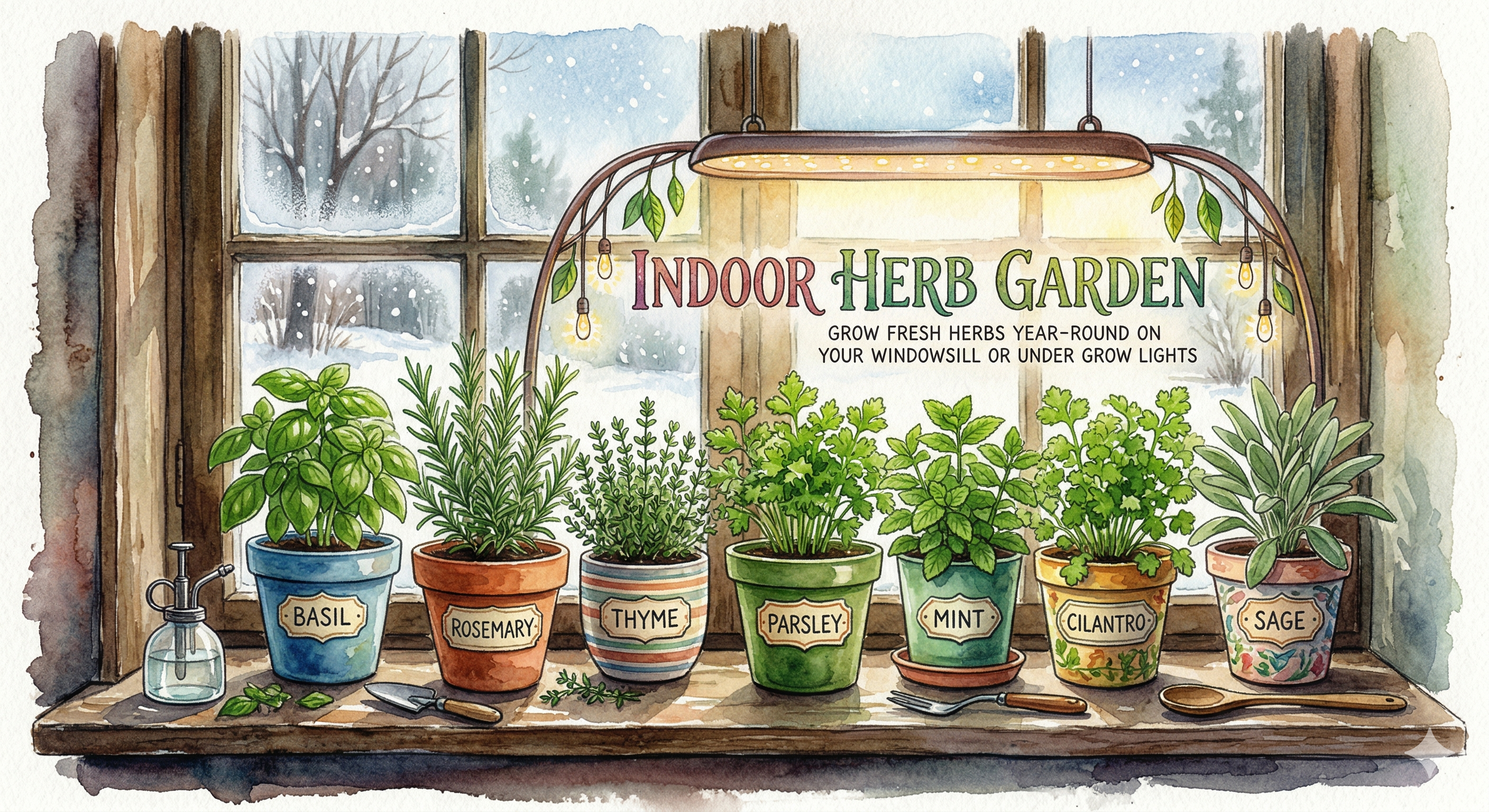
Indoor Herb Garden
Grow Fresh Herbs Year-Round on Your Windowsill or Under Grow Lights
There is something quietly extraordinary about snipping fresh basil onto pasta in February, crushing homegrown rosemary over roast chicken in December, or dropping a sprig of mint grown six inches from your kitchen sink into a glass of iced tea in July. An indoor herb garden delivers the full sensory pleasure of a summer garden in every season — no yard required, no growing zone limitations, no waiting for spring. This guide gives you everything you need to build one that actually works.
Section 1: Why Grow Herbs Indoors?
The Case for Growing Your Own Herbs Indoors
Fresh herbs from the grocery store are expensive, often partially wilted when you buy them, and sold in quantities that almost guarantee you'll use a third of the bunch and watch the rest turn yellow in your crisper drawer. A bunch of basil at the supermarket costs $2.50–4.00 and lasts a week. A basil plant costs $3.99, lives for months with proper care, and produces far more usable herb than you could buy for $20.
That's the economic argument. The culinary argument is even stronger. Dried herbs, which most American home cooks rely on, are pale shadows of their fresh counterparts — the volatile oils that carry flavor begin degrading the moment the herb is cut, and are largely gone within a year of drying. Fresh herbs have a brightness, fragrance, and complexity that dried simply cannot replicate. A sprig of fresh tarragon, a handful of just-snipped chives, a few torn basil leaves — these are not garnishes. They are the difference between food that's good and food that's memorable.
The challenge is growing them successfully indoors, year-round, in the widely varying conditions of American homes. This guide addresses that challenge directly — not with overly optimistic advice that ignores the real constraints of indoor growing, but with honest guidance about what works, what doesn't, and how to set up your herb garden for genuine success.
The Two Big Challenges — and How This Guide Addresses Them
Nearly every indoor herb garden fails for one of two reasons: insufficient light or improper watering. Understanding these challenges before you plant is the most important preparation you can do.
Challenge 1: Light. Most American homes do not have enough natural light to grow herbs reliably year-round — especially in winter, and especially in climates north of the 35th parallel (roughly Charlotte, NC / Albuquerque, NM and northward). The answer for most growers is grow lights, which eliminate the light constraint entirely and allow successful herb growing in any room, in any season, in any American climate. This guide covers both windowsill growing and grow light growing in full detail.
Challenge 2: Watering. Herbs in small containers dry out faster than most growers expect, and the combination of inconsistent watering — too much one week, too little the next — is the primary cause of the slow decline that kills most windowsill herb gardens within 6–8 weeks. The solution is understanding each herb's specific water needs, choosing the right containers, and establishing a watering routine that matches the plant's actual requirements — not a calendar schedule.
What Makes an Indoor Herb Garden Actually Work
Before diving into specific herbs, light sources, and care techniques, it's worth naming the five elements that distinguish successful indoor herb gardens from the ones that peter out by January:
| Element | Why It Matters | The Baseline |
|---|---|---|
| Adequate light | The single most important factor. Without sufficient light, no other factor matters. | Minimum 6 hours of direct sun for most culinary herbs on a windowsill; 12–16 hours of artificial light under grow lights. |
| Right-sized containers with drainage | Herbs in pots without drainage holes die from root rot. Herbs in containers much larger than their root system often struggle from excess moisture. | Match pot size to plant size; all containers must have reliable drainage. |
| Appropriate potting mix | Standard potting soil works for some herbs, but many Mediterranean herbs need fast-draining mix that won't stay wet. | A 1:1 mix of potting soil and perlite works for most culinary herbs. |
| Consistent harvesting | The counterintuitive truth most new herb growers miss: the more you harvest, the more the plant produces. An unharvested herb plant bolts to flower and dies. | Harvest aggressively. Regular cutting stimulates new growth. |
| Proper expectations | Indoor herbs grow more slowly than outdoor herbs. They are plants for growing consistent, accessible amounts of fresh flavor year-round — not for rapid bulk production. | Adjust expectations accordingly and the experience is deeply rewarding. |
The most common indoor herb garden mistake is placing herbs in a spot that looks bright to human eyes but is actually inadequate for plant growth. Light intensity drops dramatically as you move away from a window — a plant just 3 feet back receives roughly 1/4 the light of a plant in the window itself. When in doubt, move herbs closer to the glass or add a grow light.
Section 2: Light — The Foundation of Everything
If you take nothing else from this guide, take this: light is the single most important variable in indoor herb growing. Every other factor — soil, water, fertilizer, container — matters far less than whether your herbs are getting enough light. Herbs that receive insufficient light grow slowly, become leggy and weak, lose flavor intensity, and eventually die. Herbs with sufficient light are vigorous, aromatic, flavorful, and productive.
The challenge is that most of us significantly overestimate the light quality in our homes. A room that feels bright and sunny to human eyes may provide only a fraction of the light intensity herbs need for productive growth. Understanding this gap — and knowing what to do about it — is the key to indoor herb success.
Understanding Window Light for Herbs
| Window Orientation | Light Hours (Direct) | Light Intensity | Best Herbs | Honest Assessment |
|---|---|---|---|---|
| South-facing | 6–8+ hours direct sun in summer; 4–6 in winter | Highest of any indoor window; comparable to outdoor partial shade | Basil, rosemary, thyme, oregano, sage, bay, chives, parsley — essentially anything | The best possible windowsill herb garden situation. Even so, northern climates will see significant winter light reduction. South-facing windows south of the Mason-Dixon line are genuinely excellent year-round. |
| West-facing | 3–5 hours direct afternoon sun | Strong afternoon light; morning indirect | Basil, chives, parsley, mint, thyme, oregano; most herbs with some compromise | Adequate for moderately light-hungry herbs; afternoon heat can stress plants in summer; better than east in total energy but hotter. Acceptable for most herbs with attentive care. |
| East-facing | 2–4 hours direct morning sun | Gentle morning light; bright indirect rest of day | Mint, chives, parsley, cilantro, lemon balm, Vietnamese coriander; shade-tolerant herbs | Enough for shade-tolerant and medium-light herbs; not enough for sun-lovers like basil, rosemary, and thyme without supplemental lighting. A common source of disappointment for herb growers. |
| North-facing | No direct sun; indirect only | Lowest of any orientation; insufficient for most herbs | Mint (barely); chives (barely); most herbs will fail or grow too slowly to be practical | Honest truth: a north-facing window is not a suitable environment for most culinary herbs. Grow lights are the only practical solution for north-facing kitchens. |
| Corner/Skylight | Variable; skylights can be excellent | Diffuse but high-quantity | Parsley, cilantro, chives, mint, lemon balm; diffuse-light tolerant herbs | Skylights provide good overall light but less useful direct light than south windows for sun-loving herbs; excellent for shade-tolerant species. |
The Light Drop-Off Reality: Light intensity drops dramatically as you move away from a window — following an inverse-square relationship. A plant 3 feet from a sunny window receives roughly 1/4 the light of a plant directly in the window. A plant 6 feet away receives 1/16 as much. Place herbs as close to glass as possible for maximum benefit.
Seasonal Light Changes: The Winter Problem
For gardeners north of roughly the 35th parallel — the line running through Charlotte, NC; Memphis, TN; Albuquerque, NM; and Los Angeles, CA — winter light presents a serious challenge for windowsill herbs. The combination of shorter days (as few as 9 hours of daylight in December), lower sun angle, and more overcast days means winter light in a north-facing kitchen may be only 10–15% of summer light levels. Even a south-facing window in Minnesota provides limited light for sun-hungry herbs in January.
| U.S. Region | Winter Day Length (Dec) | Winter Light Quality | Windowsill Herb Viability | Recommendation |
|---|---|---|---|---|
| Deep South / Gulf Coast / S. Florida (Zone 9–11) | 10.5–11 hours | Generally good; mild winters with frequent sun | Excellent year-round; south windows fully adequate in winter | Windowsill herbs are a reliable year-round option; grow lights optional enhancement only |
| Mid-South / Southwest (Zone 7–8) | 10–11 hours | Good; mostly sunny winters in arid Southwest; mild in SE | Very good year-round; south windows excellent; slight reduction November–January | Windowsill herbs reliable; supplement with grow lights for north or east windows |
| Mid-Atlantic / Transition Zone (Zone 6–7) | 9.5–10 hours | Variable; cloudy winters in Mid-Atlantic; sunnier in Mountain West | Good on south windows; marginal on east/west in winter; poor on north | Supplement south-window herbs with grow lights from November–February; grow lights essential for other orientations |
| Great Lakes / New England / Pacific NW (Zone 5–6) | 8.5–9.5 hours | Often overcast; limited direct sun in winter particularly in Pacific NW and Great Lakes | Marginal even on south windows December–February; disappointing results common | Grow lights strongly recommended for year-round production; windowsill herbs supplemented heavily in winter |
| Northern Plains / Upper Midwest (Zone 3–5) | 8–9 hours | Short days; very cold; often overcast; low sun angle limits effective window light | Very limited; basil impossible; rosemary/thyme minimal at best on south windows | Grow lights essential for year-round herb production; windowsill growing alone not viable for most herbs October–March |
Grow Lights: The Complete Solution
A grow light eliminates the light constraint of indoor herb growing entirely. With the right grow light setup, you can grow lush, productive herbs in a basement, a north-facing kitchen, a windowless office, or anywhere else in your home — regardless of your climate, season, or window orientation. Grow lights have become dramatically more affordable, efficient, and aesthetically pleasing over the past decade, making them an increasingly practical choice for any home herb grower.
| Light Type | Efficiency | Heat Output | Best For Herbs | Cost Range | Notes |
|---|---|---|---|---|---|
| Full-Spectrum LED | Excellent (highest) | Low to minimal | Best overall choice; full spectrum supports all growth stages; dimmable models available | $30–$200+ | The clear winner for most home herb growers; energy-efficient; long lifespan (50,000+ hours); minimal heat means lights can be close to plants without burning; many attractive fixtures available for kitchen use |
| LED Strip Lights (grow spectrum) | Very good | Very low | Excellent for shelving and under-cabinet mounting; discreet; easy to customize length | $20–$80 per strip set | Very popular for kitchen herb setups; mount under cabinets directly over a windowsill or counter; many include timers; white-spectrum LEDs are dual-purpose (also light your kitchen) |
| Fluorescent T5/T8 High-Output | Good | Low to moderate | Reliable and proven; good light distribution over larger areas; excellent for herb shelves | $40–$150 for fixture | The original grow light standard; still excellent; bulbs replaceable; slightly less efficient than LED but reliable and long-proven; good choice for larger setups |
| Compact Fluorescent (CFL) | Moderate | Moderate | Acceptable for supplementing windowsill light or for shade-tolerant herbs; not ideal as primary light source | $10–$30 | Budget option; adequate for low-demand herbs (mint, chives, parsley) but not for basil, rosemary, or other sun-lovers as a sole light source |
| High-Pressure Sodium / Metal Halide | Good (old standard) | Very high | Not recommended for home herb growing; designed for commercial use | $100–$500+ | Excessive heat and electricity for home herb gardens; replaced by LED in virtually all applications |
Grow Light Specifications: What to Look For
- •Light spectrum: Look for "full spectrum" LEDs that cover the 400–700nm range. For herbs grown for leaves rather than fruit, blue-spectrum emphasis is beneficial. "Daylight" white LEDs (5000–6500K) provide an excellent spectrum and look better in a kitchen than purple/pink grow lights.
- •PAR / PPFD rating: Measures actual light energy available for plant growth. For herbs, target 200–400 PPFD at plant canopy level. If a product doesn't list these values, treat the listing with skepticism.
- •Coverage area: Match the light's recommended coverage area to your herb garden footprint. A light rated for 2x2 ft will underperform on a 3x3 ft shelf. Buy slightly oversized rather than too small.
- •Timer compatibility: Essential — you cannot reliably provide consistent 14–16 hour light cycles by hand. Smart plug timers ($10–15) work with any grow light; many lights now include integrated timers.
- •Heat output: Quality LEDs run cool enough to touch and can be placed 4–12 inches above herb canopies without burning. Low heat is one of the key advantages of modern LEDs for kitchen growing.
- •Aesthetics: If your grow light is in a kitchen or living space, appearance matters. White or matte-black fixtures with white-spectrum bulbs look like ordinary lighting rather than the purple/red lights associated with indoor growing.
How Long to Run Grow Lights for Herbs
- •Most culinary herbs: 14–16 hours of light per day for full production; 12 hours minimum for maintenance growth
- •Basil: 16 hours optimal; at fewer than 12 hours, basil grows slowly and may bolt prematurely
- •Mediterranean herbs (rosemary, thyme, oregano, lavender): 12–14 hours; these are naturally adapted to long summer days
- •Cool-season herbs (cilantro, parsley, chervil): 12–14 hours; longer days can trigger bolting in cilantro
- •Mint, lemon balm, chives: Tolerant; 12 hours adequate; 14–16 hours for maximum production
- •Always use a timer: Light consistency matters more than perfect duration — consistent 14-hour days beat irregular 10–18 hour days every time
- •Distance from light to plant: 4–8 inches for most LED grow lights; 8–12 inches for fluorescents; if plants are stretching toward the light, move it closer
The Grow Light Herb Shelf: A Practical Setup
The most effective and popular approach for serious indoor herb growers is a dedicated herb shelf with built-in grow lights — a stackable wire shelving unit with LED strip lights or small grow light panels mounted to the underside of each shelf. This creates a self-contained, year-round growing system that can be placed anywhere in your home.
- •Choose a wire shelving unit: A basic 4-tier wire shelving unit (approximately 48"W x 18"D x 72"H) provides multiple growing levels and adequate airflow; available at any hardware store for $40–80
- •Mount grow lights under each shelf: LED strip lights or small LED panels mounted to the underside of each shelf provide light for the tier below; leave 8–12 inches between light and plant canopy for LEDs
- •Add a timer: A simple mechanical or digital outlet timer ($10–15) maintains consistent light cycles without any daily management
- •Consider a fan: A small USB fan on one shelf improves air circulation, reduces humidity around plants (lowering fungal risk), and creates gentle air movement that strengthens herb stems
- •Drip trays on every shelf: Line each shelf with waterproof trays or a silicone mat; this catches drainage and makes watering clean and easy
- •Expected cost: A complete setup — shelving, LED strips, timer, trays, fan — runs approximately $100–200 and can accommodate 20–40 herb plants simultaneously
The grow light herb shelf is the single upgrade that transforms indoor herb growing from an occasional success to a reliable, year-round production system. Once set up, it requires minimal daily attention — just water, harvest, and enjoy fresh herbs every month of the year.
Section 3: The Herbs — Complete Growing Profiles
The following profiles cover every major culinary herb grown indoors in American kitchens, organized by how demanding they are to grow successfully. Each profile includes honest information about what the herb truly needs indoors — not what it thrives with in ideal outdoor conditions, but what actually works in real kitchen environments.
Tier 1: The Easiest Indoor Herbs — Start Here
These herbs are the most forgiving, most adaptable, and most likely to succeed even for complete beginners. They tolerate somewhat inconsistent watering, lower light levels, and temperature swings — making them ideal for a first indoor herb garden.
Chives (Allium schoenoprasum)
| Factor | Details |
|---|---|
| Why grow indoors | One of the easiest and most productive indoor herbs; grows continuously and rebounds quickly from cutting; mild onion flavor excellent in countless dishes; beautiful as a kitchen plant |
| Light | Medium — can get by with 4–6 hours of sun on a south or west window; excellent under grow lights; one of the best herbs for lower-light situations |
| Water | Keep consistently moist but not waterlogged; tolerates brief drying better than prolonged wet feet; check every 2–3 days |
| Temperature | 60–75°F ideal; very cold-tolerant; can handle brief drops to 50°F without damage |
| Container | Wide, shallow containers work well; 6-inch pot minimum for a productive clump; chives grow in clumps and appreciate space to spread |
| Harvesting | Snip from the outer edge, cutting to 1 inch above the soil; the interior continues growing; harvest up to 1/3 at once; regrows in 2–3 weeks |
| Starting | Direct seed (7–14 days to germinate) or divide an outdoor clump; grocery store chives can sometimes be potted up and revived |
If chives flower (small purple spherical blooms), the flowers are edible and beautiful — but flowering slows leaf production. Snip off flowers promptly if you want maximum leaf harvest.
Mint (Mentha spp.)
| Factor | Details |
|---|---|
| Why grow indoors | Extremely vigorous; virtually indestructible; one of the most useful culinary herbs (teas, cocktails, desserts, salads, lamb dishes); many variety options |
| Light | Low to medium — one of the few herbs that thrives on an east-facing or even partially north-facing window; the most shade-tolerant culinary herb |
| Water | Consistently moist; mint likes more water than most herbs; check every 1–2 days; wilts quickly but recovers immediately when watered |
| Temperature | 65–75°F optimal; tolerates a wide range; cooler temperatures actually intensify mint's essential oils and flavor |
| Container | IMPORTANT: Grow mint in its own dedicated container — it spreads aggressively through runners and will crowd out neighboring herbs within weeks; 6–8 inch pot is adequate |
| Harvesting | Pinch the growing tips regularly to prevent flowering and maintain a bushy, compact shape; harvest up to 1/3 at once; regrows very quickly |
| Varieties | Spearmint: Classic culinary; excellent for cooking and tea. Peppermint: More intense menthol; better for teas and desserts. Chocolate mint: Mild chocolate-mint flavor. Apple/Pineapple mint: Fruity; excellent in summer drinks. |
Never plant different mint varieties in the same pot — they hybridize and the most aggressive variety (usually peppermint) takes over within weeks.
Lemon Balm (Melissa officinalis)
| Factor | Details |
|---|---|
| Why grow indoors | Highly fragrant lemon-herb scent; calming herbal tea; cocktail garnish; pairs with fish and chicken; very productive indoors and underappreciated |
| Light | Low to medium; tolerates partial shade and east windows; one of the most light-forgiving culinary herbs |
| Water | Medium moisture; allow top inch to dry between waterings; more drought-tolerant than mint; check every 3 days |
| Temperature | 60–75°F; very adaptable; can tolerate brief cold spells |
| Harvesting | Harvest the growing tips frequently; this herb gets leggy if not cut regularly — pinch the top 2–3 sets of leaves to encourage bushy growth |
| Best uses | Herbal tea (the classic use); lemonade; cocktails; infused into dessert cream or vinaigrette; rubbed on chicken or fish before cooking |
Tier 2: Excellent Indoor Herbs — Worth the Extra Attention
These herbs are slightly more demanding than Tier 1 — they need consistent light (at least 6 hours south-facing or grow lights) and more careful watering, but they are fundamentally reliable indoor herbs that reward even moderate attentiveness with generous harvests.
Basil (Ocimum basilicum)
| Factor | Details |
|---|---|
| Why grow indoors | The most popular culinary herb in America; irreplaceable in Italian cooking, Thai cooking, salads, and countless applications; grocery store basil is often disappointing; homegrown basil is extraordinary |
| Light | High — needs 6+ hours of direct south-facing sun OR grow lights; inadequate light produces pale, weak, stretched basil with poor flavor; grow lights are often the better solution |
| Water | Consistent moisture is critical; basil wilts dramatically when dry; do not let basil sit in water (root rot is fast and fatal); excellent candidate for self-watering pots; check daily in warm conditions |
| Temperature | 65–85°F; very cold-sensitive; never below 55°F (cold damage appears as blackening of leaves and stems); keep away from air conditioning vents and cold drafts |
| Container | 6–8 inch pot minimum for a productive single plant; basil has a significant root system and struggles in tiny pots; multiple plants in a larger 12-inch pot works very well |
| Harvesting | THE CRITICAL TECHNIQUE: Always harvest the growing tips, never individual leaves from the middle of a stem. Pinch above a leaf node — two new branches will grow from that point. Never let basil flower; pinch flowers off immediately. Regular harvesting is what keeps basil alive and productive. |
| Varieties | Genovese: Classic Italian; best for pesto. Thai basil: Anise flavor; heat-tolerant. 'Spicy Globe': Compact; excellent windowsill variety. 'Red Rubin': Purple-leaved; beautiful and flavorful. Lemon basil: Citrus notes; excellent with seafood. |
| Starting | Seed to harvest in 6–8 weeks; avoid grocery store plants (usually multiple seedlings crowded into a tiny pot) — separate and repot immediately or they will fail within weeks |
Parsley (Petroselinum crispum)
| Factor | Details |
|---|---|
| Why grow indoors | One of the most used culinary herbs in American cooking; both flat-leaf (Italian) and curly types grow well inside with adequate light |
| Light | Medium to high; 4–6 hours on south or west window is adequate; grow lights work well; east window works for flat-leaf parsley but growth is slower |
| Water | Keep consistently moist; parsley has a long taproot that stores some moisture; check every 2–3 days; tolerates brief dryness better than basil |
| Temperature | 60–75°F; very adaptable; tolerates cooler temperatures that would stress basil |
| Container | Deeper containers preferred for the taproot; 6–8 inch deep pot minimum; avoid very shallow containers |
| Harvesting | Harvest outer stems at the base, leaving the inner growing center intact; never harvest the growing center or the plant stops producing |
| Varieties | Flat-leaf / Italian: Much more flavor; preferred for cooking; easier to wash. Curly: More decorative; slightly less flavor; traditional garnish use. |
| Note | Parsley is notoriously slow to germinate from seed (2–4 weeks); soak seeds overnight before planting to speed germination; buying transplants is often more practical |
Cilantro / Coriander (Coriandrum sativum)
| Factor | Details |
|---|---|
| Why grow indoors | Heavily used in Mexican, Indian, Southeast Asian, and Middle Eastern cooking; arguably the most challenging common herb to keep continuously available — precisely why growing your own is so valuable |
| Light | Medium; 4–6 hours on an east or south window; grows well under grow lights; IMPORTANT: too much heat (above 75°F) causes early bolting regardless of light |
| Water | Medium moisture; allow top inch to dry between waterings; overwatering more dangerous than underwatering |
| Temperature | 60–72°F optimal; cilantro is a cool-season herb that bolts quickly in heat; grow light setups in air-conditioned rooms work perfectly |
| The bolting challenge | Cilantro bolts (flowers and goes to seed) faster than almost any culinary herb — often in 3–6 weeks when warm. The solution is succession planting: start a new pot from seed every 2–3 weeks so a fresh plant is always coming up as the previous one bolts. |
| Varieties | Slow-bolt varieties ('Santo', 'Calypso', 'Long-standing') last significantly longer before bolting — always choose these for indoor growing |
| Bonus | When cilantro does bolt, let it go to seed — the seeds are coriander, a completely different spice used in Indian cooking, baking, and pickling. You get two spices from one plant. |
Green Onions / Scallions (Allium fistulosum)
| Factor | Details |
|---|---|
| Why grow indoors | Among the fastest-producing indoor herbs; can be harvested within 3–4 weeks of planting; grocery store green onions can be regrown in water or soil; mild onion flavor used in countless cuisines |
| Windowsill water method | Place root ends of grocery store green onions in a glass of water (roots submerged, greens above); place in a sunny window; greens regrow within days; harvest the tops and they regrow repeatedly. Change water every few days. |
| Soil method | Plant root ends 1 inch deep in potting mix; water consistently; harvest by snipping greens above 2 inches from soil; roots continue producing for 2–3 months |
| Light | Medium; 4–6 hours on any window; tolerates lower light than most herbs |
| Temperature | 60–75°F; very adaptable; tolerates cool temperatures |
| Continuous harvest | Grow 2–3 pots at staggered intervals for a continuous supply; some growers keep a glass of water-grown scallions on the counter as a permanent kitchen resource |
Tier 3: Mediterranean Herbs — Rewarding but Specific Needs
Mediterranean herbs (rosemary, thyme, oregano, sage, lavender) are among the most used culinary herbs in the world — but they evolved in hot, sunny, dry Mediterranean climates with poor, rocky, fast-draining soils. Indoors, they need full sun or grow lights, excellent drainage, and significantly less water than most people provide. Get these three things right and they are long-lived, beautiful, and highly productive kitchen plants.
Rosemary (Salvia rosmarinus)
| Factor | Details |
|---|---|
| Why grow indoors | Indispensable in American cooking (roast chicken, lamb, potatoes, bread) and one of the most beautiful kitchen plants — an aromatic, woody shrub that can live for decades with proper care |
| Light | High — needs 6+ hours of direct south-facing sun, or grow lights; without adequate light, rosemary slowly declines over months; powdery mildew follows low-light stress |
| Water | CRITICAL: Drought-tolerant and extremely sensitive to overwatering; allow the top half of the soil to dry completely between waterings; water even less in winter. More rosemary plants die from overwatering than from any other cause. When in doubt, don't water. |
| Soil | Must be very fast-draining; use 1:1 potting mix and perlite minimum, or a dedicated cactus/herb blend; standard potting soil alone stays too wet and leads to root rot |
| Container | Terra cotta pots are ideal — the porous clay wicks moisture away from roots faster than plastic; ensure drainage hole is not blocked; 6–8 inch pot minimum |
| Humidity | Low humidity preferred; the primary indoor disease is powdery mildew, promoted by high humidity and poor air circulation; ensure good airflow around plants |
| Varieties | 'Tuscan Blue': Upright; excellent flavor; classic kitchen rosemary. 'Prostratus': Trailing; excellent for hanging shelves. 'Arp': More cold-tolerant; good for northern kitchens. 'Gorizia': Large leaves; robust flavor. |
Thyme (Thymus vulgaris and others)
| Factor | Details |
|---|---|
| Why grow indoors | Indispensable in French, Italian, and Middle Eastern cooking — in stocks, braises, roasted meats, and Mediterranean vegetables; beautiful and fragrant as a kitchen plant |
| Light | High; 6+ hours direct sun on south window or grow lights; inadequate light makes thyme leggy and flavorless |
| Water | Drought-tolerant; allow soil to dry thoroughly between waterings; excellent drainage essential; check every 3–4 days |
| Soil | Fast-draining essential; 1:1 potting mix and perlite; do not use moisture-retaining mixes |
| Harvesting | Snip 4–6 inch stems; avoid cutting into the woody base (it won't resprout from wood); harvest the soft growing tips only; thyme is slow-growing indoors so harvest conservatively |
| Varieties | Common/French thyme: Classic culinary. Lemon thyme: Bright citrus notes; excellent with fish and poultry. 'Orange Balsam': Citrus-balsam scent; excellent in tea. |
Oregano (Origanum vulgare / O. heracleoticum)
| Factor | Details |
|---|---|
| Why grow indoors | Essential in Italian, Greek, and Mexican cooking; fresh oregano has a more nuanced, brighter flavor that dried cannot match |
| Light | High; 6+ hours on south window or grow lights for best flavor; one of the herbs where light directly affects culinary quality — lower light means less essential oil and less flavor |
| Water | Allow soil to dry thoroughly between waterings; drought-tolerant; similar to thyme and rosemary in water needs; excellent drainage required |
| Varieties and flavor | IMPORTANT: Not all oregano is equal. Common oregano sold as houseplants (O. vulgare) has very mild flavor. Greek oregano (O. vulgare subsp. hirtum) is the strongly flavored culinary oregano. Italian oregano (hybrid) has excellent flavor. Smell before buying — culinary oregano should have a strong, spicy fragrance. |
| Harvesting | Harvest the growing tips; avoid cutting into woody stems; harvest before the plant flowers for maximum flavor |
Sage (Salvia officinalis)
| Factor | Details |
|---|---|
| Why grow indoors | Irreplaceable in Thanksgiving stuffing, brown butter pasta, pork dishes, and bean preparations; a beautiful plant with attractive gray-green leaves; long-lived once established |
| Light | High; same as rosemary and thyme; needs bright direct sun or grow lights for productive growth and good flavor |
| Water | Drought-tolerant; allow soil to dry thoroughly; similar Mediterranean water needs to rosemary and thyme; terra cotta pots ideal |
| Growth habit | Slower-growing than many herbs; give it 2–3 months to establish before heavy harvesting; once established, very productive |
| Varieties | Common/Garden sage: The classic; best culinary flavor. Purple sage: Beautiful colored foliage; good flavor. 'Berggarten': Very large rounded leaves; excellent flavor. 'Icterina': Gold-variegated; decorative and edible. |
| Note | Sage can grow quite large indoors (18–24 inches) with enough light. Use it in cooking regularly to keep it compact and productive. |
Tier 4: Specialty Herbs — Rewarding the Adventurous Grower
These herbs are slightly less common in American kitchens but highly rewarding for cooks who use them — and often easier to find fresh by growing your own than at any grocery store.
| Herb | Cuisine / Use | Light | Indoor Challenge | Key Tip |
|---|---|---|---|---|
| Tarragon (French) | French cooking; béarnaise sauce; chicken; egg dishes; vinegars | High (grow lights ideal) | Must be French tarragon (Artemisia dracunculus var. sativa) — Russian tarragon has no flavor; French tarragon must be propagated vegetatively, never from seed | Buy a named French tarragon division; never buy "tarragon" from seed packets — it will be flavorless Russian tarragon |
| Bay Laurel (Laurus nobilis) | Mediterranean; soups; stews; stocks; rice pilaf; brines | High; south window or grow lights | Slow-growing; a tree rather than an herb; patience required; very long-lived once established | A single potted bay tree can live for years and provide ample leaves; harvest individual leaves as needed — drying intensifies flavor |
| Lemongrass (Cymbopogon citratus) | Thai; Vietnamese; Southeast Asian; cocktails; teas | Very high; full sun essential | Needs very bright light (grow lights strongly recommended); grows large (3 ft tall clumps); tropical; no frost tolerance | Buy stalks from Asian grocery stores; place root ends in water until roots appear (1–2 weeks), then pot in well-draining soil |
| Chervil (Anthriscus cerefolium) | French cuisine; fine herbes blend; eggs; salads; fish | Medium to low; more shade-tolerant than most | Cool-season herb that bolts rapidly in heat; similar management to cilantro | Succession plant every 3 weeks; much more shade-tolerant than most herbs — a rare gem for lower-light kitchens |
| Vietnamese Coriander (Persicaria odorata) | Vietnamese; Thai; Malaysian; cilantro substitute in hot weather | Medium; tolerates lower light | Not cold-tolerant; otherwise easier than cilantro and doesn't bolt | If you love cilantro flavor but hate cilantro's bolting, Vietnamese coriander is your solution — same flavor profile, no bolting, much easier indoors |
| Stevia (Stevia rebaudiana) | Natural sweetener; teas; baked goods | High; south window or grow lights | Needs warmth and good light; can grow quite large | Grow from cuttings for true sweetness; seed-grown stevia is highly variable; fresh leaves are 15–30x sweeter than sugar |
| Shiso / Perilla (Perilla frutescens) | Japanese; Korean; sushi; salads; pickling | Medium to high | Very large plant for an herb (2–3 ft); needs space and good light | Easy to grow from seed; produces prolifically; worth growing if you cook Japanese or Korean food |
| Epazote (Dysphania ambrosioides) | Mexican cooking; black beans; quesadillas; tamales | High; full sun preferred | Hard to find fresh outside the Southwest; grow from seed if you cook Mexican food seriously | Traditional bean herb — a sprig cooked with beans adds essential authentic flavor; widely available as seed |
Start with Tier 1 herbs (chives, mint, lemon balm) before attempting Mediterranean herbs. Once you understand how light and watering work in your specific home environment, the Tier 2 and Tier 3 herbs become much more approachable.
Section 4: Containers, Soil & Setup
Container selection for herbs is more important than most beginners realize. The wrong pot — wrong size, wrong material, wrong drainage situation — is responsible for more herb garden failures than any other single factor aside from light. Understanding what each herb actually needs in a container will save you plants, money, and frustration.
Container Size: Matching Pot to Plant
Herbs in containers that are too small dry out too quickly and become root-bound. Herbs in containers that are too large have a high soil-to-root ratio that leads to soggy soil that never fully dries — a recipe for root rot. Matching pot size to plant size is essential.
| Herb | Minimum Container | Optimal Container | Notes on Sizing |
|---|---|---|---|
| Basil (single plant) | 6-inch diameter, 6-inch deep | 8-inch diameter, 8-inch deep | Basil needs more root space than most people provide; larger pot extends productive life significantly |
| Basil (3-plant collection) | 10–12-inch diameter, 8-inch deep | 12-inch diameter, 10-inch deep | Multiple basil plants in a wide container work well; provides insurance if one declines |
| Chives | 6-inch diameter, 6-inch deep | 8–10-inch diameter | Chives grow in clumps; wider containers accommodate spreading better than deep pots |
| Mint | 6-inch diameter | 8-inch diameter | Keep in its own pot; the pot itself contains spreading; don't give mint too much room |
| Rosemary | 8-inch diameter, 8-inch deep | 10–12-inch diameter | Rosemary grows large; give it room; terra cotta strongly preferred for drainage |
| Thyme | 6-inch diameter, 6-inch deep | 8-inch diameter | Compact grower; terra cotta ideal for drainage |
| Oregano | 6-inch diameter | 8-inch diameter | Spreads somewhat; a wider pot allows natural growth habit |
| Sage | 8-inch diameter, 8-inch deep | 10-inch diameter | Grows quite large; plan for a shrub-sized plant at maturity |
| Parsley | 6-inch diameter, 8-inch deep | 8-inch diameter, 8-inch deep | Needs depth for taproot; shallow containers cause premature stress |
| Cilantro | 6-inch diameter, 6-inch deep | 8-inch wide | Fast-growing and fast-dying; a 6-inch pot is fine for a succession-planting rotation |
| Bay laurel | 10-inch diameter | 12–14-inch diameter | A tree; plan for eventual large size; repot every 2–3 years as it grows |
| Lemongrass | 12-inch diameter, 12-inch deep | 14–16-inch diameter | Grows large clumps; needs substantial container; can be overwintered indoors in a large pot |
| Mixed herb planter (3–4 herbs) | 12–14-inch diameter | 16-inch diameter window box | Only mix herbs with compatible water and light needs; Mediterranean herbs together, moisture-lovers together |
Container Materials: What Really Matters
| Material | Drainage Rate | Best For | Avoid For |
|---|---|---|---|
| Terra cotta (unglazed) | Fastest — porous walls wick moisture away from soil | Rosemary, thyme, oregano, sage, lavender — any Mediterranean herb | Mint, parsley, cilantro — herbs that prefer consistently moist soil; terra cotta dries them too fast |
| Glazed ceramic | Moderate — drains through hole only | Medium-water herbs; windowsill display where aesthetics matter | Mediterranean herbs (holds too much moisture) |
| Plastic | Slowest — retains moisture longest | Moisture-loving herbs (mint, cilantro, parsley, basil); grow light shelves where weight is a concern | Mediterranean herbs in high-moisture environments |
| Self-watering pots | Reservoir-fed from below; doesn't dry out | Basil (ideal — consistent moisture without waterlogging); parsley; herbs grown by forgetful waterers | Rosemary, thyme, sage, oregano — Mediterranean herbs that must dry between waterings |
| Hanging baskets | Very fast — dries quickly; requires frequent watering | Trailing thyme, mint, tumbling basil varieties, nasturtium | Anything that can't be watered every day |
| Window boxes | Moderate to slow depending on length | Mixed herb displays on windowsills; parsley, chives, and basil together | Mediterranean herbs mixed with moisture-lovers — they have conflicting water needs |
The Right Potting Mix for Indoor Herbs
| Mix Type | Composition | Best For | Why It Works |
|---|---|---|---|
| Mediterranean herb mix | 50% quality potting mix + 30% perlite + 20% coarse sand or pumice | Rosemary, thyme, oregano, sage, lavender | Fast drainage mimics their native poor, rocky, dry soils; roots get oxygen between waterings; dramatically reduces root rot risk |
| Standard herb mix | 70% quality potting mix + 30% perlite | Basil, chives, parsley, lemon balm, bay, tarragon, shiso | Well-draining but retains adequate moisture; perlite addition prevents compaction |
| Moisture-retentive mix | 60% potting mix + 20% perlite + 20% coco coir | Mint, cilantro, Vietnamese coriander, lemongrass | Coco coir retains moisture without becoming waterlogged; supports herbs that prefer more consistently moist soil |
| Seedling / germination mix | Fine-textured seed-starting mix; very light, no perlite chunks | Starting herbs from seed | Fine texture allows delicate roots to penetrate easily; sterilized to prevent damping-off fungal disease |
| Ready-made herb mix | Commercial potting mixes formulated for herbs | All herbs; convenience option | Quality commercial herb mixes work well; check that they include drainage amendments (perlite or vermiculite); avoid heavy, dense mixes |
Drainage Holes Are Non-Negotiable: Every herb container must have drainage holes. No exceptions. Herbs sitting in water develop root rot within days — sometimes hours for rosemary and thyme. If you love a beautiful ceramic pot without a drainage hole, use it as a cachepot: place your herb in a plain nursery pot inside the decorative one, and empty the decorative pot of any water 30 minutes after each watering.
Section 5: Year-Round Care & Harvesting
Consistent, attentive care is what distinguishes a thriving indoor herb garden from one that slowly declines. Most care tasks are simple once you understand the reasoning behind them — and the reasoning always comes back to the same principles: provide enough light, water appropriately for each herb's needs, harvest regularly, and catch problems early.
Watering: The Most Important Daily Habit
Watering is where most herb gardeners go wrong — either chronically overwatering (which kills Mediterranean herbs through root rot) or chronically underwatering (which stresses moisture-loving herbs and reduces flavor and productivity). Different herbs on the same windowsill may need very different watering frequencies.
| Herb Category | Herbs | Frequency | How to Check | Signs of Underwatering | Signs of Overwatering |
|---|---|---|---|---|---|
| Mediterranean / Drought-tolerant | Rosemary, thyme, oregano, sage, lavender | Every 7–14 days; allow top half to fully dry between waterings | Push finger 2 inches into soil; water only when dry at that depth | Dry, brittle leaf tips; woody stems losing lower leaves; shriveling | Yellowing leaves; mushy stems at base; dropping leaves; powdery mildew; foul-smelling soil |
| Moderate water | Basil, parsley, chives, bay, tarragon, lemon balm | Every 3–5 days; allow top inch to dry between waterings | Finger test to 1 inch; also observe plant — basil shows slight drooping when water-ready | Wilting; dull leaf surface; edges curling; basil drama-wilts quickly | Yellowing lower leaves; slow decline; root odor; fungus gnats |
| Moisture-preferring | Mint, cilantro, Vietnamese coriander, lemongrass | Every 1–3 days; keep consistently moist but not soggy | Finger test to 1 inch; soil should feel slightly moist at all times | Mint wilts; cilantro collapses; rapid leaf loss; stunted growth | Yellowing; mushy roots; fungus gnats; sour smell |
Fertilizing Indoor Herbs
- •The goal for herbs is moderate, steady nutrition — not maximum growth. High-nitrogen feeding produces lush but diluted growth with reduced essential oil content and less flavor.
- •Best fertilizer type: Balanced liquid fertilizer (e.g., 5-5-5 or 10-10-10) at half the recommended dose every 3–4 weeks during active growing season; monthly in winter.
- •Organic liquid fertilizers (fish emulsion, liquid kelp, worm casting tea) are excellent for kitchen herbs — gentle, broad-spectrum nutrition with less risk of over-fertilizing.
- •Slow-release granular fertilizers (Osmocote or similar): Work into potting mix at planting or top-dress; release nutrients over 3–6 months; very convenient for low-maintenance growing.
- •Avoid high-nitrogen fertilizers: Excess nitrogen produces weak, diluted herbs with reduced flavor; use balanced or slightly lower-nitrogen formulas.
- •Reduce fertilizing in winter: When light levels are low and growth slows, cut fertilizing by 50–75% to avoid nutrient accumulation in slower-growing plants.
- •Flush occasionally: Water heavily until water pours freely from drainage holes once a month to flush accumulated fertilizer salts that cause leaf tip burn.
The Art of Harvesting: Growing More by Taking More
The most counterintuitive truth in indoor herb growing is that harvesting — aggressive, regular harvesting — is the action that keeps herbs alive and productive. For herbs, which evolved to be grazed by animals and insects in the wild, being cut stimulates new vegetative growth, delays flowering, and extends the productive life of the plant.
- •Harvest at the nodes: Always cut stems just above a pair of leaves or a node. The plant will send two new shoots from that node, doubling the branches at that point — the key to a bushy, productive herb plant.
- •Never harvest more than 1/3 at once: Taking more than one-third stresses the plant and slows recovery. Harvest lightly and frequently rather than heavily and occasionally.
- •Harvest the growing tips first: The top few inches of each stem is the most tender, most flavorful part. Harvesting tips also prevents the stem from becoming woody.
- •Harvest before and instead of flowering: The moment an herb bolts (flowers), it redirects energy from leaf production to reproduction. Leaves become less flavorful. Pinch off flower buds the moment they appear.
- •Morning is the best harvest time: Essential oil content is highest before heat volatilizes the oils. The flavor difference is real, though modest for casual kitchen use.
- •Use a sharp, clean snip: Scissors or pruning snips rather than tearing; clean cuts heal faster and reduce disease entry points.
| Herb | Where to Cut | How Much at Once | Regrowth Time | Special Notes |
|---|---|---|---|---|
| Basil | Above a pair of leaves, at a node; harvest the top 2–4 leaf pairs of each stem | 1/3 of the plant maximum | 1–2 weeks to visible new growth | Pinch flower buds IMMEDIATELY when they appear; flowering is the beginning of the end for basil; keep it pinched back to a bushy shape at all times |
| Chives | Cut entire clump to 1 inch above soil level from the outer edge | 1/4 to 1/3 of the clump at once | 2–3 weeks to harvest-ready length | Can also harvest individual leaves; edible flowers can be snipped too — beautiful as a garnish |
| Mint | Pinch growing tips; cut stems to any node | Up to 1/3 at once | 1–2 weeks | Pinching tips promotes bushy growth and prevents the leggy, stretched look of unharvested mint; keep it compact |
| Rosemary | Cut 4–6 inch stem tips; never cut into woody brown stems | Only 15–20% at once; slow-growing | 3–4 weeks | Rosemary regrows slowly indoors; harvest conservatively; woody stems do not resprout — always cut into green growth |
| Thyme | Cut 4–5 inch stem tips; avoid woody base | 20% at once maximum | 2–3 weeks | Slow-growing indoors; snip sprigs as needed rather than taking large amounts at once |
| Oregano | Cut stems to first set of leaves from tip; 4–6 inch sections | 1/3 at once | 2–3 weeks | Flavor is most intense just before flowering; harvest regularly to delay bolting; excellent for drying |
| Parsley | Cut outer stems at the base near soil level; leave inner growing center untouched | 1/3 of outer stems at once | 2–3 weeks | The inner growing rosette is the plant's future production — never cut it; only take the outer, most mature stems |
| Cilantro | Cut stems near the base when 6 inches tall; harvest whole plants as they begin to bolt | Harvest aggressively when bolting begins | Succession plant rather than waiting for regrowth | Accept cilantro's short life; when it bolts, harvest everything, pull it, and plant the next succession pot |
| Sage | Cut 4–6 inch stem tips; avoid woody stems | 20% at once; slow-growing | 3–4 weeks | Sage produces best flavor just before flowering; once established, very productive; don't be timid with mature plants |
Troubleshooting Indoor Herb Problems
| Problem | Likely Cause | Solution | Prevention |
|---|---|---|---|
| Leggy, stretched stems reaching toward light | Insufficient light — the most common herb problem | Move to brighter window; add grow light; rotate pot so all sides receive equal light | Provide adequate light from the start; grow lights eliminate this problem entirely |
| Yellowing leaves (lower leaves first) | Overwatering, poor drainage, or natural leaf senescence on lower stems | Check drainage; allow soil to dry more; ensure pot isn't sitting in water; remove yellow leaves | Proper drainage; appropriate watering frequency; don't let pots sit in saucers of water |
| Yellowing leaves overall; slow growth | Underfeeding; depleted potting mix | Begin regular fertilizing schedule; repot with fresh potting mix if mix is old (1+ year) | Fertilize every 3–4 weeks during growing season |
| White powdery coating on leaves | Powdery mildew — caused by poor air circulation and humidity stress; most common on rosemary, sage, and basil | Remove affected leaves; improve air circulation with a small fan; reduce watering; treat with dilute baking soda spray (1 tsp/quart water) or neem oil | Good airflow around plants; avoid wetting foliage; space plants so air moves between them |
| Brown, crispy leaf tips and edges | Low humidity; mineral/salt buildup from fertilizer or hard water; or fluoride sensitivity | Flush soil with plain water; use filtered or rainwater; reduce fertilizer concentration; raise humidity | Monthly soil flushing; occasional use of rain or filtered water for sensitive herbs |
| Sudden wilting despite moist soil | Root rot — roots damaged and can no longer function; caused by prolonged overwatering | Remove plant from pot; inspect roots (healthy = white/tan; rotten = brown/black/mushy); cut away all rotten roots; repot in fresh, dry mix; reduce future watering | Proper drainage holes; appropriate watering frequency; fast-draining soil mix |
| Tiny flying insects around soil (fungus gnats) | Overwatered soil; larvae feed on roots; common in moisture-retentive mixes | Allow soil to dry more between waterings; use yellow sticky traps; apply Bacillus thuringiensis israelensis (Bti) to soil | Avoid chronically moist soil; allow soil surface to dry; cover soil with a thin layer of sand |
| Aphids or whiteflies on leaves | Common pest; more likely when plants are weakened by inadequate light or improper care | Knock off with strong water spray in sink; apply insecticidal soap spray or neem oil; separate affected plant immediately | Healthy plants are more resistant; inspect new plants before placing near existing herbs |
Refresh your potting mix every 12–18 months. Potting mix breaks down over time, losing its structure and drainage properties. Annual repotting into fresh mix with new perlite is one of the simplest ways to revitalize a struggling herb garden.
Section 6: Starting Herbs from Seed
Growing herbs from seed is inexpensive, gives you access to a much wider variety of herbs and cultivars than any nursery carries, and produces plants that are perfectly adapted to indoor conditions from their first day. It requires more patience and attention than buying transplants, but for herbs you use heavily — basil, cilantro, chives, parsley — seed-starting pays dividends almost immediately.
Seeds vs. Transplants: When to Choose Each
| Herb | Seed or Transplant? | Why | Germination Time | Weeks to First Harvest |
|---|---|---|---|---|
| Basil | Either; seed is inexpensive and fast | Seed-starting gives access to many more varieties; germination quick; transplants available everywhere | 5–10 days at 70°F | 5–7 weeks from seed |
| Cilantro | Seed preferred | Cilantro develops a taproot and transplants poorly; direct seeding in final container is best | 7–14 days | 3–4 weeks (harvesting starts early) |
| Parsley | Transplant preferred; seeds viable | Parsley seeds germinate very slowly (2–4 weeks); transplants save time | 14–28 days (soak seeds overnight first) | 6–8 weeks from seed; 3–4 weeks from transplant |
| Chives | Either; seed easy and inexpensive | Very easy from seed; seed gives you many plants inexpensively | 7–14 days | 8–10 weeks from seed for a good clump |
| Mint | Transplant strongly preferred | Mint seeds are tiny, slow, and variable in flavor; named varieties cannot be grown true from seed — they must be propagated vegetatively | Variable; not recommended | 4–6 weeks from divisions |
| Rosemary | Transplant preferred; seed very slow | Rosemary germinates slowly and inconsistently (30–90 days); plants take 6 months to become useful from seed | 14–45 days (unreliable) | 3+ months from seed; 4–6 weeks from transplant |
| Thyme | Either; seed acceptable | Thyme germinates reasonably well; transplants produce faster results | 14–28 days | 8–10 weeks from seed |
| Oregano | Either; seed works well | Seed germinates reliably; ensure you buy named culinary varieties (Greek, Italian), not plain O. vulgare which has minimal flavor | 7–14 days | 6–8 weeks |
| Sage | Transplant preferred; seeds fine | Seeds work but are slow; transplants more practical for kitchen use | 14–21 days | 8–10 weeks from seed |
| French Tarragon | Transplant only — NEVER seed | French tarragon cannot be grown from seed; "tarragon" seeds produce Russian tarragon with no culinary flavor; buy only named French tarragon divisions or cuttings | N/A | 4–6 weeks from division |
| Bay Laurel | Transplant or cutting | Seeds germinate poorly; slow-growing regardless of method; buy a small nursery plant and grow it on | Unreliable (months) | 6–12 months before useful harvest size |
| Lemon Balm | Either; seed excellent | Very easy from seed; germinates quickly; inexpensive; a good beginner seed-starting herb | 7–14 days | 6–8 weeks |
Never buy "tarragon" seeds. They produce Russian tarragon — a flavorless weed with no culinary value. French tarragon (the herb used in béarnaise sauce and French cooking) cannot be grown from seed. Always buy a division or cutting of named French tarragon.
Seed Starting Step-by-Step
- •Choose your containers: Small cell trays, 2-inch pots, or 4-inch pots work well for starting most herb seeds; use larger final pots for herbs like cilantro and parsley that don't transplant well.
- •Use seed-starting mix: Not regular potting soil — seed-starting mix is finer-textured, lighter, and sterile to prevent damping-off fungal disease. Available at any garden center.
- •Plant at the right depth: Plant seeds at a depth equal to 2–3 times their diameter. Tiny seeds (basil, thyme, oregano) are sown on the surface and barely covered. Larger seeds (cilantro, parsley) are pressed 1/4 inch deep.
- •Moisten before and after: Moisten the seed-starting mix before filling containers; water gently after sowing using a spray mister to prevent washing seeds away.
- •Cover for humidity: A clear plastic dome or plastic wrap over the tray maintains the high humidity that aids germination; remove immediately once seedlings emerge.
- •Heat for germination: Most herb seeds germinate best at 65–75°F; a bottom heat mat speeds germination significantly for basil and other warm-season herbs. Cool-season herbs (cilantro, parsley, chervil) germinate well at 60–70°F.
- •Light after germination: Seedlings need light immediately upon emergence — grow lights or a bright south window prevents damping-off and leggy seedlings; position lights 2–4 inches above seedling tops.
- •Thin to the strongest seedling: When 2 sets of true leaves appear, snip (don't pull) the weaker seedlings at soil level, leaving the strongest one per cell.
- •Transplant when root-bound: When roots begin circling the bottom of the cell or you can see roots at the drainage holes, it's time to move to the final growing container.
Succession Planting: The Key to Continuous Harvest
For herbs that have a short productive life — particularly cilantro, basil (in summer, when it bolts quickly), and dill — succession planting ensures you always have a productive plant on deck when the current one declines. The concept is simple: start a new pot from seed every 2–3 weeks so that by the time one plant bolts or declines, the next is just reaching productive size.
- •Cilantro succession: Plant a new pot from seed every 2–3 weeks, year-round. Keep 3 pots in rotation: one just planted, one at peak production, one beginning to bolt. Harvest from the peak pot; let the bolting one go to coriander seed; start a new one to replace it.
- •Basil succession in summer: In warm conditions, basil bolts quickly even indoors. Start a new basil plant from seed every 4–6 weeks in summer. In winter under grow lights at controlled temperatures, a single basil plant can last 6+ months with proper pinching.
- •Parsley succession: Parsley is biennial — after its first year, it bolts and dies. Start a new parsley plant annually, keeping one plant in production at all times.
- •Chives succession: Chives grow from bulbs and are very long-lived; they don't need succession planting. Simply let the clump grow and divide it annually to make more plants.
- •The succession planting calendar: Keep a small notebook or phone note tracking when each herb pot was started. Set reminders to start the next succession when needed. Within 2–3 rotation cycles, succession planting becomes automatic.
The most reliable succession planting system: keep a small bag of cilantro seeds on your kitchen counter. Every time you harvest the last of a cilantro plant, immediately sow a new pot. No calendar needed — the harvest itself is the reminder.
Section 7: Design, Layout & Hydroponics
An indoor herb garden can be a purely functional arrangement — plants on a windowsill, optimized for light and access — or it can be a design feature of your kitchen that is beautiful to look at every day while also being productive and practical. The best indoor herb gardens are both: thoughtfully arranged to maximize growing conditions while also creating an aesthetic that enhances the kitchen space.
Setup Options: Finding the Right Arrangement
| Setup Type | Space Required | Light Source | Best Herbs | Approximate Cost | Ideal For |
|---|---|---|---|---|---|
| Simple south windowsill | Standard kitchen windowsill (12–30 in wide) | Natural south-facing light | Basil, chives, parsley, thyme, oregano in summer; chives and parsley year-round | $20–50 (containers only) | Kitchens with excellent south-facing light; warm climates (Zone 7+); anyone starting simply |
| Window box / long planter | 24–48 in windowsill length | Natural south or west window | Row of 4–6 herbs in one long container; herbs with compatible water needs grouped together | $30–80 (planter + plants) | Visual cohesion; kitchens with wide windowsills; people who want a "designed" look |
| Over-the-sink herb garden | Above or alongside kitchen sink | Natural skylight or supplemental LED strip | Culinary herbs used most often (basil, chives, parsley, thyme) | $50–150 (hanging shelf or brackets + grow lights) | Keeping herbs within reach of where you cook most; dramatic visual focal point |
| Counter-top grow light setup | 12–18 in of counter space | Dedicated tabletop LED grow light | Any herbs; especially basil, cilantro, parsley — herbs that need consistent light | $80–200 (light + containers) | Kitchens with poor natural light; northern climates; year-round serious herb growing |
| Wire shelving grow light system | 24–48 in wide, 18–24 in deep; floor space | LED strips mounted under each shelf | 20–40 herb plants; all varieties including Mediterranean; maximum production | $150–350 (shelving + lights + containers) | Serious herb growers; cooks who use large quantities; all-season high-production setups |
| Under-cabinet LED strip lights | Existing counter space below cabinets | LED strips mounted to cabinet undersides | Most culinary herbs on the counter directly below cabinets | $50–150 (LED strips + timer + containers) | Kitchens with cabinets above counters; aesthetically seamless; doubles as task lighting |
| Hanging herb garden | Wall space; 12–18 in deep shelf | Near window or grow light strip | Trailing herbs (trailing thyme, mint in hanging pots); herbs in hanging baskets | $60–150 (wall shelf + hooks + containers) | Small kitchens with limited counter space; decorative emphasis; apartment kitchens |
| Hydroponic herb kit | Compact countertop footprint | Built-in grow lights (included) | Basil, cilantro, mint, chives, parsley — fast-growing herbs ideal for hydro | $80–300 (all-in-one systems like AeroGarden, Click & Grow) | Beginners who want a complete system; anyone who wants minimal setup and guaranteed light; gift option |
Herb Garden Design Principles
- •Group by water needs, not appearance: The most common design mistake is grouping herbs aesthetically when they have incompatible water needs. Rosemary and mint in the same pot is a setup for failure. Mediterranean herbs together; moisture-loving herbs together.
- •Height variation creates visual interest: Place taller herbs (rosemary, sage, bay) at the back of a windowsill or shelf arrangement; medium herbs (basil, parsley) in the middle; low or trailing herbs (thyme, chives) at the front or edges.
- •Label everything: Label pots clearly, especially for herbs that look similar when young (thyme, oregano, savory). Wooden craft sticks with a waterproof marker are simple and effective; clay tags are a popular upgrade.
- •Match container style to kitchen aesthetic: Consistent container materials and colors create a more intentional look. All terra cotta, all white ceramic, or all glazed ceramic in one color family looks designed. Choose 1–2 container materials and stick to them.
- •Plan for access: Place herbs you use most in the most accessible spot — the front of the windowsill, the most convenient spot on the counter. Herbs that are hard to reach get used less and tend to be neglected.
- •Consider fragrance zones: Heavily fragrant herbs (mint, lemon balm, rosemary, lavender) placed near cooking areas release aroma when touched or when steam hits them — this is a feature worth designing for intentionally.
Hydroponic Herb Growing: The High-Tech Option
Countertop hydroponic systems have become popular kitchen appliances over the past decade, with systems like AeroGarden, Click & Grow, and similar products making entry-level hydroponic herb growing accessible to anyone. These systems eliminate soil, provide built-in grow lights on timers, and use nutrient-enriched water to grow herbs faster than soil-based methods.
| Factor | Details |
|---|---|
| Advantages | Complete turnkey system; built-in lighting eliminates the light problem; no soil mess; very fast growth (often 2–3x faster than soil); automated water and nutrient delivery; excellent for beginners; no drainage concerns |
| Disadvantages | More expensive upfront; replacement pods or nutrients are an ongoing cost; herbs often outgrow systems quickly; some systems have limited pod capacity (3–9 plants); not all herbs are suitable |
| Best herbs for hydro | Basil (thrives — fastest of any hydroponic herb), mint, chives, parsley, cilantro, dill, and most fast-growing leafy herbs. Mediterranean woody herbs (rosemary, thyme, sage) are less successful. |
| Popular systems | AeroGarden: Most widely available; various sizes (3–24 pod models); pods are proprietary but plants can be grown from seed in the pod holders. Click & Grow: Uses plant "pods" with soil-like substrate; very easy; attractive design. DIY Kratky: A passive, inexpensive method using any container — popular among serious herb growers. |
| Cost reality | Entry-level 3–6 pod systems: $50–100. Mid-range 7–12 pod systems: $100–200. Pod refills: $5–15 per pod. Electricity: $3–8/month. Higher cost than soil growing, but convenience is significantly greater for many users. |
Hydroponic systems are an excellent gift option for someone who wants to grow herbs but is intimidated by soil-based growing. The all-in-one format eliminates most failure modes for beginners. Once confident, many hydroponic growers expand to soil-based growing to access a wider range of herbs.
Quick Reference: Indoor Herb Growing at a Glance
Use this table to quickly compare all major culinary herbs across the key growing variables. Ratings reflect indoor growing conditions specifically — not what herbs prefer outdoors.
| Herb | Light (Indoor) | Water | Min Temp | Best Container | Harvest Method | Difficulty | Start By |
|---|---|---|---|---|---|---|---|
| Basil | High (6+ hrs or grow light) | Consistent moisture; check daily | 60°F | Plastic or glazed 6–8" | Pinch tips above leaf nodes | Moderate | Seed or transplant |
| Chives | Medium (4–6 hrs) | Moderate moisture | 45°F | Wide shallow 6–8" | Snip outer leaves 1" above soil | Very Easy | Seed or division |
| Mint | Low–Medium | Consistently moist | 50°F | Plastic 6–8" solo pot | Pinch growing tips | Very Easy | Transplant / division |
| Parsley (flat) | Medium–High | Moderate; don't let dry | 50°F | Deep pot 6–8" | Cut outer stems at base | Easy | Transplant or seed (soak seeds) |
| Parsley (curly) | Medium–High | Moderate | 50°F | Deep pot 6" | Cut outer stems at base | Easy | Transplant or seed |
| Cilantro | Medium; keep cool (under 72°F) | Moderate moisture | 50°F | Any 6–8"; direct seed in final pot | Harvest whole stems; succession plant | Easy (but short-lived) | Seed directly in final pot |
| Rosemary | Very High (6+ hrs south or grow light) | Drought-tolerant; dry deeply between waterings | 40°F | Terra cotta 8–10" | Snip 4–6" stem tips (green only) | Moderate | Transplant |
| Thyme | High (6+ hrs or grow light) | Drought-tolerant; allow to dry | 30°F | Terra cotta 6–8" | Snip 4–5" stem tips | Easy–Moderate | Seed or transplant |
| Oregano (Greek) | High (6+ hrs or grow light) | Drought-tolerant; allow to dry | 30°F | Terra cotta 6–8" | Snip growing tips before flowering | Easy | Seed or transplant |
| Sage | High (6+ hrs or grow light) | Drought-tolerant; allow to dry | 15°F | Terra cotta 8–10" | Snip 4–6" stem tips (green only) | Moderate | Transplant |
| Lemon Balm | Low–Medium | Moderate | 20°F | Plastic or glazed 6" | Pinch growing tips | Very Easy | Seed or transplant |
| French Tarragon | High | Moderate; well-drained | 10°F (dormant) | Any 6–8" | Snip stem tips | Moderate | Division ONLY (never from seed) |
| Bay Laurel | High | Moderate; allow partial drying | 20°F | Any 10–14"; repot annually | Harvest individual leaves | Easy once established | Nursery plant |
| Lemongrass | Very High | Consistent moisture | 55°F | Large 12–14" | Cut stalks at base when thick | Moderate | Division or grocery stalks |
| Chervil | Low–Medium; cool | Consistent moisture | 30°F | Any 6" | Snip outer leaves | Easy | Seed |
| Stevia | High | Moderate | 55°F | Any 6–8" | Harvest leaves and tips | Moderate | Cutting (not seed) |
| Shiso / Perilla | Medium–High | Consistent moisture | 60°F | Large 8–10" | Harvest leaves and tips | Easy | Seed |
| Vietnamese Coriander | Medium | Consistently moist | 55°F | Plastic or glazed 6" | Snip growing tips | Easy | Cutting or transplant |
| Green Onions / Scallions | Medium | Consistent moisture | 40°F | Any pot or water glass | Snip greens above 2" | Very Easy | Grocery store root ends or seed |
| Dill | High | Moderate; don't overwater | 50°F | Deep pot 6–8" (taproot) | Snip fronds; succession plant | Easy (short-lived) | Seed directly in final pot |
Begin with the "Very Easy" herbs — chives, mint, and lemon balm. These three together cover an enormous range of culinary uses and will teach you the rhythms of your specific kitchen environment. Add more demanding herbs once you've found your light and watering groove.
Getting Started: Your First Indoor Herb Garden
The most important thing now is to begin — because an indoor herb garden, like most good things, teaches you far more in practice than it can from a guide.
The One-Week Start: Minimum Viable Herb Garden
- •Buy two or three plants this week: Chives (easiest, most productive, most forgiving), basil (if you have a south window or will get grow lights), and mint (most shade-tolerant, most versatile). These three herbs cover a huge range of culinary applications.
- •Get proper containers: Terra cotta 6-inch pots for Mediterranean herbs, plastic 6-inch pots for moisture-lovers; every pot must have a drainage hole.
- •Use quality potting mix: Add 25–30% perlite to whatever potting mix you buy. This one step prevents more problems than almost anything else.
- •Place strategically: South window if you have one; grow light if you don't. Accept no compromise on light.
- •Start the watering habit: Check your herbs every day for the first two weeks. You're calibrating — learning how fast each pot dries in your specific kitchen conditions. After two weeks, you'll know the rhythm instinctively.
The One-Month Expansion
- •Add rosemary, thyme, or oregano: Now that you understand your light situation, add a Mediterranean herb to the sunny spot you've identified. Use terra cotta, use fast-draining mix, and water less than you think you should.
- •Add parsley: A deep 6-inch pot, consistent moisture, medium light. The workhorse herb that goes with almost everything.
- •Start a succession of cilantro from seed: Plant six seeds in a 6-inch pot. In 3–4 weeks, start another. The rhythm of cilantro succession planting is satisfying once established.
- •Consider a grow light if winter is approaching: If it's September or October, get LED strip lights before winter arrives. A simple under-cabinet strip light over your herb arrangement makes the difference between herbs that make it through winter and ones that slowly fail.
The Ongoing Practice
A thriving indoor herb garden is not a project you finish — it's a practice you maintain. Herbs die, decline, get repotted, get replaced, and are started again from seed. The gardener who understands this and treats each failure as information rather than defeat builds something genuinely remarkable over time: a living kitchen garden that provides fresh herbs 365 days a year, that requires five minutes of daily attention and rewards that attention with ingredients that make every meal better.
That's the real payoff. Not just the basil on the pasta or the mint in the drink, but the daily act of caring for something living in your kitchen — snipping a few leaves, checking the soil, noticing new growth — which turns out to be one of the most quietly satisfying things you can do in a home.
Fresh herbs change how you cook. Not dramatically, not all at once — but steadily, season by season, meal by meal. The moment you reach six inches to your left and snip fresh basil onto something you're cooking instead of opening a jar of dried flakes, you'll understand why people grow herbs indoors. Start simple. Start now. Go get a pot of chives — it starts there.