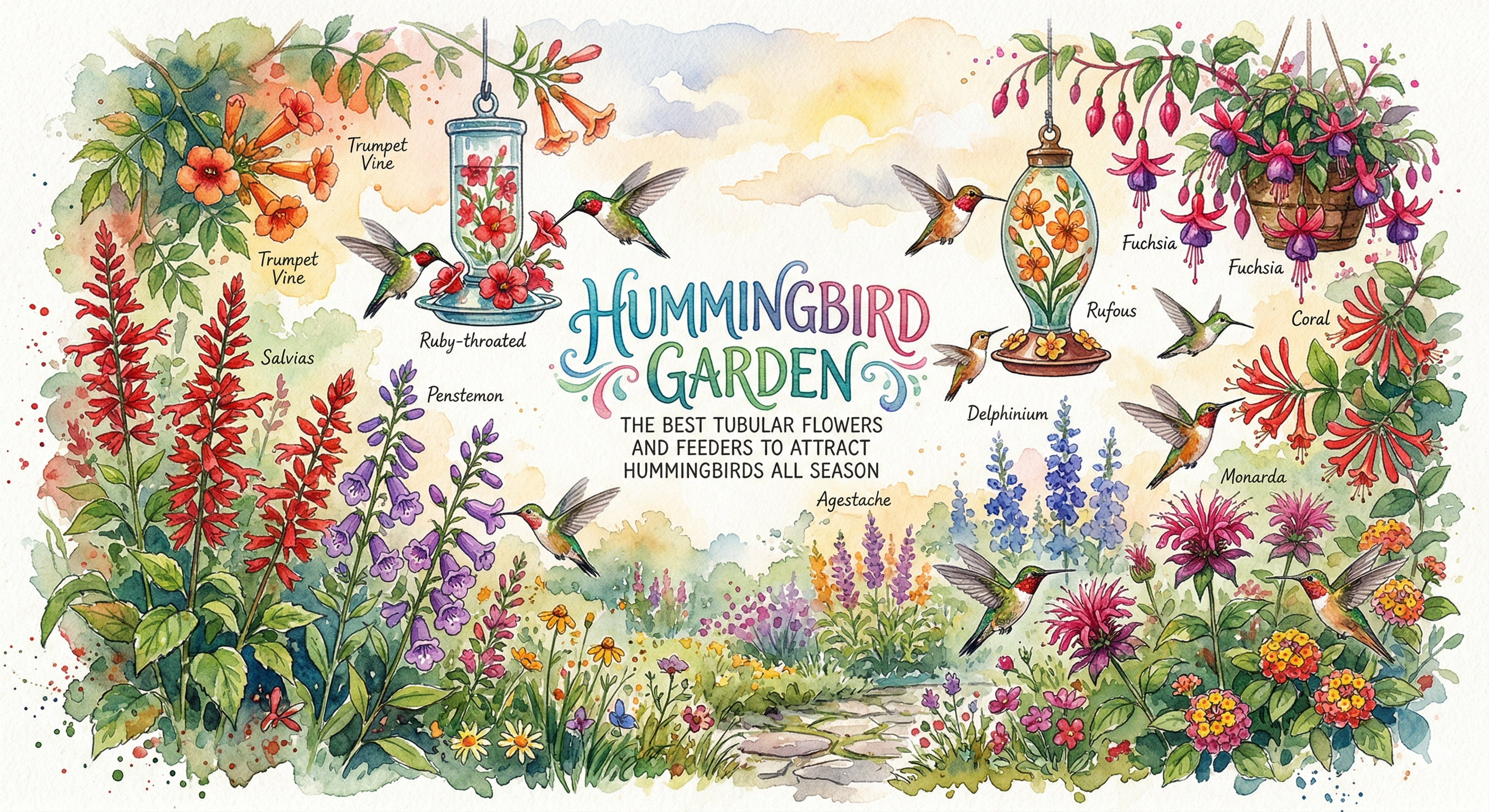
Hummingbird Garden
Plants, Feeders, and Design for Year-Round Hummingbird Habitat
Hummingbirds are among the most captivating visitors a garden can attract — impossibly fast, iridescent, and fiercely territorial. Creating a garden that supports them goes far beyond hanging a red feeder. The most effective hummingbird habitats layer native tubular flowers through the full growing season, offer clean reliable nectar sources, and provide the structural diversity these birds need for perching, nesting, and hunting insects. This guide covers the plants, feeders, design principles, and regional strategies that turn any yard into a hummingbird destination.
Section 1: Meet the Hummingbirds
More than 15 hummingbird species visit the contiguous United States, though most gardeners will encounter only one or two species depending on their region. Understanding which species use your area — and when — is the first step to designing a garden that works for them.
| Species | Range | Presence | ID Notes | Garden Notes |
|---|---|---|---|---|
| Ruby-throated Hummingbird | Eastern US / Midwest | Migratory (Apr–Oct) | Male has iridescent red throat; female plain white throat | Only breeding species east of the Mississippi; returns reliably to the same garden each year |
| Rufous Hummingbird | Western US / migrates through all regions | Migratory (Feb–Oct, route-dependent) | Male fiery orange-red; most aggressive of common species | Visits western gardens in summer; appears in eastern states during fall migration more than once thought |
| Anna's Hummingbird | Pacific Coast (CA, OR, WA) | Year-round resident | Male rose-red crown and throat; stocky build | Year-round feeder and garden presence; often nests in winter; needs winter-blooming plants |
| Costa's Hummingbird | Desert Southwest (CA, AZ, NV) | Year-round / seasonal | Male purple crown and extended gorget; small size | Adapted to Mojave and Sonoran Desert; prefers desert natives like penstemon and chuparosa |
| Black-chinned Hummingbird | Western US (widespread) | Migratory (Apr–Sep) | Male black chin with violet band below; female similar to Ruby-throated | The western equivalent of the Ruby-throated; common in urban and suburban gardens |
| Broad-tailed Hummingbird | Rocky Mountains / Mountain West | Migratory (May–Sep) | Male rose-magenta gorget; distinctive wing trill in flight | High-altitude specialist; common in Rocky Mountain gardens above 5,000 ft; arrives with first wildflowers |
| Calliope Hummingbird | Mountain West / Pacific NW | Migratory (Apr–Aug) | Smallest US bird; male has streaked magenta gorget like a starburst | Attracted to native penstemons and paintbrush; passes through many mountain-state gardens during migration |
| Allen's Hummingbird | Coastal California | Resident/migratory | Nearly identical to Rufous; male orange flanks and tail, green back | One of the earliest migrants; present along CA coast Feb–Aug; island population is year-round resident |
| Broad-billed Hummingbird | Southern Arizona / New Mexico | Migratory (Mar–Sep) | Male brilliant blue-green body with red bill; unmistakable | Attracted to Mexican sage, ocotillo, and desert willow; regular in Southeast AZ garden feeders |
| Blue-throated Mountain-gem / Rivoli's (Magnificent) | Southeast AZ / SW NM | Seasonal resident (May–Oct) | Large species; male has blue or purple throat; Rivoli's has green-purple iridescence | Occasionally visit feeders in mountain canyons; more common in higher-elevation riparian gardens in sky islands |
Hummingbird Biology: Key Facts for Gardeners
| Trait | Detail | Garden Implication |
|---|---|---|
| Heart rate | Up to 1,260 beats per minute during flight | Hummingbirds must feed constantly — they visit hundreds of flowers daily and cannot survive more than a few hours without food |
| Wing beats | 40–80 beats per second (species-dependent) | The hovering ability that lets them access tubular flowers; they also catch small insects in flight |
| Metabolism | Highest of any warm-blooded animal; burn ~10 calories/day | A garden with 20–30 tubular flower species in bloom can meaningfully reduce energy expenditure vs. scattered single-plant feeders |
| Torpor | Enter nightly hypothermia to conserve energy (body temp drops 50°F) | Dense shrubs and trees for night roost sites matter as much as flowers; avoid disturbing known roosting spots at dusk |
| Memory | Exceptional spatial memory; remember every flower and feeder visited | Once a hummingbird finds your garden, it will return reliably — year after year if migratory, or daily if resident |
| Territory | Males fiercely defend food sources; females range more widely | Multiple feeders placed out of sight of each other reduce aggressive monopolization and allow more birds to feed |
| Lifespan | 3–5 years average; banded birds recorded to 12 years | Investing in perennial plants and habitat structure pays dividends over many seasons |
| Diet | ~80% nectar, ~20% small insects and spiders (protein source) | Insect-supporting plants (aphid-prone plants, flying insect hosts) are part of complete hummingbird habitat |
| Migration cue | Photoperiod (day length), not temperature or feeder presence | Leaving feeders up in fall does NOT prevent migration; it provides critical fueling for the journey south |
| Color preference | Strong attraction to red, orange, and hot pink; learn any reliable food source regardless of color | Red flowers and red feeders attract initial scouting birds; white, purple, and blue flowers are visited readily once the garden is established |
Download the free eBird app (Cornell Lab of Ornithology) to see exactly which hummingbird species have been reported in your county and when they typically arrive and depart. This data, collected by thousands of local birders, is far more precise than general range maps and helps you time feeder setup and early-blooming plant choices.
Section 2: The Best Hummingbird Plants
Hummingbirds and tubular flowers co-evolved over millions of years. The long, narrow flower tube fits a hummingbird's bill and excludes most other pollinators, while the bird receives concentrated nectar in exchange for reliable cross-pollination. This relationship means that truly tubular, nectar-rich flowers — especially native species — will always outperform flat-faced blooms. A garden built around a succession of these plants, blooming from the moment your local hummingbirds arrive through the end of their season, is the single most powerful thing you can do to attract and retain them.
Native plants are the gold standard for hummingbird gardens. They evolved alongside local hummingbird populations, typically offer higher nectar volume and concentration than non-native cultivars, and support the insects hummingbirds eat. Where possible, source straight species or minimally-bred cultivars rather than heavily doubled or modified forms — breeders often prioritize appearance over nectar production.
Top Native Hummingbird Plants
| Plant | Type | Bloom Season | Regions | Zones | Rating |
|---|---|---|---|---|---|
| Trumpet Honeysuckle (Lonicera sempervirens) | Vine | Spring–Fall | East, Midwest, SE | 4–9 | ★★★★★ |
| Scarlet Sage / Tropical Sage (Salvia coccinea) | Annual / tender perennial | Spring–Fall | SE, Gulf, SW | 8–11 (annual elsewhere) | ★★★★★ |
| Cardinal Flower (Lobelia cardinalis) | Perennial | Midsummer–Fall | East, Midwest, SE, SW | 3–9 | ★★★★★ |
| Trumpet Vine (Campsis radicans) | Vine | Summer | East, Midwest, SE | 4–9 | ★★★★☆ |
| Bee Balm (Monarda didyma) | Perennial | Summer | East, Midwest, NE | 3–9 | ★★★★★ |
| Scarlet Gilia / Skyrocket (Ipomopsis aggregata) | Biennial/perennial | Summer | Mountain West, SW | 4–9 | ★★★★★ |
| Firecracker Penstemon (Penstemon eatonii) | Perennial | Spring | Desert SW, Mountain West | 4–9 | ★★★★★ |
| Rocky Mountain Penstemon (Penstemon strictus) | Perennial | Late Spring–Summer | Mountain West | 3–9 | ★★★★☆ |
| Hummingbird Sage (Salvia spathacea) | Perennial | Spring | California | 8–10 | ★★★★★ |
| Red Columbine (Aquilegia canadensis) | Perennial | Spring | East, Midwest, Mountain West | 3–8 | ★★★★★ |
| Standing Cypress (Ipomopsis rubra) | Biennial | Summer | SE, South-Central | 6–9 | ★★★★☆ |
| Cigar Plant (Cuphea ignea) | Annual / tender perennial | Summer–Fall | SE, Gulf (annual elsewhere) | 10–11 (annual elsewhere) | ★★★★☆ |
| Wild Columbine / Eastern Columbine (Aquilegia canadensis) | Perennial | Spring | East, Midwest | 3–8 | ★★★★★ |
| Ocotillo (Fouquieria splendens) | Shrub/tree | Spring | Desert SW | 8–11 | ★★★★★ |
| Chuparosa (Justicia californica) | Shrub | Winter–Spring | Desert SW (CA, AZ) | 9–11 | ★★★★★ |
Non-Native Plants Worth Growing
Well-chosen non-native plants can extend bloom season, fill regional gaps, and provide exceptional nectar volume. The following perform reliably for hummingbirds across a wide range of US gardens without becoming invasive problems (verify invasive status for your specific region before planting).
| Plant | Type | Bloom Season | Zones | Notes |
|---|---|---|---|---|
| Salvia guaranitica (Anise-scented sage) | Tender perennial | Summer–Fall | 7–11 (annual elsewhere) | Deep blue flowers; visited enthusiastically despite non-red color; 'Black and Blue' is the most common cultivar |
| Salvia elegans (Pineapple sage) | Tender perennial | Fall | 8–11 (annual elsewhere) | Blooms late; critical fuel for migrating hummingbirds in Sep–Oct; pineapple-scented foliage |
| Agastache (Hyssop / Hummingbird mint) | Perennial | Summer–Fall | 5–9 (varies by species) | Exceptionally long bloom; drought-tolerant; 'Blue Fortune', 'Desert Sunrise', and native hybrids all perform well |
| Crocosmia (Montbretia) | Bulb | Summer | 5–9 | Orange-red arching sprays; reliable hummingbird magnet; can spread aggressively in mild climates |
| Fuschia (hardy forms) | Shrub / annual | Summer–Fall | 6–10 (species-dependent) | Hanging tubes are perfectly designed for feeding; 'Gartenmeister Bonstedt' particularly productive |
| Cannas (Canna × generalis) | Bulb | Summer–Fall | 7–11 (annual elsewhere) | Vivid red/orange species types more productive than heavily hybridized cultivars; good tropical effect |
| Cigar plant (Cuphea micropetala) | Tender perennial | Fall | 9–11 (annual elsewhere) | Orange-and-yellow tubes bloom late into fall; often the last hummingbird plant still producing |
| Lantana (Lantana camara) | Annual / shrub | Summer–Fall | 8–11 (annual elsewhere) | Extremely productive nectar source; treat as invasive and do not allow to naturalize in warm-winter climates |
| Tithonia (Mexican sunflower) | Annual | Summer–Fall | Annual | Orange 3-inch flowers; visited by hummingbirds for nectar and insects attracted to bloom |
| Red hot poker (Kniphofia uvaria) | Perennial | Summer | 5–9 | Torch-like spikes; visited frequently by hummingbirds; tolerates dry conditions once established |
| Salvia microphylla (Baby sage / Graham's sage) | Shrub | Spring–Fall (long) | 7–10 | Exceptionally long season; small red-pink flowers; many named cultivars available |
| Impatiens (standard) | Annual | Summer–Fall | Annual | Lower-rated than tubular options but visited for nectar; useful in deep shade where other options fail |
| Weigela (red-flowering forms) | Shrub | Spring | 4–8 | One of the best spring shrubs for early migrants; 'Wine and Roses' and species forms most productive |
Season-by-Season Bloom Calendar
The goal is unbroken bloom from the day your local hummingbirds arrive through their last day in the garden. Use this calendar as a planning tool — your exact timing will shift 2–4 weeks per USDA zone.
| Season | Target Bloom Window | Key Plants | Goal |
|---|---|---|---|
| Early Spring (Zones 7–9) / Late Spring (Zones 5–6) | First hummingbird arrival + 2 weeks | Red columbine, weigela, native azaleas, early penstemons, trumpet honeysuckle (first flush) | Greet arriving birds immediately; establish territory before they range further |
| Late Spring / Early Summer | Weeks 3–8 of bird presence | Bee balm, salvia species, penstemon peak, columbine second flush, early trumpet vine | Support territory establishment and early nesting females who need maximum calories |
| Midsummer | Peak season for most regions | Trumpet vine, cardinal flower, agastache, lantana, tithonia, Salvia guaranitica, canna | Highest competition period; supplement with feeders; prioritize plants with high nectar volume |
| Late Summer / Early Fall | 4–6 weeks before last expected bird | Pineapple sage, cigar plant, late agastache, Salvia microphylla, late bee balm, cardinal flower second flush | Critical fueling period before and during migration; do not cut back late-blooming plants |
| Winter (Zones 8–11 with resident Anna's) | Year-round | Chuparosa, winter-blooming aloes, Salvia leucantha, early-winter natives | Anna's hummingbirds in CA/PNW require winter flowers; feeders become primary fuel source for most of the country |
| Year-round feeder rule | — | — | Keep at least one feeder up through the entire season — even in a garden rich with flowers. Feeders act as an anchor that draws birds into range of your plants. |
The "12-month feeder" rule: if you live in a region with year-round residents (Pacific Coast, Desert Southwest) or where unexpected late migrants appear, keep a feeder up every month of the year. For purely migratory areas (most of the East and Midwest), set your feeder out one week before your local average first-arrival date and leave it up two weeks after your average last-sighting date — the birds that linger latest need fuel most urgently.
Section 3: Hummingbird Feeders
A well-maintained feeder is a powerful complement to a planted hummingbird garden — it draws birds in from a distance, anchors territory, and provides critical calories during periods when flowers are between bloom cycles. The key word is well-maintained: a neglected feeder with spoiled nectar is worse than no feeder at all, as moldy sugar water can cause fatal fungal infections in the birds that drink it.
Feeder Types
| Type | How It Works | Pros | Cons | Best For |
|---|---|---|---|---|
| Saucer / dish feeder | Shallow reservoir; ports sit above the nectar surface | Easy to clean; bee and wasp resistant; no drips | Smaller capacity; exposed nectar heats faster in direct sun | Most gardeners; beginners; anyone prioritizing cleanliness |
| Bottle / inverted tube feeder | Inverted bottle creates vacuum seal; nectar drawn up through ports | Larger capacity; widely available; many decorative options | Drips when temperature changes create vacuum breaks; harder to clean bottle neck | High-traffic gardens; regions with multiple birds needing high-volume supply |
| Window-mount feeder | Suction-cup mounted directly to glass; birds feed inches from indoors | Exceptional close-up viewing; no pole required | Small capacity; must be cleaned frequently; some birds initially wary | Close observation; patios and apartment balconies; photography |
| Decorative ceramic / glass feeder | Hand-blown glass or ceramic; typically bottle-style with decorative ports | Attractive; sturdy; less UV degradation than plastic | Often difficult to clean thoroughly; irregular shapes may harbor mold | Aesthetic-focused gardens where appearance matters; low-traffic sites |
| Large capacity / multiple port feeder | High-volume reservoirs with 6–10+ feeding ports; often with perches | Serves many birds simultaneously; reduces refill frequency | Perches can encourage aggressive monopolizing; large reservoir = faster spoilage if turnover is low | High-density areas with many birds; late summer migration fueling stations |
Feeder Buying Guide
- •Choose red feeders or feeders with red ports — initial scouting birds are drawn to red; do not add red dye to the nectar itself
- •Prioritize ease of cleaning above all else — if you cannot disassemble and scrub every surface, the feeder will grow mold
- •Avoid feeders with yellow bee guards — yellow attracts bees and wasps; most saucer-style feeders naturally resist insects because the nectar sits below port level
- •Look for wide-mouth openings and smooth interior curves — bottle-style feeders with narrow necks are nearly impossible to clean properly without a bottle brush set
- •Perches are optional — hummingbirds can hover to feed, but perches allow tired migrants to rest and make for better observation; they do let aggressive males monopolize a feeder more easily
- •BPA-free, UV-stable plastic or glass are both acceptable materials; avoid cheap plastic that cracks or discolors quickly
Nectar Recipe
The correct nectar formula is simple, cheap, and matches the sugar concentration of the flowers hummingbirds evolved to visit. Use plain white granulated cane sugar and clean water — nothing else.
Standard nectar recipe: 1 part white granulated sugar to 4 parts water (1:4 ratio). Boil water briefly, stir in sugar until fully dissolved, cool completely before filling the feeder. This produces approximately a 20% sucrose solution — within the natural range of hummingbird-adapted flowers. Store unused nectar in the refrigerator for up to two weeks.
What Not to Use
- •Red dye or food coloring — completely unnecessary and potentially harmful; the red feeder body is sufficient to attract birds
- •Honey — ferments rapidly and can cause fatal fungal infections (Candidiasis); never use in feeders
- •Brown sugar, raw sugar, turbinado, or coconut sugar — contain molasses and other compounds that are difficult for hummingbirds to process; stick to plain white cane sugar
- •Artificial sweeteners — provide no calories; hummingbirds will abandon a feeder filled with zero-calorie liquid
- •Nectar concentrate products — some commercial mixes contain additives, preservatives, or incorrect ratios; mixing fresh 1:4 sugar water is cheaper and safer
- •Well water high in minerals — use filtered or tap water; very high mineral content can leave residue and affect palatability
Nectar Freshness — How Often to Change
Nectar spoilage is temperature-dependent. Fermented or moldy nectar is the leading cause of feeder-related hummingbird illness. When in doubt, change the nectar — the cost of a cup of sugar water is trivial compared to the harm spoiled nectar causes.
| Temperature | Change Nectar Every | Notes |
|---|---|---|
| Below 60°F | Every 5–7 days | Cool weather slows fermentation; still check for cloudiness or floating particles |
| 60–70°F | Every 3–4 days | Moderate fermentation risk; inspect visually at each fill |
| 70–80°F | Every 2–3 days | Fermentation noticeably faster; nectar may appear cloudy before full spoilage |
| 80–90°F | Every 1–2 days | High risk; nectar can begin fermenting within 24 hours in full sun; move feeder to shade |
| Above 90°F | Daily | Critical — partial fills help so less nectar is wasted with daily changes; shade placement is essential |
Deep cleaning protocol: Every time you refill, rinse the feeder with hot water and scrub all surfaces. Every 1–2 weeks (or whenever you see black mold spots), disassemble completely and soak in a 1:10 bleach-to-water solution or undiluted white vinegar for 1–2 hours, then scrub every surface with a bottle brush and port cleaner, rinse thoroughly multiple times, and air-dry completely before refilling. Black mold in feeder ports is a serious health hazard to hummingbirds — it cannot be rinsed away.
Feeder Placement
- •Place in partial shade or morning sun only — direct afternoon sun accelerates nectar spoilage significantly
- •Hang near tubular flowers so birds moving between feeder and plants encounter your plantings naturally
- •Position multiple feeders out of sight of each other — a dominant male cannot guard what he cannot see; this is the most effective strategy for serving more birds
- •Keep at least 10–15 feet from windows to prevent collision risk; window-mount feeders are the exception (inches away is safe)
- •Hang high enough to be accessible to hummingbirds but reachable by you for cleaning — a feeder you cannot easily remove will not get cleaned often enough
- •Avoid placing near ant-prone surfaces; use an ant moat (a water-filled barrier above the hanger) to prevent ants from reaching the nectar
Section 4: Designing the Hummingbird Garden
A hummingbird garden is more than a collection of red flowers. The most productive habitat combines a layered planting structure, a reliable nectar succession from spring to fall, open flight corridors, and the structural elements that let hummingbirds do everything they need — feed, perch, rest, nest, and hunt insects. Thoughtful design multiplies the value of every plant you put in the ground.
The 5 Essential Habitat Elements
- •Nectar succession — at least one tubular hummingbird plant in bloom at all times during the active season; plan specifically for the early-arrival gap (first 2 weeks) and the late-migration fueling window (last 3 weeks)
- •Vertical structure — a mix of ground-level flowers, mid-height shrubs and perennials, and at least one tall shrub or small tree; hummingbirds use different height layers for feeding, perching, and surveying territory
- •Exposed perches — dead branch tips, thin wire, or the very tops of tall shrubs where males can perch in the open to watch for rivals and females; these high, exposed spots are used far more than leafy interior branches
- •Insect habitat — plants that host small insects and spiders (especially aphid-prone species, late-season asters, and native flowers); protein from insects is essential for breeding females and nestlings
- •Water — a misting device or a fountain with gentle moving water is far more effective than a birdbath; hummingbirds bathe by flying through fine mist or hovering under dripping water, not by standing in a pool
Plant Combination Designs
The following four combinations are proven, regionally appropriate plantings that provide bloom succession, structural variety, and high nectar value. Each can be scaled up or down and adapted to your specific site.
| Design | Key Plants | Bloom Succession | Size / Context |
|---|---|---|---|
| Eastern Hummingbird Border | Red columbine (spring) → bee balm (early summer) → trumpet honeysuckle (spring–fall) → cardinal flower (midsummer–fall) → pineapple sage (fall) | Early Apr through Oct; columbine greets migrants, sage fuels fall departure | A 10–20 ft sunny border; works in Zones 4–8; all plants native to the eastern US |
| Western Native Garden | Early penstemon species (spring) → Salvia spathacea or S. clevelandii (spring–summer) → Agastache (summer–fall) → Epilobium/Zauschneria (late summer–fall) | Mar–Nov in mild climates; Epilobium blooms while late migrants are still present | A dry, sunny slope or hillside planting; Zones 7–10 (CA, PNW, Mountain West); extremely drought-tolerant once established |
| Desert Southwest Design | Chuparosa (winter–spring) → penstemon species (spring) → desert willow (summer) → Salvia coccinea (summer–fall) → Tecoma stans or Salvia greggii (fall) | Oct–May peak for resident Costa's and Anna's; summer bloomers serve Black-chinned and Broad-billed hummingbirds | A xeric courtyard or desert-adapted garden; Zones 8–11 (AZ, NM, CA desert); designed around summer water restrictions |
| Small Space / Container Garden | Salvia microphylla or S. guaranitica (containers, long season) + Agastache 'Desert Sunrise' (container) + trailing Fuchsia (hanging basket) + annual Salvia coccinea | Late spring through hard frost; containers can be moved to maximize sun exposure as season shifts | A patio, balcony, or 6×6 ft courtyard; works in any zone with appropriate annual/tender perennial choices; feeders essential as supplement |
5 Design Principles
- •Mass plantings over single specimens — three to five plants of the same species in a cluster produce enough nectar to register as a territory-worth defending; a single plant of everything produces scattered calories that hummingbirds may not bother to defend or return to reliably
- •Design for flight corridors — hummingbirds approach feeders and flowers from above and to the side; avoid planting dense barriers directly in front of feeders or between major nectar sources; leave open airspace for the fast, direct flight patterns they prefer
- •Separate competing males — if you want more than one male hummingbird using your garden, space high-value nectar sources (feeders or dense flower clusters) at least 20–30 feet apart and use tall shrubs or fences as visual barriers between them
- •Include at least one large structural plant — a tall native shrub, small tree, or large vine (trumpet vine, trumpet honeysuckle on a substantial trellis) provides the elevated perching, territorial survey, and shelter structure that turns a "flower garden with hummingbirds" into actual hummingbird habitat
- •Plan for the gaps — identify the weeks in your season when nothing hummingbird-worthy is blooming and fill them deliberately; the most common gaps are the 2–3 weeks after spring bulbs fade before early perennials peak, and the midsummer lull when spring bloomers are finished and fall salvias haven't yet started
A garden mister is one of the highest-return investments you can make for hummingbirds. Attach a fine-mist nozzle to a hose near a shrub or small tree and run it for 15–20 minutes in the morning. Hummingbirds will fly through the mist repeatedly to bathe — a behavior rarely triggered by birdbaths. Once they discover it, they will return to that spot daily.
Section 5: Regional Hummingbird Gardening Guide
Hummingbird gardening strategies vary dramatically by region — not just because different species visit, but because climate, native plant availability, and seasonal timing all shape what works. Use the region that best matches your location, then cross-reference with your USDA hardiness zone for plant selection.
| Region | Primary Species | Season | Key Native Plants | Key Non-Native Plants | Regional Notes |
|---|---|---|---|---|---|
| New England & Maritime Canada (Zones 4–6) | Ruby-throated (only species) | Early May – late Sep | Red columbine, bee balm, trumpet honeysuckle, cardinal flower, native azaleas | Weigela (spring), agastache, pineapple sage (fall fueling) | Short but intense season; bee balm and cardinal flower are the backbone plants; set feeders out by May 1; aggressive late-fall fueling support is critical as birds prepare for Gulf crossing |
| Mid-Atlantic & Southeast (Zones 6–9) | Ruby-throated (primary); occasional Rufous in fall | Apr – Oct; year-round along Gulf Coast | Trumpet vine, cardinal flower, coral honeysuckle, standing cypress, native salvias | Salvia guaranitica, Salvia coccinea, lantana, cigar plant, cannas | Long season allows for a full succession planting; trumpet vine is the signature plant; Gulf Coast gardeners should plan for year-round feeder maintenance and winter-blooming salvias |
| Midwest & Great Plains (Zones 4–7) | Ruby-throated (primary) | May – Sep | Bee balm, cardinal flower, red columbine, trumpet honeysuckle, native salvias | Agastache, Salvia guaranitica, weigela, tithonia | Season peaks June–August; bee balm and cardinal flower are the highest-value plants; prairie-style plantings with agastache and native grasses as structure work well; late summer fueling plants are critical before southward migration |
| Pacific Northwest (Zones 7–9) | Anna's (year-round); Rufous and Calliope (migratory, spring–summer) | Anna's year-round; Rufous Feb–Aug | Red-flowering currant (critical early spring), salvia species, penstemon, native columbines, Epilobium | Fuchsia (year-round for Anna's), agastache, Salvia microphylla | Red-flowering currant (Ribes sanguineum) is the single most important plant — it blooms Feb–Mar when Anna's hummingbirds are nesting and nothing else is open; keep winter feeders up for Anna's; Rufous arrive Feb in southern PNW |
| California & Coastal West (Zones 8–11) | Anna's (year-round); Allen's (coastal, Feb–Jul); Costa's (southern CA) | Year-round for residents; Feb–Aug for Allen's | Salvia spathacea, Salvia clevelandii, native penstemons, Epilobium (Zauschneria), Ribes sanguineum | Fuchsia, Salvia microphylla, agastache, pineapple sage | Year-round gardening for year-round birds; California native salvias are unmatched for attracting Anna's and Allen's; Epilobium californica blooms Aug–Nov and fuels both late-season residents and passing migrants; avoid invasive plants like Lantana camara in frost-free zones |
| Mountain West & Rocky Mountains (Zones 3–7) | Broad-tailed (primary); Rufous, Calliope, Black-chinned (migratory); Ruby-throated in eastern foothills | May – Sep (elevation-dependent) | Scarlet gilia, native penstemons, red columbine, native salvias, paintbrush (difficult to cultivate) | Agastache, Salvia guaranitica, Crocosmia | Elevation dramatically shifts timing — gardens above 7,000 ft may have a 90-day season; broad-tailed hummingbirds arrive with early penstemons and scarlet gilia; multiple species pass through during August migration; late-season agastache and salvias are high value |
| Southwest Desert (Zones 8–11) | Costa's and Anna's (residents/winter); Black-chinned and Broad-billed (summer); Rufous (migration) | Year-round; two peaks (spring and fall migration) | Chuparosa, desert willow, ocotillo, native penstemons, Salvia coccinea, Justicia species | Salvia greggii, Tecoma stans, Salvia microphylla, Salvia guaranitica | The most diverse hummingbird region in the US; spring (Feb–Apr) and fall (Aug–Oct) are peak migration periods with the greatest species variety; summer heat requires shade-sited feeders changed daily; xeric native plants are far more sustainable than water-intensive non-natives |
| Texas (Zones 6–10, highly varied) | Ruby-throated (East TX); Black-chinned (West TX); Rufous, Broad-tailed, and many rare species during migration | Mar – Nov; year-round in deep South TX | Salvia coccinea, Turk's cap (Malvaviscus arboreus), native salvias, trumpet vine, coral honeysuckle | Salvia greggii (native to TX Hill Country), Salvia guaranitica, cigar plant, Hamelia patens | Texas sits at a migration crossroads and records more hummingbird species than any other eastern state; Turk's cap is the signature Texas hummingbird plant — blooms summer through frost, tolerates heat and some shade, and is visited constantly; keep feeders up through November for late migrants |
| Florida & Gulf Coast (Zones 8–11) | Ruby-throated (migratory); increasing Rufous and rare western strays in winter | Year-round potential; peak Apr–May and Aug–Oct migration | Firebush (Hamelia patens), coral honeysuckle, Salvia coccinea, native salvias | Salvia guaranitica, Salvia elegans, cigar plant, Cuphea species, shrimp plant (Justicia brandegeana) | Florida's hot, humid climate favors heat-tolerant tropical and subtropical plants over traditional northern hummingbird plants; firebush is the standout native — blooms nearly year-round and is visited by every hummingbird that passes through; keep winter feeders for the growing Rufous and other rare overwintering birds |
Regional boundaries are guidelines, not hard lines. If you garden near a regional border — the eastern edge of the Mountain West, the northern edge of the Southwest — read both adjacent regions and combine strategies. Migration routes cut across all regions, meaning well-planted gardens anywhere can attract species outside their usual range during spring and fall movement.
Section 6: Advanced Hummingbird Gardening
Once you have the basics in place — a succession of tubular flowers, clean feeders, and structural habitat — the following strategies take your garden to the next level: supporting nesting, attracting hard-to-reach species, photographing the birds you attract, and contributing to the science that helps protect them.
Troubleshooting Common Problems
| Problem | Likely Cause | Solution |
|---|---|---|
| No hummingbirds after several weeks | Garden not yet discovered; no early-arrival signal plant; feeder not visible | Add a bright red feeder to draw scouts; ensure at least one early-blooming tubular plant is visible from above; be patient — newly established gardens can take a full season to be found |
| One aggressive male chases all others away | Natural territorial behavior of dominant males | Add 2–3 additional feeders placed out of line-of-sight of each other; add supplemental nectar plantings in separate areas so the male cannot monitor all food sources simultaneously |
| Ants in the feeder | Ants following scent trail to nectar | Install an ant moat (water-filled barrier) above the feeder hanger; never use oil or petroleum products on the hanger — hummingbirds preen with their bills and can be poisoned |
| Bees and wasps dominating feeder | Yellow ports attract bees; sweet nectar is irresistible to wasps in late summer | Switch to a saucer-style feeder where nectar sits below port level; remove yellow bee guards if present; reduce nectar concentration slightly (1:5 ratio) during worst wasp periods |
| Feeder ignored despite birds in garden | Wrong feeder style; nectar spoiled; location conflict with dominant bird | Try a different feeder style; change nectar and move feeder to a new location; ensure feeder is not in the direct sightline of a territorial male's perch |
| Hummingbirds disappearing in midsummer | Post-breeding dispersal; females and juveniles moving after nesting; temporary lull | Normal behavior — activity often drops July–early August after breeding; maintain feeders and plants; activity typically resumes in mid-August as migration begins and new juveniles appear |
| Nectar turning black or cloudy within days | Mold growth; feeder not cleaned between fills; direct sun location | Increase cleaning frequency; move feeder to shade; in very hot weather, make smaller batches and change daily; inspect all port seals for cracks where mold hides |
| Hummingbird hitting windows | Bird sees reflected sky/trees in glass; high-traffic flight path near window | Apply window collision tape or decals in a grid pattern (2×4 inch spacing); move feeder more than 3 feet or less than 1 foot from glass — intermediate distances are the most dangerous; add external window screens |
Supporting Nesting Hummingbirds
Hummingbird nests are among the most remarkable structures in the bird world — a walnut-sized cup of plant fibers, spider silk, and lichen, built entirely by the female. Females alone incubate eggs and raise young; the male plays no role after mating. Supporting nesting females requires understanding what they need.
- •Plant native trees and large shrubs — nests are built on small horizontal branches 10–40 feet up in deciduous trees; oaks, maples, sycamores, and alders are commonly used in the East; eucalyptus, live oaks, and native conifers in the West
- •Provide spider silk sources — female hummingbirds actively collect spider webs to bind and elasticize the nest; allow orb-weaver and grass spiders to maintain webs in sheltered spots in the garden
- •Leave lichen on trees and rocks — lichen is the primary camouflage material pressed onto the outside of the nest; do not scrub or remove lichen from tree bark
- •Plant native plants that produce soft seed-down — thistle, cattail, willow catkins, and dandelion fluff are used as nest lining material; leaving a few of these "weeds" in a back corner of the garden supports breeding females
- •Minimize disturbance near known nesting sites — females will abandon eggs if disturbed repeatedly during incubation; once you locate a nest, observe from a distance and avoid pruning or mowing in that immediate area until fledglings have left
Hummingbird Photography in the Garden
- •Use a fast shutter speed — hummingbird wings beat 40–80 times per second; to freeze wing motion you need at least 1/2000 sec, ideally 1/4000–1/8000 sec; raise ISO as needed to achieve this in your garden's light conditions
- •Pre-focus on a known perch or flower — hummingbirds are creatures of habit; identify where a bird returns repeatedly and pre-focus there rather than trying to track fast movement
- •Position the sun behind you and slightly to one side — gorget (throat) iridescence only appears when light hits it at the right angle; without front-lighting, male throat patches often appear black in photos
- •Use a feeder as a controlled setting — replace one port cover with a single fresh flower stem for a more natural-looking shot; the bird's approach and hover time is predictable
- •Burst mode and patience — even experienced wildlife photographers take dozens of shots per bird; continuous shooting mode captures the one frame where wings, light, and position align perfectly
Winter Feeder Guidance
For most of the country, winter feeders serve two purposes: supporting year-round residents (Anna's hummingbirds along the Pacific Coast) and catching late-season or off-course migrants that would otherwise have no fuel source. Never take down a feeder thinking you are "helping" birds migrate — if a hummingbird is still present in cold weather, it either cannot migrate or is a year-round resident that depends on your feeder.
- •In freezing temperatures, nectar freezes before it spoils — rotate two feeders, bringing one inside overnight and putting it out in the morning while the other warms indoors
- •A low-wattage outdoor light bulb or hand warmer placed near (not touching) the feeder can keep nectar liquid on cold nights
- •Do not increase sugar concentration above 1:3 (one part sugar to three parts water) in winter — higher concentrations were once recommended but current evidence suggests the standard 1:4 ratio is appropriate year-round
- •In the Pacific Northwest and California, Anna's hummingbirds require feeders through all winter months; pair feeders with winter-blooming plants like red-flowering currant, winter jasmine, or early-blooming native shrubs
Citizen science: Submit your hummingbird sightings to eBird (ebird.org) and Hummingbird Central (hummingbirdcentral.com/migration). Your first-of-season and last-of-season sightings contribute to migration tracking maps used by researchers to monitor population trends and climate-shift responses. It takes 30 seconds and directly helps hummingbird conservation.
Quick Reference: Top 40 Hummingbird Plants
Use this table as a quick planning reference. Native status reflects US nativity (N = native to some part of the US; NN = non-native). Zones are general guidelines — microclimates, heat tolerance, and moisture can shift these by 1–2 zones. Season codes: Sp = Spring, ESu = Early Summer, Su = Summer, LSu = Late Summer, F = Fall.
| Plant | Native | Zones | Flower Color | Height | Peak Season | Rating |
|---|---|---|---|---|---|---|
| Trumpet Honeysuckle (Lonicera sempervirens) | N | 4–9 | Red-orange | Vine to 15 ft | Sp–F (repeat) | ★★★★★ |
| Cardinal Flower (Lobelia cardinalis) | N | 3–9 | Scarlet red | 2–4 ft | Su–LSu | ★★★★★ |
| Bee Balm (Monarda didyma) | N | 3–9 | Red, pink, purple | 2–4 ft | ESu–Su | ★★★★★ |
| Red Columbine (Aquilegia canadensis) | N | 3–8 | Red and yellow | 1–3 ft | Sp | ★★★★★ |
| Scarlet Sage (Salvia coccinea) | N | 8–11 / annual | Red | 2–3 ft | Sp–F | ★★★★★ |
| Scarlet Gilia (Ipomopsis aggregata) | N | 4–9 | Scarlet red | 2–4 ft | Su | ★★★★★ |
| Firecracker Penstemon (Penstemon eatonii) | N | 4–9 | Scarlet red | 2–3 ft | Sp | ★★★★★ |
| Hummingbird Sage (Salvia spathacea) | N | 8–10 | Magenta-pink | 2–3 ft | Sp | ★★★★★ |
| Ocotillo (Fouquieria splendens) | N | 8–11 | Scarlet red | 10–20 ft | Sp | ★★★★★ |
| Chuparosa (Justicia californica) | N | 9–11 | Red-orange | 3–5 ft | Win–Sp | ★★★★★ |
| Red-flowering Currant (Ribes sanguineum) | N | 5–9 | Pink-red | 5–10 ft | Early Sp | ★★★★★ |
| California Fuchsia / Epilobium (Zauschneria) | N | 6–10 | Scarlet red | 1–3 ft | LSu–F | ★★★★★ |
| Turk's Cap (Malvaviscus arboreus) | N | 7–11 | Red | 3–8 ft | Su–F | ★★★★★ |
| Firebush (Hamelia patens) | N | 8–11 | Orange-red | 4–10 ft | Sp–F | ★★★★★ |
| Trumpet Vine (Campsis radicans) | N | 4–9 | Orange-red | Vine to 30 ft | Su | ★★★★☆ |
| Standing Cypress (Ipomopsis rubra) | N | 6–9 | Scarlet red | 4–6 ft | Su | ★★★★☆ |
| Rocky Mountain Penstemon (Penstemon strictus) | N | 3–9 | Blue-purple | 2–3 ft | LSp–Su | ★★★★☆ |
| Native Azalea species (Rhododendron spp.) | N | 4–9 | Red, orange, pink | 4–10 ft | Sp | ★★★★☆ |
| Desert Willow (Chilopsis linearis) | N | 6–11 | Pink-purple | 15–25 ft | Su | ★★★★☆ |
| Cigar Plant (Cuphea ignea) | N (Mexico) | 10–11 / annual | Orange-red | 1–2 ft | Su–F | ★★★★☆ |
| Salvia guaranitica (Anise-scented sage) | NN | 7–11 / annual | Deep blue | 3–5 ft | Su–F | ★★★★★ |
| Salvia elegans (Pineapple sage) | NN | 8–11 / annual | Scarlet red | 3–5 ft | F | ★★★★★ |
| Agastache (Hyssop / Hummingbird mint) | N/NN | 5–9 | Orange, pink, blue | 2–4 ft | Su–F | ★★★★★ |
| Salvia microphylla (Baby sage) | NN | 7–10 | Red, pink, magenta | 2–4 ft | Sp–F (long) | ★★★★★ |
| Salvia greggii (Autumn sage) | N (TX/NM) | 6–9 | Red, pink, white | 2–3 ft | Sp–F | ★★★★★ |
| Fuchsia — hardy forms | NN | 6–10 | Red-purple | 1–4 ft | Su–F | ★★★★☆ |
| Crocosmia (Montbretia) | NN | 5–9 | Orange-red | 2–3 ft | Su | ★★★★☆ |
| Red Hot Poker (Kniphofia uvaria) | NN | 5–9 | Red-orange-yellow | 2–4 ft | Su | ★★★★☆ |
| Weigela — red forms | NN | 4–8 | Deep red-pink | 4–6 ft | Sp | ★★★★☆ |
| Tithonia (Mexican sunflower) | NN | Annual | Orange | 3–5 ft | Su–F | ★★★★☆ |
| Canna — species types | NN | 7–11 / annual | Red, orange | 4–6 ft | Su–F | ★★★★☆ |
| Cuphea micropetala | NN | 9–11 / annual | Orange-yellow | 3–4 ft | LSu–F | ★★★★☆ |
| Lantana (use with caution) | NN | 8–11 / annual | Red, orange, yellow | 2–4 ft | Su–F | ★★★★☆ |
| Shrimp Plant (Justicia brandegeana) | NN | 8–11 / annual | Shrimp-pink bracts | 2–3 ft | Sp–F | ★★★★☆ |
| Hamelia patens 'Compacta' (compact firebush) | N/cultivar | 8–11 / annual | Orange-red | 3–4 ft | Su–F | ★★★★☆ |
| Ipomopsis longiflora (White-flowered gilia) | N | 4–8 | White with pink | 1–2 ft | Su | ★★★☆☆ |
| Monarda fistulosa (Wild bergamot) | N | 3–9 | Lavender-pink | 2–4 ft | Su | ★★★☆☆ |
| Salvia leucantha (Mexican bush sage) | NN | 8–11 / annual | Purple-white | 3–4 ft | F–Win | ★★★★☆ |
| Tecoma stans (Yellow bells) | N (SW) | 8–11 | Bright yellow | 6–20 ft | Su–F | ★★★★☆ |
| Impatiens — standard (shade use) | NN | Annual | Red, orange, pink | 1–2 ft | Su–F | ★★★☆☆ |
When building your plant list, aim for at least 8–10 species from this table — choosing plants that collectively cover early spring, peak summer, and late fall in your region. Prioritize native species first, then fill gaps with high-performing non-natives. Even a small garden with 5–6 well-chosen plants in mass plantings will outperform a large garden with 20 single specimens scattered randomly.
Getting Started Action Plan
Whether you have a week, a month, or a full season to invest, these action plans give you a clear starting point. You do not need to do everything at once — hummingbird habitat builds incrementally, and even a single well-chosen plant or a clean feeder can make your garden a stop on a migration route.
If You Have One Week
- •Hang one red saucer-style feeder in a partially shaded spot visible from a window and fill it with fresh 1:4 sugar water
- •Check eBird for which hummingbird species visit your county and their typical first-arrival date — set a calendar reminder to have the feeder up one week before that date
- •Buy one or two of the highest-rated native plants for your region from the Quick Reference table and place them near the feeder
- •Commit to a feeder-change schedule based on your typical summer temperature — write it on the calendar so it becomes a habit from day one
If You Have One Month
- •Plan a bloom succession: identify which weeks in your season currently have no hummingbird-attractive flowers and fill those gaps with at least one plant each
- •Add a second feeder positioned out of sight of the first to reduce territorial monopolization
- •Install an ant moat above each feeder
- •Plant a mass of at least 3–5 plants of your highest-rated native species — a single specimen registers less than a cluster
- •Add one structural element: a section of trellis for trumpet honeysuckle or coral honeysuckle, or a tall shrub that provides both nectar and a high perch
- •Set up a garden mister near a shrub for 15–20 minutes in the morning — observe within a week whether hummingbirds discover it
If You Have One Full Season
- •Map your garden in early spring and identify the sunniest, most visible area for a hummingbird border — this becomes your primary planting zone
- •Build a full succession planting using the Season-by-Season Bloom Calendar: at least one plant for early arrival, two or three for peak season, and one for late-migration fueling
- •Establish at least one large structural plant (trumpet vine on a trellis, or a native shrub like red-flowering currant or native azalea) that provides vertical height and a territory anchor
- •Keep detailed notes on your first and last sighting dates, which plants were visited most frequently, and which feeder positions attracted the most birds — this becomes your personalized guide for next year
- •Submit sightings to eBird and Hummingbird Central throughout the season; photograph what you can and begin to learn individual bird differences (male vs. female, resident vs. migrant)
- •In fall, resist the urge to cut back late-blooming plants before the last bird has departed — pineapple sage, cigar plant, and late agastache are feeding birds that are about to make long journeys
Hummingbird gardening rewards patience and observation more than any other kind of wildlife gardening. The birds themselves will teach you what works — pay attention to which flowers they visit first each morning, which perches they favor, and where they go when they leave your yard. Over two or three seasons, a garden built around those observations becomes something genuinely alive: a place that hummingbirds choose, return to year after year, and occasionally raise young in. That is the goal worth working toward.
The single most important thing you can do today: put up one clean feeder with fresh nectar and plant one native tubular flower. Everything else in this guide builds from that foundation. Start small, observe carefully, and let the hummingbirds show you what to do next.