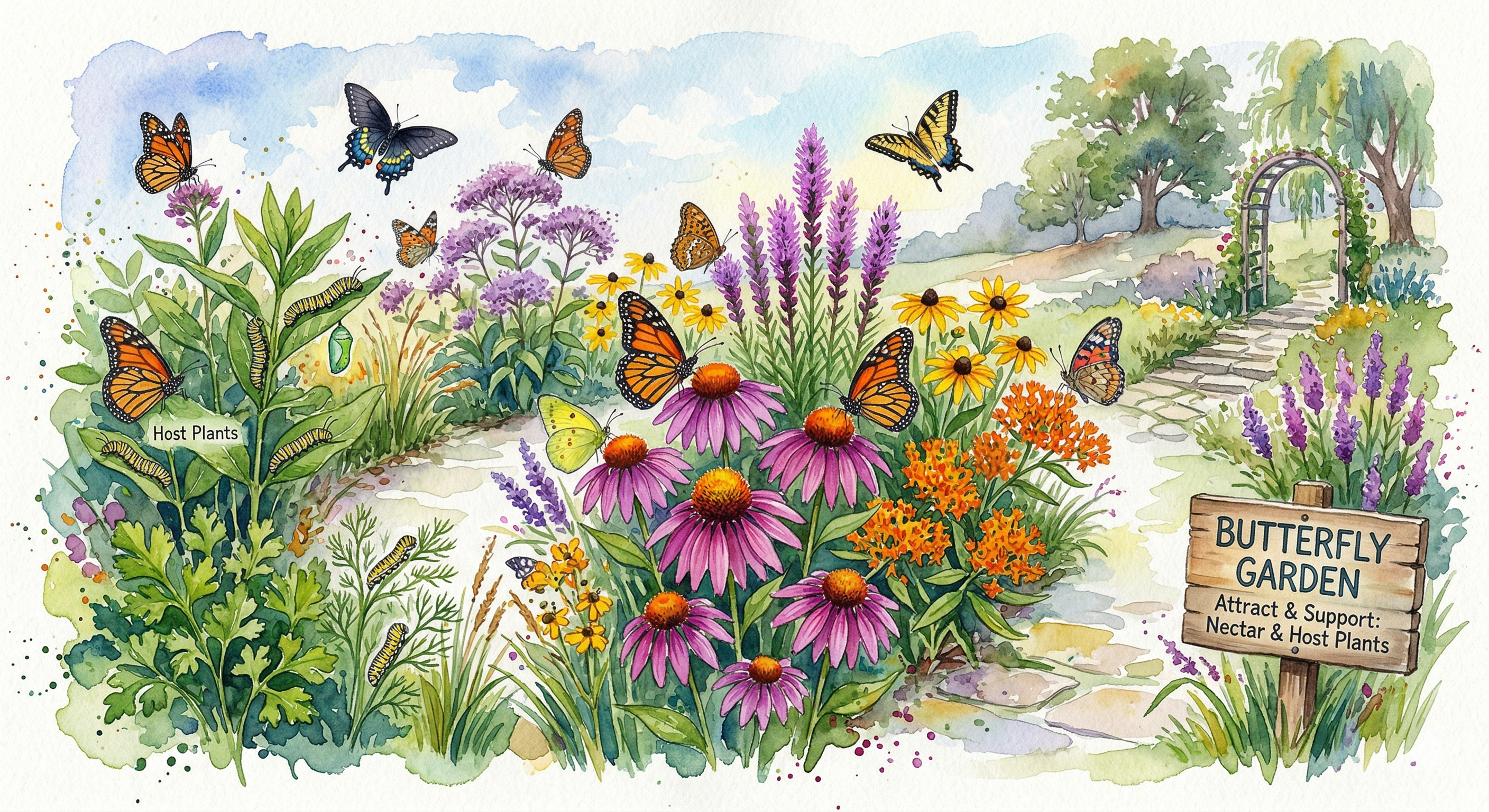
Butterfly Garden
Attract and Support Butterflies with the Right Host and Nectar Plants
Most butterfly gardens are nectar gardens in disguise — they attract visiting adults but cannot support butterfly populations because they are missing the element butterflies need most: host plants where females lay eggs and caterpillars feed. A garden that includes both nectar plants and host plants becomes a butterfly nursery. This guide is built around that distinction, covering the 30 most common garden butterfly species, the host plants that support complete life cycles, nectar plant sequences from spring through fall migration, habitat design, monarch conservation, and regional planting guides.
Overview: What a Complete Butterfly Garden Provides
Every butterfly species is entirely dependent on specific host plants to complete its life cycle. The monarch butterfly can only lay eggs on milkweed (Asclepias spp.). The black swallowtail lays only on members of the carrot family. The spicebush swallowtail requires spicebush (Lindera benzoin) or sassafras. The zebra longwing depends on native passionflower vines. Without these host plants, butterflies visit to feed and then leave — they cannot breed there.
A garden that includes both nectar plants (to feed adults) and host plants (to support the complete life cycle) does something qualitatively different from a nectar-only garden: it becomes a butterfly nursery. The caterpillars that appear on host plants are not a problem to be managed; they are the next generation of butterflies. American butterfly diversity spans 750+ species. This guide focuses on those most commonly found in and around residential gardens across the continental United States, and the specific plants — both native and well-adapted non-native — that support them.
A note on native plants: butterflies have co-evolved with native plants over millions of years. Most butterfly host plant relationships are with specific native plant species or genera. A garden built primarily on native plants will support more butterfly species, more individual butterflies, and more complete life cycles than one built on ornamental non-natives of equivalent beauty.
The Butterfly Life Cycle: What Each Stage Needs from Your Garden
| Life Stage | Duration | What It Needs from Your Garden | How to Support It |
|---|---|---|---|
| Egg | 3–10 days (temperature-dependent) | Host plants with appropriate foliage on which the female chooses to lay; specific plants for each species | Plant the correct host plant species for the butterflies in your region; learn what their eggs look like so you can recognize them |
| Larva (caterpillar) | 2–6 weeks; grows through 4–5 instars (molts) | Abundant host plant foliage to consume; protection from pesticides; managed balance with natural parasitoids | Never use pesticides (including Bt unless extremely targeted) on or near host plants; allow caterpillars to consume foliage without intervention; plant enough host plant that caterpillar feeding does not destroy the entire planting |
| Pupa (chrysalis) | 1–2 weeks (summer); longer for overwintering species | A place to attach and pupate safely; often on nearby structures, stems, or leaf litter rather than on the host plant itself | Leave plant stems, fence posts, and twigs undisturbed; do not disturb leaf litter where some species overwinter as pupae |
| Adult (butterfly) | 1–2 weeks for most species; 8–9 months for overwintering adults like monarchs and mourning cloaks | Nectar sources; puddling areas (moisture and minerals); basking sites (warm, flat surfaces in sun); shelter from wind and rain | Diverse nectar flowers throughout the season; a shallow puddling area; flat stones for basking; wind shelter from hedgerows or structures |
Butterfly Diversity: The United States hosts 750+ butterfly species across every habitat from arctic tundra to tropical rainforest. Even a modest garden with host plants and pesticide-free management can support 15–25 species across a full season in most regions.
Section 1: Butterfly Profiles — 30 Key Garden Species
The 30 species below represent the butterflies most frequently encountered in residential gardens across the continental United States. Each profile covers wingspan, regional range, host plants (what caterpillars eat), nectar preferences (what adults drink), and a field mark — the single most distinctive visual feature for identification. Species are grouped by family and behavior, since butterflies within the same group often share host plant requirements and garden design needs.
Swallowtails (Family Papilionidae)
Swallowtails are among the largest and most conspicuous North American butterflies. Most produce two to three broods per season in the South and one to two in the North. Their caterpillars are often as distinctive as the adults — many are camouflaged to resemble bird droppings in early instars, then turning green with eye spots in later instars.
| Species | Wingspan | Range | Host Plants | Top Nectar Plants | Field Mark |
|---|---|---|---|---|---|
| Eastern Tiger Swallowtail (Papilio glaucus) | 3.5–5.5" | East of the Rockies; absent from far North and South Texas | Tulip poplar, wild black cherry, sweetbay magnolia, white ash, basswood | Joe Pye weed, ironweed, butterfly bush, phlox, coneflower, milkweed | Yellow ground color with black tiger stripes; females may be dark form (all-black with blue hindwing wash) |
| Western Tiger Swallowtail (Papilio rutulus) | 2.75–4" | West of the Rockies; mountains and riparian corridors | Cottonwood, willow, alder, ash, wild plum, sycamore | Thistle, teasel, penstemons, ceanothus, milkweed | Similar to Eastern Tiger but smaller; lacks orange-red marginal spots on forewing underside |
| Black Swallowtail (Papilio polyxenes) | 3.25–4.25" | Coast-to-coast; absent from Pacific NW mountains | Queen Anne's lace, parsley, dill, fennel, carrots, golden alexanders (Zizia) | Milkweed, red clover, thistles, phlox, coneflower | Black with two rows of yellow spots; males have wider yellow band across wings; iridescent blue on hindwing (larger in females) |
| Giant Swallowtail (Papilio cresphontes) | 4–6" | East of Rockies, extending through Southwest; rare in North | Prickly ash (Zanthoxylum), citrus (Rutaceae family), gas plant (Dictamnus) | Azalea, milkweed, bougainvillea, bouncing bet, goldenrod | Largest butterfly in North America; dark brown-black with two crossing bands of yellow spots; yellow underside |
| Spicebush Swallowtail (Papilio troilus) | 3.5–4.5" | East of the Rockies, south of Canada | Spicebush (Lindera benzoin), sassafras (Sassafras albidum), sweetbay magnolia | Jewelweed, Joe Pye weed, azalea, milkweed, honeysuckle | Black with pale green-blue iridescent wash on hindwing; two rows of orange spots on hindwing underside |
| Pipevine Swallowtail (Battus philenor) | 2.75–4" | Much of the US; uncommon in the upper Midwest | Pipevine (Aristolochia spp.) — the sole host plant genus | Thistles, azalea, ironweed, milkweed, dame's rocket | Brilliant iridescent blue-green on hindwing upperside; underwing has single row of large orange spots on black ground |
Swallowtail gardening tip: Plant parsley, dill, and fennel together in a cluster to support Black Swallowtails — caterpillars will consume an entire plant, so having multiple in close proximity ensures enough foliage for a full brood. Spicebush is a superior native shrub for mid-Atlantic and southeastern gardens; it supports Spicebush Swallowtail exclusively, tolerates shade, has fragrant spring flowers, and produces bird-attracting red berries in fall.
Monarchs and Milkweed Butterflies (Family Nymphalidae — Subfamily Danainae)
| Species | Wingspan | Range | Host Plants | Top Nectar Plants | Field Mark |
|---|---|---|---|---|---|
| Monarch (Danaus plexippus) | 3.5–4" | Coast-to-coast during migration; breeding range across most of the US | Milkweed (Asclepias spp.) exclusively — all milkweed species are suitable | Milkweed, ironweed, goldenrod, asters, liatris, Mexican sunflower (Tithonia) | Brilliant orange with black veins and white-spotted black border; male has black scent patch on hindwing |
| Queen (Danaus gilippus) | 2.75–3.5" | South and Southwest; rare strays northward in fall | Milkweed (Asclepias spp.); also Cynanchum and Funastrum milkweed relatives | Shepherd's needle, goldenrod, ironweed, wild lantana | Dark mahogany-brown (not orange) with white-spotted black border; black veins less prominent than monarch; no orange on hindwing |
Tropical milkweed (Asclepias curassavica) in frost-free climates: In USDA Zones 9–11 where tropical milkweed does not die back in winter, it can disrupt monarch migration and concentrate a protozoan parasite (Ophryocystis elektroscirrha). In those zones, cut tropical milkweed back to the ground in November–December to force a die-back period, or replace it with native milkweed species appropriate for your region.
Brush-Footed Butterflies — Fritillaries and Checkerspots (Family Nymphalidae)
| Species | Wingspan | Range | Host Plants | Top Nectar Plants | Field Mark |
|---|---|---|---|---|---|
| Great Spangled Fritillary (Speyeria cybele) | 2.5–3.5" | Most of northern and central US; absent from Deep South and arid Southwest | Native violets (Viola spp.) exclusively | Milkweed, thistles, bergamot, purple coneflower, ironweed, Joe Pye weed | Tawny orange above with black pattern; hindwing underside has wide buff-yellow band and large silver spots |
| Gulf Fritillary (Agraulis vanillae) | 2.5–3.75" | South and Southwest; summer emigrant northward to Great Plains | Native passionflower (Passiflora incarnata) and other Passiflora species | Lantana, pentas, impatiens, verbena, tithonia | Bright orange above with black marks; hindwing underside has elongated silver spots on brown; not a true fritillary despite the name |
| Variegated Fritillary (Euptoieta claudia) | 1.75–2.25" | Much of the US; resident in South, summer emigrant in North | Passionflower, violets, stonecrop, plantain, purslane, flax | Verbena, milkweed, dogbane, clovers, peppermint | Smaller than Great Spangled; orange with complex dark pattern; underside mottled brown/orange without silver spots |
| Baltimore Checkerspot (Euphydryas phaeton) | 1.75–2.5" | Northeast and upper Midwest; localized populations | White turtlehead (Chelone glabra) primarily; also plantain, ash in some populations | Wild rose, milkweed, dogbane, viburnum | Dramatic orange, white, and black checkerboard pattern; state butterfly of Maryland; closely tied to wet meadow habitats with turtlehead |
Brush-Footed Butterflies — Admirals, Anglewings, and Tortoiseshells (Family Nymphalidae)
| Species | Wingspan | Range | Host Plants | Top Nectar Plants | Field Mark |
|---|---|---|---|---|---|
| Red Admiral (Vanessa atalanta) | 1.75–2.5" | Coast-to-coast; year-round in South, migratory in North | Nettles (Urtica dioica and relatives) exclusively | Milkweed, asters, goldenrod, rotting fruit, sap flows, bird droppings | Black wings with broad red-orange band across forewing; white spots near forewing tip; underside is intricately patterned in blue, brown, and red |
| Painted Lady (Vanessa cardui) | 2–2.5" | Most widespread butterfly in the world; found across all of the continental US | Thistles, mallows, hollyhock, sunflowers, legumes — one of the broadest host plant ranges of any butterfly | Thistles, asters, coneflower, goldenrod, milkweed | Orange with black and white pattern; four small eye spots on hindwing underside; easily confused with West Coast Lady (V. annabella) in the West |
| American Lady (Vanessa virginiensis) | 1.75–2.25" | Coast-to-coast; more resident in South | Pearly everlasting (Anaphalis), pussytoes (Antennaria), cudweed (Gnaphalium) | Milkweed, dogbane, asters, marigold, goldenrod | Distinguishable from Painted Lady by two large eye spots on hindwing underside (vs. four small ones in Painted Lady) |
| Red-Spotted Purple (Limenitis arthemis) | 3–3.5" | Eastern US and upper Midwest | Wild black cherry, aspen, poplar, willows, oaks | Sap flows, rotting fruit, dung, carrion; rarely visits flowers but will take dogbane and milkweed | Iridescent blue-black above with red-orange spots on hindwing margin and near wingtip; Pipevine Swallowtail mimic |
| Viceroy (Limenitis archippus) | 2.5–3.25" | East of the Rockies | Willows (Salix) primarily; also cottonwood, aspen, poplar, apple | Goldenrod, asters, thistles, milkweed, Joe Pye weed, teasel | Monarch mimic — orange with black veins; distinguishable by postmedian black line crossing hindwing veins (absent in Monarch) and smaller size |
| Eastern Comma (Polygonia comma) | 1.75–2.5" | Eastern US and lower Canada | Nettles, hops, elms, false nettles | Rotting fruit, sap flows, mudpuddles, goldenrod, asters | Ragged-edged orange-brown wings with dark spots; hindwing underside bark-like brown with a small silver comma-shaped spot |
| Question Mark (Polygonia interrogationis) | 2–2.75" | Eastern US and lower Canada | Elms, nettles, hackberry, hops | Rotting fruit, sap flows, goldenrod, asters, milkweed | Similar to Eastern Comma but larger; silver mark on hindwing underside is curved with a dot (question mark vs. simple comma) |
| Mourning Cloak (Nymphalis antiopa) | 3–4" | One of widest ranges in North America — coast-to-coast | Willows, cottonwood, aspen, elms, hackberry, birch | Tree sap, rotting fruit, mudpuddles; rarely visits flowers | Dark maroon-brown with ragged edges; bright yellow border with row of blue spots; among earliest butterflies to fly in spring — overwinters as an adult |
Wood Nymphs, Satyrs, and Hackberry Emperors (Family Nymphalidae — Satyrinae / Apaturinae)
| Species | Wingspan | Range | Host Plants | Top Nectar Plants | Field Mark |
|---|---|---|---|---|---|
| Common Wood Nymph (Cercyonis pegala) | 1.75–2.75" | Nearly all of the continental US except the arid Southwest | Grasses — primarily purpletop (Tridens flavus), poverty grass, bluestems | Thistle, bergamot, milkweed; also sap flows and rotting fruit | Brown with two yellow-rimmed eye spots on forewing; variable yellow patch around eye spots from North to South |
| Hackberry Emperor (Asterocampa celtis) | 1.5–2.5" | Most of the eastern and central US | Hackberry (Celtis) species only | Rotting fruit, tree sap, mud, animal dung; rarely at flowers | Tawny-brown with dark forewing tip marked by white spots; forewing eye spot without a pupil (distinguishes from Tawny Emperor) |
Whites and Sulphurs (Family Pieridae)
| Species | Wingspan | Range | Host Plants | Top Nectar Plants | Field Mark |
|---|---|---|---|---|---|
| Cabbage White (Pieris rapae) | 1.25–1.75" | Ubiquitous across all of the continental US; non-native species introduced from Europe | Mustard family (Brassicaceae) — kale, cabbage, broccoli, ornamental mustards, alyssum, nasturtium | Mustards, dandelion, clover, mints, asters | White with black forewing tip; male has one black spot on forewing, female has two; most commonly seen white butterfly in gardens |
| Clouded Sulphur (Colias philodice) | 1.25–2" | Coast-to-coast except far South | Clovers (Trifolium), alfalfa (Medicago), vetches (Vicia) | Milkweed, asters, goldenrod, clovers, dandelion | Yellow above with solid black forewing border; hindwing has orange-centered silver spot; female may be white (alba form) |
| Cloudless Sulphur (Phoebis sennae) | 2.25–3" | South and Southeast as resident; fall emigrant throughout eastern US | Sennas (Cassia and Senna spp.) — candlestick, partridge pea | Bougainvillea, cardinal flower, impatiens, morning glory, lantana | Large bright yellow butterfly; male unmarked canary-yellow; female yellow or white with irregular dark forewing border and spot |
| Orange Sulphur (Colias eurytheme) | 1.25–2.25" | Coast-to-coast; especially common in agricultural areas | Alfalfa, clovers, vetches, sweet clover | Milkweed, asters, goldenrod, alfalfa, clovers | Orange above with black border; hybridizes freely with Clouded Sulphur producing intermediates; underside of hindwing has two silver spots |
Blues, Hairstreaks, and Coppers (Family Lycaenidae)
| Species | Wingspan | Range | Host Plants | Top Nectar Plants | Field Mark |
|---|---|---|---|---|---|
| Eastern Tailed-Blue (Cupido comyntas) | 0.75–1" | East of the Rockies; scattered western populations | Clovers, vetches, tick-trefoils, wild peas (Fabaceae) | White clover, wild strawberry, asters, fleabane | Tiny; male iridescent blue above; female gray-brown; hindwing has one or two small orange spots and a tiny tail |
| Gray Hairstreak (Strymon melinus) | 1–1.25" | Most common hairstreak in North America; coast-to-coast | An exceptionally broad host plant list: mallow, clover, beans, corn, oaks, hops, strawberry — over 90 species recorded | Milkweed, dogbane, goldenrod, white sweet clover, mint | Gray above and below; orange-capped black spot and hindwing tail; underside has postmedian white line with orange and black near tail |
| American Copper (Lycaena phlaeas) | 0.875–1.25" | Northern US and montane West; often local and colonial | Sheep sorrel (Rumex acetosella), common sorrel, mountain sorrel | Yarrow, white clover, butterfly weed, goldenrod, ox-eye daisy | Brilliant orange forewing with dark spots and gray margin; hindwing gray-brown with orange submarginal band |
| Banded Hairstreak (Satyrium calanus) | 1–1.25" | Eastern US and lower Canada | Oaks (Quercus), hickories (Carya), black walnut — overwinters as egg on host plant bark | Milkweed, sumac, dogbane, New Jersey tea | Brown-gray above; underside has staggered dark bars with white edges (not aligned in straight line); blue patch near tail with orange cap |
Skippers (Family Hesperiidae)
Skippers are often dismissed as "dull brown" but are important pollinators and easy to attract with the right host plants. Their caterpillars typically fold or roll leaves of grass hosts to create shelters. Most skippers are fast-flying and perch in a characteristic triangular "jet plane" posture with forewings angled separately from hindwings.
| Species | Wingspan | Range | Host Plants | Top Nectar Plants | Field Mark |
|---|---|---|---|---|---|
| Silver-Spotted Skipper (Epargyreus clarus) | 1.75–2.5" | Coast-to-coast; most common large skipper in North America | Black locust, honey locust, wisteria, groundnut (Apios), false indigo (Amorpha) | Milkweed, clovers, vetch, blazing star, thistles, lantana | Dark brown with gold spots on forewing; large distinctive silver patch on hindwing underside; unmistakable |
| Fiery Skipper (Hylephila phileus) | 1–1.375" | South as resident; summer emigrant northward | Bermuda grass, crabgrass, Kentucky bluegrass, St. Augustine grass | Lantana, verbena, zinnia, ageratum, coneflower | Bright orange male above with irregular dark border and spots; female dark brown with orange spots; both sexes have small dark spots on hindwing underside |
| Sachem (Atalopedes campestris) | 1.125–1.375" | South and Southwest as resident; major summer emigrant throughout eastern US | Bermuda grass, crabgrass, St. Augustine grass | Lantana, alfalfa, asters, red clover, thistles | Male orange with square dark stigma patch; female dark brown with pale translucent spots on forewing; one of the most common lawn-grass skippers |
ID resource: The North American Butterfly Association (naba.org) and iNaturalist both maintain searchable, photo-verified species databases organized by state. Photograph butterflies from above and from the underside of the wings — underside markings are often more diagnostic than the upperside. Free apps including iNaturalist and Seek use AI recognition to identify most species from photos.
Section 2: Host Plants — The Foundation of a Butterfly Nursery
Host plants are the single most important element missing from most butterfly gardens. Without them, butterflies may visit but cannot breed. Female butterflies locate host plants primarily through chemical receptors on their feet — they literally taste plants by standing on them. Each species has evolved to recognize specific plant compounds and will only lay eggs on species containing those compounds. The table below covers the most impactful host plants by the number and diversity of butterfly species they support, with garden integration notes for each.
| Host Plant | Plant Type | Zones | Butterfly Species Supported | Garden Notes |
|---|---|---|---|---|
| Milkweed (Asclepias spp.) — native species by region | Perennial forb | 3–11 (species-dependent) | Monarch (primary), Queen, Soldier; adult nectar source for 100+ species | Use native milkweed species matched to your region: A. tuberosa (butterfly weed, Zones 3–9), A. incarnata (swamp milkweed, Zones 3–6), A. syriaca (common milkweed, Zones 3–8), A. speciosa (showy milkweed, Zones 3–9 West). Plant in groups of 3+ for colony impact. Allow caterpillar feeding — a stripped plant will regrow. |
| Native violets (Viola sororia, V. canadensis, V. pedata, and related species) | Perennial groundcover | 3–9 | Great Spangled Fritillary, Aphrodite Fritillary, Diana Fritillary, Variegated Fritillary, Meadow Fritillary — all obligate violet feeders | The most undervalued butterfly host plant in American gardens. Viola sororia (common blue violet) is extremely tough and spreads freely under deciduous trees where little else grows. It is the sole host plant for all large fritillaries in the East. Allow it to naturalize in partly shaded areas rather than pulling it as a weed. |
| Spicebush (Lindera benzoin) | Native shrub | 4–9 | Spicebush Swallowtail (primary); also supports Promethea Silkmoth | Dioecious — plant both male and female for berry production. Tolerates part to full shade; excellent understory shrub under oaks and maples. Fragrant yellow flowers in early spring before leaves emerge. Female butterflies return to the same shrubs repeatedly to lay eggs — single large spicebush is more productive than multiple small ones. |
| Wild black cherry (Prunus serotina) | Native tree | 3–9 | Eastern Tiger Swallowtail, Red-Spotted Purple, Coral Hairstreak, Striped Hairstreak, Spring Azure, Viceroy (on some Prunus spp.) | One of the most ecologically valuable native trees in eastern North America — supports 450+ Lepidoptera species total. Fast-growing; can reach 60–80 feet but is easily limbed up for garden use. Birds eat the fall fruits. Cyanogenic compounds in the foliage are what makes it attractive to specialized swallowtails. |
| Willows (Salix spp.) — native or hybrid species | Tree or large shrub | 2–9 | Mourning Cloak, Viceroy, Red-Spotted Purple, Western Tiger Swallowtail, Dreamy Duskywing, numerous moths | Native shrub willows (pussy willow S. discolor, sandbar willow S. interior, peach-leaf willow S. amygdaloides) are far better for gardens than weeping willow, which is non-native. Willows fix nitrogen via root associations and are among the earliest pollen sources for native bees. Plant in rain gardens or low wet areas where drainage is slow. |
| Native oaks (Quercus spp.) | Native tree | 3–10 (species-dependent) | Horace's Duskywing, Juvenal's Duskywing, Banded Hairstreak, White M Hairstreak, Edwards' Hairstreak, Striped Hairstreak; also supports 500+ Lepidoptera species total | No single plant genus supports more butterfly and moth species than oaks. Even a single medium-sized oak becomes a habitat hub. For butterfly host use specifically, hairstreaks lay overwintering eggs directly on oak bark. Caterpillar oak feeding is a critical food source for nesting birds — do not treat oaks with systemic insecticides. |
| Pipevine / Dutchman's Pipe (Aristolochia macrophylla or A. tomentosa) | Native woody vine | 5–8 | Pipevine Swallowtail (sole host plant genus) | The Pipevine Swallowtail is entirely dependent on this one plant genus. Plant native species (A. macrophylla or A. tomentosa for the East, A. californica for California). Aristolochia contains aristolochic acids that make Pipevine Swallowtail caterpillars and adults toxic to predators — the species is mimicked by Spicebush Swallowtail, Red-Spotted Purple, and Diana Fritillary. A single large vine can support dozens of caterpillars. |
| Passionflower (Passiflora incarnata) | Native perennial vine | 5–9 | Gulf Fritillary (primary), Variegated Fritillary, Zebra Longwing (in frost-free areas) | Maypop passionflower is native to the eastern and central US and dies to the ground in winter but is reliably perennial in Zones 5–9. Spreads aggressively by runners — best grown on a trellis in a contained bed. Produces ornate purple-white flowers followed by edible yellow fruit. A passionflower vine is the single most impactful host plant for fritillaries in the South. |
| Parsley, dill, and fennel (Petroselinum, Anethum, Foeniculum) | Annual and perennial herbs | Annual (parsley, dill); perennial in Zones 6–10 (fennel) | Black Swallowtail (primary); also Anise Swallowtail in the West | The easiest and most popular butterfly host plants for kitchen gardeners. Plant in clusters — one or two plants will be stripped by a single brood. Let fennel go to flower for adult nectar. Golden alexanders (Zizia aurea), a native carrot-family alternative, blooms in spring when cultivated herbs are just starting and supports the same butterfly species with no maintenance. |
| Hackberry (Celtis occidentalis and C. laevigata) | Native tree | 3–9 | Hackberry Emperor, Tawny Emperor, American Snout, Question Mark, Eastern Comma | Common hackberry is a tough, drought-tolerant native tree that grows on disturbed sites, roadsides, and urban areas where other trees struggle. It is the exclusive host plant for the Hackberry Emperor and Tawny Emperor. Birds eat the abundant small fruits. Sugarberry (C. laevigata) serves the same role in the Southeast. |
| Native thistles (Cirsium discolor, C. horridulum, C. undulatum) | Native biennial / short-lived perennial | 3–9 | Painted Lady (native thistles preferred over exotic species), Mylitta Crescent in West; major adult nectar source for monarchs, swallowtails, and skippers | Native thistles are dramatically different from invasive Canada thistle and bull thistle — they grow as single-stemmed biennials that self-seed in place without spreading aggressively. They are among the top nectar sources for butterflies, native bees, and hummingbirds and serve as larval hosts for Painted Lady. Allow two to three native thistles to complete their biennial cycle and set seed in a meadow or garden edge. |
| Stinging nettle (Urtica dioica) | Native perennial forb | 3–10 | Red Admiral, Eastern Comma, Question Mark, Satyr Comma, Milbert's Tortoiseshell | Nettles are despised as weeds but are irreplaceable host plants for several common garden butterflies. Grow a patch of 3–6 square feet in a back corner, contained by a mowing edge or raised bed frame. Wear gloves when handling — sting disappears within 30 minutes. Young leaves are edible (sting destroyed by cooking or drying); nettle tea is a traditional garden fertilizer. |
| Lupine (Lupinus perennis — wild blue lupine) | Native perennial forb | 3–8 | Frosted Elfin, Wild Indigo Duskywing, Persius Duskywing, Silvery Blue | Wild blue lupine is the sole host plant for the Frosted Elfin, a Species of Conservation Concern in much of its range. A dry, well-drained sandy or loamy site in full sun is essential — lupine will not persist in clay or wet soil. Direct-seeded lupine takes 2–3 years to establish; once established, plants are long-lived and self-seed modestly. |
| White turtlehead (Chelone glabra) | Native perennial forb | 3–8 | Baltimore Checkerspot (primary host) | The Baltimore Checkerspot is a wetland and wet meadow specialist tied almost entirely to white turtlehead. Plant in consistently moist to wet soil in part shade — it thrives at pond edges, in rain gardens, and along streams. Hummingbirds also visit the white to pale pink tubular flowers in late summer. If turtlehead is unavailable, some Baltimore Checkerspot populations accept white ash or plantain as alternative hosts. |
| Golden alexanders (Zizia aurea) | Native perennial forb | 3–8 | Black Swallowtail; also a major early-season nectar source for native bees | Golden alexanders is the native carrot-family plant that supports Black Swallowtail caterpillars before cultivated dill and parsley are large enough to use. It blooms in spring (April–June) at a time when few other nectar plants are available. Tolerates part shade and moist to average soils. Elegant and low-maintenance — ideal for rain gardens and woodland edges. |
| Native grasses — little bluestem, purpletop, panic grasses (Schizachyrium, Tridens, Panicum) | Native perennial grasses | 3–9 | Common Wood Nymph, Little Wood Satyr, Appalachian Brown, Eufala Skipper, Crossline Skipper, Sachem, and dozens of grass skippers | Grass-feeding butterfly larvae are among the most overlooked beneficiaries of ornamental grass plantings. Little bluestem (Schizachyrium scoparium) is the single most ecologically productive native grass for butterfly and moth larvae in the eastern US. Leave grass clumps standing through winter — many skipper larvae overwinter in the base of grass tufts. A meadow or prairie edge planting with diverse native grasses can support 15–20 skipper species. |
Host plant planting density matters. A single parsley plant will be stripped by one brood of Black Swallowtail caterpillars in a week. A single milkweed stem may support only one monarch larva to pupation. Plan for several plants of each host species — a cluster of 5–7 milkweed plants, a 6-foot patch of nettles, a row of 4–6 parsley/dill/fennel plants. The goal is enough plant material that caterpillar feeding doesn't eliminate the host plant entirely before larvae complete development.
Never use systemic insecticides (neonicotinoids — imidacloprid, clothianidin, thiamethoxam, dinotefuran) on host plants or within 50 feet of them. Systemic insecticides are taken up by the plant's vascular system and expressed in all plant tissues, including the foliage that caterpillars eat. Plants labeled "protected" at the nursery have almost always been treated with neonicotinoids and should not be used as host plants. Grow your own host plants from seed or untreated transplants, or source from specialty native plant nurseries that confirm no systemic pesticide use.
Section 3: Nectar Plants — Fueling Adults from Spring Through Fall Migration
Adult butterflies feed primarily on flower nectar, though some species also take minerals from mud puddles, tree sap, rotting fruit, or animal waste. Nectar plants are the visible, attractive element of the butterfly garden — they draw adults in from surrounding areas and provide the fuel for reproduction, territorial behavior, and long-distance migration. The most productive butterfly gardens provide nectar continuously from early spring through late fall, with peak bloom timed to coincide with peak butterfly flight periods in the region.
Butterfly nectar preferences favor flat or gently curved flower heads (composites, umbels, clusters) where multiple individual florets allow prolonged feeding without the butterfly having to reposition constantly. Deep tubular flowers preferred by hummingbirds are generally less useful for butterflies. Flower color preferences vary by species but red, orange, yellow, purple, and pink tones predominate — butterflies can also see ultraviolet nectar guides invisible to humans.
Spring Nectar Plants (March–May)
| Plant | Type | Zones | Key Butterflies | Notes |
|---|---|---|---|---|
| Golden alexanders (Zizia aurea) | Native perennial | 3–8 | Black Swallowtail, Spring Azure, early skippers, native bees | Blooms April–June, well before most nectar plants are available. Tolerates part shade and moist soils. Also a host plant for Black Swallowtail — doubles as host and nectar. |
| Wild columbine (Aquilegia canadensis) | Native perennial | 3–8 | Eastern Tiger Swallowtail, Spring Azure; hummingbirds compete with butterflies for nectar | Blooms April–June in woodland edges and rocky outcrops. Self-seeds freely in appropriate habitat. Hybridizes readily — use straight species for maximum native value. |
| Pussy willow and native shrub willows (Salix discolor, S. interior) | Native shrub | 2–7 | Mourning Cloak, Eastern Comma, Question Mark; overwintered adults emerge and feed on willow pollen and early sap | Catkins provide pollen (not nectar per se) but are critical for overwintered adult butterflies in March–April when no other food exists. Early-emerging Mourning Cloaks and anglewings rely almost entirely on willows, maples, and tree sap at this time of year. |
| Native violets (Viola spp.) | Native perennial groundcover | 3–9 | Spring Azure (early nectar), Variegated Fritillary; primarily a host plant for large fritillaries | Small but abundant flowers provide nectar for early small butterflies. More valuable as host plants than nectar plants but the combination is useful. |
| Lilac (Syringa vulgaris) | Non-native shrub | 3–7 | Eastern Tiger Swallowtail, Spicebush Swallowtail, Black Swallowtail, Spring Azure | One of the best spring nectar plants for large swallowtails despite being non-native. Native lilac alternative: wild blue indigo (Baptisia australis) or redbud (Cercis canadensis), which blooms in April and is an excellent early swallowtail nectar source. |
| Eastern redbud (Cercis canadensis) | Native tree | 4–9 | Eastern Tiger Swallowtail, Zebra Swallowtail, Henry's Elfin, Spring Azure | One of the most valuable spring butterfly nectar trees in the East. Blooms in April before leaves emerge. Henry's Elfin butterfly is closely associated with redbud as both a nectar source and occasional partial host. |
Summer Nectar Plants (June–August)
| Plant | Type | Zones | Key Butterflies | Notes |
|---|---|---|---|---|
| Milkweed (Asclepias tuberosa, A. incarnata, A. syriaca) | Native perennial | 3–9 | Monarch (host + nectar), Swallowtails, Fritillaries, Skippers, Great Spangled Fritillary, Red Admiral | Among the highest-value nectar plants in existence during June–August. Butterfly weed (A. tuberosa) blooms orange in June–August. Swamp milkweed (A. incarnata) blooms pink in July–September. Both are heavily used by 100+ species of butterflies, bees, and beneficial insects. |
| Coneflowers (Echinacea purpurea and E. pallida) | Native perennial | 3–9 | Tiger Swallowtail, Black Swallowtail, Spicebush Swallowtail, Fritillaries, Painted Lady, Red Admiral, American Lady, Monarchs, Skippers | One of the most reliable and broadly attractive butterfly nectar plants available. Blooms June–September. Deadheading extends bloom; leaving seed heads intact feeds goldfinches and other birds through winter. Grow in full sun and well-drained soil; tolerates drought once established. |
| Native bee balm (Monarda fistulosa — wild bergamot; M. didyma — scarlet bee balm) | Native perennial | 3–9 | Tiger Swallowtails, Spicebush Swallowtail, Hummingbird Clearwing Moth, Great Spangled Fritillary, skippers | Wild bergamot (M. fistulosa) blooms lavender-pink and is more drought-tolerant than scarlet bee balm. Both are outstanding summer butterfly nectar plants. Allow to spread into naturalized clumps rather than constraining to single specimens. Deadhead after first flush to encourage rebloom. |
| Black-eyed Susan (Rudbeckia hirta and R. fulgida) | Native annual/perennial | 3–9 | Fritillaries, Skippers, Eastern Tailed-Blue, Bordered Patch, Silvery Checkerspot, Monarchs | Long bloom period (June–October) and prolific flowering make Rudbeckia one of the workhorses of the butterfly meadow. Grows from seed quickly; self-seeds in most garden conditions. Goldsturm rudbeckia (R. fulgida var. sullivantii) is more reliably perennial and compact. |
| Native phlox (Phlox paniculata — garden phlox; P. maculata — meadow phlox) | Native perennial | 4–8 | Tiger Swallowtails, Spicebush Swallowtail, Monarchs, Sphinx moths (evening) | Garden phlox has a long proboscis-accessible flower tube that favors swallowtails and hummingbird moths over shorter-tongued insects. Blooms July–September. Powdery mildew is common — grow in good air circulation or choose resistant cultivars (David, Robert Poore, Jeana). Phlox glaberata and P. pilosa are shorter native alternatives for naturalized areas. |
| Ironweed (Vernonia fasciculata and V. noveboracensis) | Native perennial | 4–9 | Monarchs, Tiger Swallowtail, Spicebush Swallowtail, Black Swallowtail, Fritillaries, Skippers | Deep purple flowers on 4–6-foot plants in August–September — one of the finest monarch nectar plants available. Bold, structural plant suited to meadow gardens, rain gardens, and naturalized borders. Cut back by half in late spring to control height in formal borders. |
| Joe Pye weed (Eutrochium purpureum, E. maculatum) | Native perennial | 4–9 | Tiger Swallowtail, Spicebush Swallowtail, Pipevine Swallowtail, Monarchs, Great Spangled Fritillary, Silver-Spotted Skipper | Mauve-purple flower clusters on 5–7-foot plants in July–September attract large swallowtails reliably. Dwarf cultivars (Baby Joe, Little Joe) reach 3–4 feet and work in smaller gardens. Prefers moist soils; excellent in rain gardens. |
| Anise hyssop (Agastache foeniculum) | Native perennial | 4–9 | Painted Lady, Red Admiral, Skippers, American Lady, Pearl Crescent, Gray Hairstreak | Lavender-blue flower spikes bloom July–September and attract dozens of butterfly species. Self-seeds freely and can naturalize in a garden edge. Drought-tolerant once established; full sun to light shade. Several cultivars available (Blue Fortune, Black Adder) but the species is more prolific for wildlife. |
| Mountain mint (Pycnanthemum virginianum and related species) | Native perennial | 4–8 | Attracts virtually every butterfly species present in the region — one of the highest-diversity nectar plants known | Consistently ranked as the single most butterfly-diverse nectar plant in the mid-Atlantic and northeastern states. Small white flowers in July–September, individually modest but collectively producing exceptional amounts of nectar. Spreads by runners; best contained in a dedicated area or large container. Grows in average to moist soil in full sun to light shade. |
| Butterfly bush (Buddleia davidii) | Non-native shrub | 5–9 | Large swallowtails, Monarchs, Fritillaries, Painted Lady, Skippers — adult nectar only | Butterfly bush is a high-volume adult nectar source but provides no host plant value and can be invasive in moist disturbed areas in the Pacific Northwest, Mid-Atlantic, and Southeast. Sterile cultivars (Flutterby Grande, Lo & Behold series) eliminate seed spread. Use as a supplement to, not a replacement for, native nectar plants. Combining butterfly bush with native host plants produces better outcomes than either alone. |
Fall Nectar Plants (September–Frost) — Critical for Monarch Migration
| Plant | Type | Zones | Key Butterflies | Notes |
|---|---|---|---|---|
| Native asters (Symphyotrichum oblongifolium, S. novae-angliae, S. laeve, and others) | Native perennial | 3–9 | Monarchs (critical fall migration fuel), Painted Lady, Red Admiral, Clouded Sulphur, Common Buckeye, Skippers | Native asters are the single most important fall butterfly nectar source in North America. New England aster (S. novae-angliae) blooms purple from September to hard frost and is consistently the top monarch fueling plant on fall migration routes. Aromatic aster (S. oblongifolium) is smaller, drought-tolerant, and survives in poor soils. Sky blue aster (S. oolentangiense) and smooth blue aster (S. laeve) are excellent alternatives. Plant three or more aster species for extended fall bloom. |
| Goldenrod (Solidago rugosa, S. nemoralis, S. odora, S. speciosa, and others) | Native perennial | 3–9 | Monarchs, Gray Hairstreak, Eastern Tailed-Blue, Skippers, American Snout | Native goldenrods are among the most important fall butterfly nectar sources and a critical pollen source for native bees building winter reserves. Does not cause hay fever (wind-pollinated ragweed blooms simultaneously — goldenrod is the wrongly accused plant). Rough-stemmed goldenrod (S. rugosa Fireworks) and gray goldenrod (S. nemoralis) are well-behaved garden cultivars; wild goldenrod spreads aggressively by runners in rich soil but is fine in meadow settings. |
| Ironweed (Vernonia spp.) — continued from summer | Native perennial | 4–9 | Monarchs, Swallowtails | Late-blooming Vernonia noveboracensis continues into October in warmer regions. One of the finest monarch migration fueling plants available. |
| Late boneset (Eupatorium serotinum) and tall boneset (E. altissimum) | Native perennial | 4–9 | Monarchs, Swallowtails, Skippers, Checkered Skipper, Sachem | Blooms September–October — later than common boneset. White flowers are less showy than asters and goldenrod but equally productive for nectar. Tolerates part shade and moist soils; naturally colonizes roadsides and woodland edges. |
| Marigolds (Tagetes patula and T. erecta) | Annual | All zones (annual) | Painted Lady, Sulphurs, Gulf Fritillary, Skippers | French and African marigolds are among the most productive annual butterfly nectar plants, blooming from summer through hard frost. Plant in large drifts rather than single plants. Open-faced French marigolds are more accessible to butterflies than tightly doubled forms. Best used as fillers to extend the season alongside perennial native plantings. |
| Zinnias (Zinnia elegans) | Annual | All zones (annual) | Painted Lady, Monarchs, Swallowtails, Gulf Fritillary, Skippers, Sulphurs | One of the most visited butterfly annual nectar plants. Open single and semi-double forms (Cut and Come Again, Benary's Giant, State Fair mix) are more accessible than fully double pompon types. Bloom from midsummer through frost — most productive in the heat of August–September. Extremely easy from direct seed. |
| Lantana (Lantana camara) | Annual in northern zones; tender perennial in Zones 9–11 | Annual north of Zone 9 | Monarchs, Gulf Fritillary, Painted Lady, Swallowtails, Sulphurs | Exceptional butterfly nectar plant in heat. Flowers continuously from late spring through frost. Invasive in frost-free regions (Florida, Hawaii, California coastal) — do not plant where it can naturalize. Use sterile cultivars where available. In colder zones it is killed by frost and presents no invasive risk. |
The single most impactful change most gardeners can make to increase butterfly diversity is to add late-blooming native asters and goldenrods. Most butterfly gardens peak in midsummer and then go largely dormant in fall — precisely when monarch migration peaks and when dozens of resident butterfly species are building fat reserves for overwintering or final reproduction. A 10-foot patch of New England aster (Symphyotrichum novae-angliae) blooming in September and October will attract more butterfly species on more individual days than an equivalent area of summer annuals.
Many nectar plants sold at big-box garden centers have been treated with systemic neonicotinoid insecticides that persist in plant tissues for months to years. Butterflies feeding on treated flowers can receive sub-lethal doses that impair navigation, reproduction, and immune function. When purchasing nectar plants, ask the nursery specifically whether systemic pesticides have been used. Look for the "Bee Better" or "Pesticide-Free" certification or purchase from native plant specialists who grow without systemic treatments.
Section 4: Garden Design — Sun, Shelter, Water, and Layout
Butterfly garden design is fundamentally about creating conditions that match butterfly biology. Butterflies are ectothermic (cold-blooded) — they regulate body temperature by moving between sun and shade and by basking with wings spread to absorb heat. They require warmth to fly, to find mates, to locate host plants, and to feed. A butterfly garden that is shaded for more than half the day will attract far fewer butterflies than one in full sun, regardless of how many nectar plants it contains.
Sun and Microclimate
- •Full sun (6+ hours of direct sun) is the baseline requirement. South- and west-facing sites are most productive. East-facing sites work in warm climates; north-facing sites are generally unsuitable.
- •Wind shelter dramatically increases butterfly activity. A windbreak of shrubs, a fence, a hedge, or a garden wall on the north and west sides of the planting creates a warm, protected microclimate that butterflies preferentially use. Even a 20% reduction in wind speed meaningfully extends the daily window of butterfly activity.
- •Basking stones and bare soil patches — flat rocks, pavers, compacted sandy areas — absorb heat and provide surfaces where butterflies warm up in the morning and thermoregulate through the day. Position at least one large flat stone in the sunniest part of the garden, angled slightly toward the south.
- •Dark-colored surfaces heat up fastest. A dark flagstone or exposed dark soil patch at the garden center is consistently visited by basking butterflies, especially in the morning and on cool days.
- •Warm air pockets form at the base of south-facing walls and garden structures. Placing low-growing nectar plants (low phlox, sweet alyssum, low asters) against a south-facing wall capitalizes on these microclimates.
Water and Mud Puddling
Butterflies do not drink from open water the way birds do. Instead, many species — particularly swallowtails, sulphurs, skippers, and blues — engage in "puddling," gathering at damp soil, mud, or sand to extract dissolved minerals, amino acids, and sodium that are scarce in flower nectar. Puddling is most commonly observed in males, who pass minerals to females during mating — the nutrient transfer enhances egg fertility and caterpillar survival.
- •Create a puddling station by filling a shallow dish, clay saucer, or buried basin to the rim with coarse sand, then keeping it consistently moist with a slow drip or manual watering every few days.
- •Add a small amount of aged compost, wood ash, or a pinch of sea salt to the puddling sand — minerals and sodium significantly increase attractiveness.
- •Position the puddling station in full sun on the ground, not elevated on a stand. Butterflies puddle at ground level and are reluctant to use elevated water features designed for birds.
- •A slight depression in compacted soil that retains water after rain is a natural puddling site — observe these in your garden and enhance rather than drain them.
- •Do not add fresh manure, which may contain pathogens; use composted manure if adding organic matter to the puddling mix.
- •In arid climates, a reliable artificial puddling station may be the only mineral source for miles. Swallowtails and sulphurs in desert gardens readily adopt well-maintained puddling stations.
A mud puddle outperforms a bird bath for butterfly gardening purposes. If you have only one water feature to install, make it a ground-level sand-and-mud puddling station in full sun rather than an elevated water dish. Swallowtail clusters of 10–20 individuals are regularly observed at established puddling sites — nothing else produces the same congregation effect.
Layout and Planting Design Principles
| Design Principle | Why It Matters | How to Apply |
|---|---|---|
| Plant in drifts, not isolated specimens | Butterflies detect nectar sources from a distance. Large masses of color and scent are detected more readily than single plants. A group of 7 coneflowers produces more butterfly visits than 7 individual coneflowers scattered through the border. | Plant nectar plants in groups of 5–9 minimum. Repeat groups of the same species throughout the garden to create visual rhythm and multiple nectar stations. In small gardens, 3 plants of a kind is the minimum useful unit. |
| Layer heights for multiple species | Different butterfly species fly and feed at different heights. Ground-skimming skippers, mid-level fritillaries, and canopy-visiting swallowtails all need plants at their preferred flight height. | Design with a low layer (6–18 inches: low asters, creeping thyme, sweet alyssum, phlox subulata), mid layer (2–4 feet: coneflowers, black-eyed Susans, bee balm, mountain mint), and tall layer (4–7 feet: ironweed, Joe Pye weed, tall goldenrod, swamp milkweed). Include at least one shrub layer (spicebush, buttonbush, native viburnums). |
| Integrate host plants into the design | Host plants placed at the garden edge or hidden in utility areas are less likely to be used than those integrated into the main planting where female butterflies already congregate to nectar. | Site milkweed within or directly adjacent to the main nectar planting — female monarchs nectar and search for host plants in the same area. Plant spicebush at the garden perimeter where it can grow to a natural size. Allow violets to naturalize under deciduous shrubs. Integrate parsley and dill into herb and vegetable gardens visible from the butterfly garden. |
| Provide edge habitat | Butterflies are most abundant at the interface between open and woody habitat — garden edges, woodland margins, brushy fence lines. Edge structure provides both sunlit nectar habitat and sheltered areas for perching, roosting, and overwintering. | Create a rough edge between the sunny butterfly garden and any adjacent shrub or tree plantings. A brushy hedgerow of native shrubs (buttonbush, native viburnums, elderberry, dogwood) along one side of the butterfly garden substantially increases species diversity beyond what sun-only plantings produce. |
| Leave the leaf litter | Multiple butterfly species overwinter as adults, pupae, or eggs in leaf litter, hollow stems, and rough ground. Pristine fall and spring cleanup destroys the overwintering generation. | Leave perennial stalks standing through winter and cut them back in late March or April rather than fall. Do not blow or bag fallen leaves from garden beds — shred lightly in place or pile at the garden edge. The Mourning Cloak, Eastern Comma, and Question Mark overwinter as adults in leaf piles and loose bark; giant swallowtail pupae overwinter attached to woody stems. |
| Avoid straight-line formal layouts | Butterfly garden layouts with irregular edges, curved beds, and varied plant masses better mimic the natural habitats butterflies evolved in and are more productive than formal geometric arrangements of the same plants. | Use flowing curves for bed edges. Allow plants to grow and self-seed naturally rather than constraining them to exact grid positions. Intentional "messiness" — volunteer plants, naturalized colonies, rough edges — is biologically productive and is increasingly recognized as a design aesthetic in its own right. |
Overwintering Habitat
Butterflies overwinter in four different life stages depending on the species. Understanding which stage is used by the butterflies in your garden determines what habitat elements to maintain through winter.
| Overwintering Stage | Species Examples | Habitat Required | Garden Action |
|---|---|---|---|
| Adult (sheltered dormancy) | Mourning Cloak, Eastern Comma, Question Mark, Gray Comma, Satyr Comma | Loose bark, hollow logs, dense brush piles, spaces under leaf litter | Leave brush piles at the garden edge; do not remove dead bark from logs and stumps; avoid tidying hedgerows in fall |
| Pupa (chrysalis) | Giant Swallowtail, Black Swallowtail, Pipevine Swallowtail, Spicebush Swallowtail | Attached to woody stems, fence posts, rough bark — chrysalises are camouflaged and look like dried leaves or bark chips | Leave woody perennial stems and shrub branches uncut through winter; do not pressure-wash fences or structures in spring before April 15 |
| Larva (caterpillar) | Various hairstreaks, elfins, and some skippers overwinter as small early-instar larvae | Concealed in tight crevices, rolled leaves, or at the base of host plants | Leave leaf litter on soil surface under host plants; do not cultivate soil aggressively in early spring around host plant bases |
| Egg | Some hairstreaks, Gray Hairstreak, Juniper Hairstreak | Eggs are laid directly on host plant twigs and bark and remain there through winter | Do not prune host plants aggressively in late fall or early spring; if pruning is necessary, inspect cut material for tiny spherical eggs before composting |
The "leave the leaves" movement in garden design is directly aligned with butterfly conservation. A fall cleanup standard of "leave everything standing until daytime temperatures are consistently above 50°F in spring" protects overwintering butterflies across all four life stages. Spring cleanup done in late March to mid-April — after overwintering adults have emerged and before egg-laying begins in earnest — strikes the best balance between garden tidiness and wildlife habitat.
Section 5: Monarch Conservation — Migration, Milkweed, and the Waystation Network
The monarch butterfly (Danaus plexippus) undertakes the most remarkable insect migration in North America — a multi-generational round trip of up to 3,000 miles between overwintering sites in the oyamel fir forests of central Mexico (eastern population) or the California coast (western population) and summer breeding habitat across the United States and Canada. The eastern monarch population has declined by more than 80% since the 1990s. Habitat loss along the migration corridor — particularly the loss of milkweed from Midwestern agricultural landscapes and the loss of fall nectar plants — is the primary driver. Home gardens have become a meaningful part of the conservation response.
The Migration Cycle
| Generation | Timing | Range | What They Need |
|---|---|---|---|
| Overwintering adults — "Methuselah generation" | October–March | Oyamel fir forests in Michoacán, Mexico (eastern population); eucalyptus and Monterey pine groves on the California coast (western population) | Intact forest cover at overwintering sites; mild, humid conditions to prevent desiccation; these butterflies do not breed during winter — they enter reproductive diapause |
| First spring generation | March–May | Texas, Oklahoma, Kansas, northern Mexico — the re-colonization front moves northward following milkweed emergence | Early milkweed availability in Texas and the southern Great Plains is critical — the spring generation breeds on the first milkweed flush as monarchs move north; fall nectar plants from the previous season's seed bank in Texas provide fueling for northbound adults |
| Second and third generations | May–August | Breeding range expands north and east across the Midwest, Northeast, and into southern Canada; population builds through 3–4 summer generations | Abundant milkweed throughout the breeding range — particularly common milkweed (A. syriaca) in the Midwest; summer nectar plants to fuel reproduction; host plant availability for 3–4 successive broods |
| Migratory generation | August–October | Southward migration from breeding range to overwintering sites; major corridor through Great Plains, then Texas funnel, into Mexico | Fall nectar plants along the migration corridor — native asters, goldenrods, ironweed, and boneset in the northern range; maximilian sunflower and native composites in Texas and Oklahoma; adult monarchs must build fat reserves sufficient for the entire 2,000–3,000 mile journey to Mexico |
Milkweed Selection by Region
Not all milkweed is equal for monarch conservation. The most important rule is to plant milkweed species native to your region — monarchs have evolved to complete their breeding cycle on the milkweed species naturally present along their migration and breeding routes. Tropical milkweed (Asclepias curassavica), a popular nursery plant native to Central America, presents specific risks in warm climates that gardeners should understand.
| Region | Recommended Native Milkweed Species | Bloom Period | Notes |
|---|---|---|---|
| Midwest and Great Plains (Zones 3–6) | Common milkweed (A. syriaca), butterfly weed (A. tuberosa), swamp milkweed (A. incarnata), purple milkweed (A. purpurascens) | June–August | Common milkweed is the backbone of monarch breeding in the Midwest. It spreads by runners and forms colonies — ideal in naturalized areas, meadows, and open lawn areas. Swamp milkweed is more garden-friendly and tolerates moist soils. Allow common milkweed colonies to grow where possible rather than removing them as weeds. |
| Northeast and Mid-Atlantic (Zones 4–7) | Swamp milkweed (A. incarnata), butterfly weed (A. tuberosa), common milkweed (A. syriaca), poke milkweed (A. exaltata) | June–September | Swamp milkweed is the most reliable garden species in this region — tolerates a wide range of moisture conditions, grows to 3–4 feet, and produces abundant pink flower clusters. Poke milkweed is a woodland-edge species tolerant of part shade. |
| Southeast (Zones 6–9) | Butterfly weed (A. tuberosa), swamp milkweed (A. incarnata), aquatic milkweed (A. perennis), white milkweed (A. variegata), longleaf milkweed (A. longifolia) | May–September | Multiple species are native to the Southeast. Aquatic milkweed is important for moist and wet areas. Avoid tropical milkweed (A. curassavica) in the Southeast — in the Gulf Coast and Florida, it does not die back in winter, allowing the protozoan parasite OE (Ophryocystis elektroscirrha) to persist year-round on the plant and infect successive monarch generations. |
| Texas and Southern Plains (Zones 6–9) | Green antelope horn (A. viridis), spider milkweed (A. asperula), butterfly weed (A. tuberosa), zizotes milkweed (A. oenotheroides) | March–October (multiple flushes) | Texas is the bottleneck of monarch migration in both spring and fall — it is arguably the single most important state for monarch conservation. Green antelope horn is the primary spring breeding milkweed; zizotes milkweed is highly drought-tolerant. Native milkweed in Texas blooms in response to fall rains and provides a critical late-season resource for the migratory generation. |
| Mountain West and Intermountain (Zones 4–7) | Showy milkweed (A. speciosa), narrowleaf milkweed (A. fascicularis), butterfly weed (A. tuberosa) | June–August | Showy milkweed is the dominant native species across the interior West — large, fragrant pink-white flowers; spreads by runners in the manner of common milkweed. Narrowleaf milkweed is slender and drought-tolerant, found along roadsides and dry slopes. |
| Pacific Coast and California (Zones 8–11) | Narrowleaf milkweed (A. fascicularis), showy milkweed (A. speciosa), woollypod milkweed (A. eriocarpa), California milkweed (A. californica) | April–August | The western monarch population overwinters along the California coast and breeds primarily in California and the Pacific Northwest. Narrowleaf milkweed (A. fascicularis) is the key breeding milkweed. Do not plant tropical milkweed in California coastal areas, where it remains evergreen and supports OE parasite persistence. Cut back any tropical milkweed to the ground in November to force dormancy if removing it entirely is not possible. |
Tropical milkweed (Asclepias curassavica) sold widely at garden centers poses a conservation risk in frost-free and mild-winter regions (Zones 8–11, Gulf Coast, California). In climates where it does not freeze to the ground, tropical milkweed remains green year-round and accumulates the protozoan parasite OE (Ophryocystis elektroscirrha) on its leaves. Monarchs laying eggs on OE-contaminated foliage produce heavily parasitized offspring with reduced survival, weight, and flight ability. In the northern US (Zones 3–7), tropical milkweed freezes to the ground each winter and breaks the OE cycle — it is lower-risk in these regions but native species are still preferred. If you have tropical milkweed in a warm climate, cut it to the ground each November to force winter dormancy.
Monarch Waystation Certification
Monarch Watch, a nonprofit research and education program at the University of Kansas, operates the Monarch Waystation Program — a registry of gardens, schoolyards, and public spaces that provide monarch habitat. Certification requires a minimum of two native milkweed species, nectar plants that bloom in spring, summer, and fall, and a commitment to pesticide-free or minimal-pesticide gardening in the milkweed and nectar planting area.
- •Registration is available at monarchwatch.org/waystations/ for a modest fee that includes a metal waystation sign, habitat certificate, and registry listing.
- •Certified waystations are mapped in a publicly accessible database — your garden becomes part of a documented continental network.
- •Monarch Watch also operates the Milkweed Market program, selling plugs of regionally appropriate native milkweed species at cost to gardeners, schools, and restoration projects in the monarch breeding range.
- •The Monarch Waystation program is particularly well-suited for schoolyards, community gardens, roadsides, and institutional properties where the educational and visibility value of the signage and certification adds meaning beyond the habitat itself.
Monarch Tagging
Monarch Watch's tagging program allows citizen scientists to apply small adhesive tags to wild monarchs during the fall migration, contributing to population research that tracks survival rates, migration timing, and route shifts over time. Tagged monarchs recovered at overwintering sites in Mexico are reported back to the tagger, creating a direct personal connection between a garden in Kansas and a butterfly cluster on an oyamel fir tree in Michoacán.
- •Tagging kits (tags, instructions, catch net guidance) are available from Monarch Watch each August in time for the fall migration season.
- •Tags are applied to the discal cell of the hindwing using a gentle hand-catch method — no special equipment required beyond patience and a soft net.
- •Peak tagging window is late August through mid-October depending on region; the migration front moves south roughly 25 miles per day during favorable weather.
- •Journey North (journeynorth.org) tracks monarch migration sightings in both spring and fall — submitting observations to their database contributes to the continental migration map regardless of whether you tag butterflies.
- •The Xerces Society's Western Monarch Thanksgiving Count conducts annual overwintering population surveys at California sites each November — volunteers are recruited each fall at xerces.org.
The recovery rate for tagged monarchs at Mexican overwintering sites is roughly 1 in 1,000 tags — but the cumulative data from tens of thousands of tagged butterflies over 30 years has produced the most detailed picture of monarch migration routes, timing, and survival rates available to science. A recovered tag from your garden is among the rarest and most satisfying outcomes a butterfly gardener can experience.
Section 6: Regional Butterfly Garden Guides
Butterfly diversity and abundance vary enormously across North America — shaped by climate, native plant communities, migration routes, and the degree of habitat intact in the surrounding landscape. A garden in the lower Rio Grande Valley of Texas may host 300+ species; a well-planted garden in suburban Minnesota may attract 40–60. Understanding your region's characteristic butterfly community — which species are resident, which are migrants, which are rare strays — helps set realistic expectations and lets you prioritize the host and nectar plants that will make the greatest difference in your specific location.
| Region | Climate & Context | Signature Species | Key Host Plants | Key Nectar Plants | Garden Notes |
|---|---|---|---|---|---|
| Northeast & New England (Zones 4–7) | Four distinct seasons; cold winters limit resident species but spring and summer migration brings reinforcements from the south. Heavily forested landscape means open sunny gardens stand out as oases. | Monarch (migrant), Eastern tiger swallowtail, Spicebush swallowtail, Black swallowtail, Cabbage white, Clouded sulphur, American lady, Painted lady, Pearl crescent, Red admiral, Eastern comma, Question mark, Mourning cloak, Viceroy, Great spangled fritillary | Common milkweed (A. syriaca), swamp milkweed (A. incarnata), spicebush (Lindera benzoin), wild senna (Senna hebecarpa), native violets (Viola spp.), native clovers, wild lupine (Lupinus perennis) for Karner blue, host oaks for hairstreaks | Native asters (Symphyotrichum spp.), goldenrods (Solidago spp.), Joe Pye weed (Eutrochium purpureum), ironweed (Vernonia noveboracensis), bergamot (Monarda fistulosa), native coneflowers (Echinacea purpurea), buttonbush (Cephalanthus occidentalis) | Full sun is critical — many NE gardens have too much shade from mature trees. Edge habitat where lawn meets woods is highly productive. Fall migration (late August–October) produces peak monarch and fritillary activity; plant substantial goldenrod and aster masses to fuel southbound migrants. |
| Mid-Atlantic (Zones 6–7) | Transitional climate supports both northern and southern species; the Appalachian ridge systems concentrate migrating monarchs in fall. Suburban matrix is dominant landscape — garden quality matters enormously. | Eastern tiger swallowtail, Spicebush swallowtail, Black swallowtail, Zebra swallowtail (coastal plain), Pipevine swallowtail (south of DC), Monarch (migrant), Great spangled fritillary, Variegated fritillary, Pearl crescent, Eastern comma, Question mark, Red-spotted purple, Hackberry emperor, American snout (irruption years) | Spicebush (Lindera benzoin), pawpaw (Asimina triloba) for zebra swallowtail, pipevine (Aristolochia macrophylla) for pipevine swallowtail, wild senna (Senna hebecarpa), native violets, hackberry (Celtis occidentalis), host oaks | Native asters, goldenrods, ironweed, Joe Pye weed, milkweeds, swamp milkweed, blazing star (Liatris spicata), native thistles (Cirsium discolor), mountain mint (Pycnanthemum spp.) | Pawpaw patches in part shade support zebra swallowtails, uncommon in gardens. Pipevine swallowtail populations are patchy — where present, Aristolochia is highly productive. Mountain mint is exceptional for small native bees and butterflies alike. |
| Southeast & Gulf Coast (Zones 7–10) | Long warm season, mild winters, and high plant diversity produce the richest butterfly fauna east of the Rockies outside South Florida/Texas. Gulf fritillary, cloudless sulphur, and sleepy orange are iconic year-round or near-year-round residents. Tropical species reach their northern range limits here. | Gulf fritillary, Zebra longwing (Florida), Monarch (migrant and partial resident), Eastern tiger swallowtail, Palamedes swallowtail (coastal SE), Pipevine swallowtail, Spicebush swallowtail, Cloudless sulphur, Sleepy orange, Gray hairstreak, Pearl crescent, Viceroy, Red admiral, Question mark, Hackberry emperor, American snout | Passionvine (Passiflora incarnata) for gulf fritillary and zebra longwing, native milkweeds (A. tuberosa, A. incarnata, A. perennis — NOT A. curassavica in frost-free areas), pipevine (Aristolochia tomentosa), redbud (Cercis canadensis), spicebush, senna species, native violets, hackberry | Pentas (in warm climates), native asters, goldenrods, ironweed, swamp milkweed, Stokes' aster (Stokesia laevis), blazing star, coral honeysuckle (Lonicera sempervirens), native thistles, buttonbush | Passionvine (maypop) is the must-plant for the Southeast — gulf fritillary and zebra longwing depend on it completely and will find it quickly. Allow it to sprawl on a fence or trellis. Avoid tropical milkweed; use native milkweeds and cut A. curassavica to the ground each November if present. Zebra longwings roost communally at night — a stable passionvine provides year-round habitat in frost-free FL. |
| Midwest & Great Plains (Zones 4–7) | The agricultural Midwest was historically the core of the monarch breeding range — the loss of common milkweed from row crop fields has made gardens and roadsides critical refuges. Tallgrass prairie remnants and restorations support extraordinary butterfly diversity. | Monarch (breeding and migrant — highest priority), Eastern tiger swallowtail, Black swallowtail, Giant swallowtail (southern Midwest), Cabbage white, Clouded sulphur, Orange sulphur, Gray hairstreak, Pearl crescent, Great spangled fritillary, Regal fritillary (tallgrass remnants), Monarch, Viceroy, Red admiral, Painted lady | Common milkweed (A. syriaca) — allow colonies in naturalized areas, swamp milkweed (A. incarnata), butterfly weed (A. tuberosa), wild senna (Senna hebecarpa), dill/fennel/parsley for black swallowtail, native violets, native clovers, prairie blazing star (Liatris pycnostachya) | Native asters (Symphyotrichum oblongifolium, S. novae-angliae), goldenrods (Solidago speciosa, S. rigida), prairie blazing star (Liatris pycnostachya), ironweed (Vernonia fasciculata), wild bergamot (Monarda fistulosa), rattlesnake master (Eryngium yuccifolium), compass plant (Silphium laciniatum) | The Midwest is where individual gardens have the greatest conservation leverage for monarchs — milkweed planted here directly supports the breeding generation that produces the migratory butterflies. Allow common milkweed colonies to establish wherever possible. Prairie plant mixes (available from regional native plant nurseries) produce the most species-rich butterfly gardens in this region. |
| Texas & Southern Plains (Zones 6–10) | Texas is the single most butterfly-diverse state in the US, with 450+ species recorded. The lower Rio Grande Valley (LRGV) is the most species-rich butterfly location north of Mexico. The state is the migration funnel for monarchs in both spring and fall. | Monarch (migration bottleneck — both spring and fall), Giant swallowtail, Black swallowtail, Pipevine swallowtail, Cloudless sulphur, Gulf fritillary, Bordered patch, Texan crescent, Queen, Soldier, Red admiral, American snout (irruption years), Hackberry emperor, Goatweed leafwing, Tropical leafwing (LRGV), plus hundreds of additional species in the LRGV | Native milkweeds (A. viridis, A. asperula, A. oenotheroides, A. tuberosa), pipevine (Aristolochia erecta for pipevine swallowtail), passionvine (Passiflora incarnata), native senna species, hackberry (Celtis laevigata), hops (Humulus lupulus), native violets, turk's cap (Malvaviscus arboreus) | Gregg's mistflower (Conoclinium greggii) — arguably the single best fall butterfly nectar plant in Texas; frostweed (Verbesina virginica), native asters, fall-blooming goldenrods, maximilian sunflower (Helianthus maximiliani), zexmenia (Wedelia texana), flame acanthus (Anisacanthus quadrifidus) | Gregg's mistflower (blue mistflower) blooms September–November and is unmatched for fall migration fueling in Texas — monarchs, queens, and dozens of other species swarm it. Plant maximilian sunflower in large masses for both fall nectar and habitat structure. Texas gardeners in the LRGV should research tropical species with specific host plant requirements — many are available from NABA's International Butterfly Park in Mission, TX. |
| Rocky Mountains & Intermountain West (Zones 4–8) | High-elevation gardens have shorter seasons but concentrated butterfly activity during the summer bloom peak. Alpine and subalpine meadows above treeline support specialist species. The transition from mountains to high desert creates steep diversity gradients. | Western tiger swallowtail, Two-tailed swallowtail (lower elevations), Anise swallowtail, Pale swallowtail, Cabbage white, Western sulphur, Clouded sulphur, Painted lady, West Coast lady, American lady, Variegated fritillary, Aphrodite fritillary, Weidemeyer's admiral, Lorquin's admiral (Pacific slope), Monarch (migration through eastern foothills) | Showy milkweed (A. speciosa), narrowleaf milkweed (A. fascicularis), native willows (Salix spp.), aspens and cottonwoods (Populus spp.), native violets, lupines (Lupinus spp.), native thistles (Cirsium spp.) | Rocky Mountain penstemon (Penstemon strictus), native asters, goldenrods, blanketflower (Gaillardia aristata), native coneflowers, yarrow (Achillea millefolium), native thistles, hyssop (Agastache spp.), rabbitbrush (Ericameria nauseosa) — exceptional fall nectar | Rabbitbrush blooming in late summer and fall is exceptional for monarchs and other migrants passing through the eastern slopes of the Rockies — plant it in masses. Shorter growing seasons mean planting high-quality nectar sources with a long bloom window is more important than species diversity. At elevations above 7,000 feet, focus on alpine-adapted natives. |
| Pacific Northwest (Zones 7–9) | Mild, wet winters and dry summers create a distinctive butterfly season concentrated in spring and early summer. The Willamette Valley and lowland areas support the highest diversity; western mountains have alpine specialists. Western monarchs migrate to the coast. | Western tiger swallowtail, Anise swallowtail, Pale swallowtail, Cabbage white, Sara's orangetip (spring), Clodius parnassian (mountains), Painted lady, West Coast lady, Lorquin's admiral, Western white admiral, Satyr comma, Hoary comma, Margined white, Western sulphur, Monarch (western population migrant) | Narrowleaf milkweed (A. fascicularis), showy milkweed (A. speciosa), native willows, Oregon white oak (Quercus garryana) for hairstreaks, lupines (Lupinus spp.), bleeding heart (Dicentra formosa) for clodius parnassian, native violets, nettles (Urtica dioica) for anglewings | Native asters, goldenrods, native thistles, yarrow, penstemon species, Douglas spiraea (Spiraea douglasii), Oregon grape (Mahonia aquifolium), native clovers, phacelia (Phacelia tanacetifolia), hyssop (Agastache urticifolia) | The dry summer of the Pacific Northwest means irrigation is necessary for late-season nectar plants. Native thistles (Cirsium edule, C. brevistylum) are exceptional for painted ladies, swallowtails, and bees — allow them to naturalize in wild areas. Spring ephemerals (bleeding heart, native violets) serve the early fliers like Sara's orangetip and parnassians. |
| California & Coastal West (Zones 8–11) | The most biologically diverse state in the contiguous US; the Central Valley, Coast Ranges, Sierra Nevada, and southern deserts each have distinct butterfly communities. Western monarch overwintering colonies along the coast are a conservation priority. Year-round gardening season allows continuous nectar. | Western tiger swallowtail, Anise swallowtail, Pipevine swallowtail, Pale swallowtail, Sara's orangetip (spring), Monarch (overwintering colonies on coast), Western sulphur, Cabbage white, Painted lady, West Coast lady, Gulf fritillary (Southern CA), Variable checkerspot, Lorquin's admiral, California sister, California hairstreak, Mormon metalmark (desert), Acmon blue | Narrowleaf milkweed (A. fascicularis), California milkweed (A. californica), pipevine (Aristolochia californica — endemic species critical for pipevine swallowtail), native willows, oaks (Quercus spp.) for hairstreaks and California sister, lupines (Lupinus spp.), native violets, deerweed (Acmispon glaber) | California native asters (Symphyotrichum chilense), goldenrods (Solidago californica, S. velutinoides), native clovers, gumplant (Grindelia stricta), coyote brush (Baccharis pilularis), buckwheats (Eriogonum spp.) for blues and hairstreaks, phacelia, hyssop, penstemon, salvia species | Aristolochia californica (California pipevine) is the obligate host plant for the California pipevine swallowtail — this native vine is available from California native plant nurseries and should be planted anywhere the species occurs. Buckwheats (Eriogonum spp.) are critical for the diverse hairstreak and blue community of California. Avoid tropical milkweed along the coast where monarch overwintering colonies occur — use narrowleaf or California milkweed only. |
| Desert Southwest (Zones 7–11) | The Sonoran and Chihuahuan deserts have distinct monsoon-season butterfly pulses — July–September brings an explosion of activity following summer rains. Winter-active species are possible in low desert. The borderlands of Arizona and New Mexico are among the most butterfly-rich areas in North America, with regular Mexican strays. | Giant swallowtail, Two-tailed swallowtail, Pipevine swallowtail, Cloudless sulphur, Sleepy orange, Queen, Soldier, Painted lady, West Coast lady, Gulf fritillary, Marine blue, Ceraunus blue, Reakirt's blue, Gray hairstreak, Bordered patch, Arizona sister, Palmer's metalmark, plus numerous Mexican strays in the borderlands | Desert milkweed (A. subulata), desert pipevine (Aristolochia watsonii), desert senna (Senna covesii), native acacias (Acacia spp.), velvet mesquite (Prosopis velutina), desert willow (Chilopsis linearis), Wright's bee bush (Aloysia wrightii), native violets, turk's cap (Malvaviscus drummondii) | Desert marigold (Baileya multiradiata), desert zinnia (Zinnia acerosa), desert milkweed, globe mallow (Sphaeralcea ambigua), desert lavender (Hyptis emoryi), brittlebush (Encelia farinosa), native salvias (Salvia species), desert willow (Chilopsis linearis), Gregg's mistflower (Conoclinium greggii — monsoon season) | Time your garden for the monsoon season (July–September) — this is when butterfly activity peaks in the Sonoran and Chihuahuan deserts. Desert milkweed (A. subulata) is a leafless succulent milkweed that persists year-round and is safe to use (no OE concern). The borderlands of SE Arizona are among the best butterfly watching locations on the continent — plant for both resident species and Mexican strays that cross regularly. |
Native Plant Nurseries and Regional Resources
Sourcing regionally appropriate native plants is the foundation of an effective butterfly garden — and it is easier than ever as the native plant movement has grown. Local ecotypes (plants grown from seed collected within your region) are best for both ecological function and plant hardiness, but any nursery-propagated (not wild-collected) native plant is a significant improvement over non-native alternatives.
- •The Xerces Society's "Bring Back the Pollinators" plant lists (xerces.org/bring-back-the-pollinators) include regionally specific native plant recommendations for every state.
- •The Lady Bird Johnson Wildflower Center's Native Plant Database (wildflower.org) allows you to search native plants by state, sun, soil, and wildlife value — one of the most comprehensive resources available.
- •Butterfly gardening societies in your region often maintain local plant lists and nursery directories: the North American Butterfly Association (naba.org), the Lepidopterists' Society, and state-specific butterfly societies (e.g., Butterfly Society of Virginia, Texas Butterfly Ranch) are good starting points.
- •NABA operates butterfly gardens and counts at sites nationwide — attending a local butterfly count (usually held in July) is an excellent way to learn your regional species firsthand and connect with local expertise.
- •Prairie Moon Nursery (Midwest), Ernst Conservation Seeds (Mid-Atlantic/Northeast), Izel Native Plants (national), and many regional native nurseries ship plugs and seed of native milkweeds, asters, goldenrods, and other key butterfly plants.
- •The Pollinator Partnership's "Ecoregional Planting Guides" (pollinator.org/guides) provide free downloadable plant lists organized by North American ecoregion — over 30 guides covering the continent.
iNaturalist (inaturalist.org) is the most powerful tool available for learning your local butterfly community. Search observations near your location, filtered to Lepidoptera, to see which species have been recorded in your county or zip code in the past year. This gives you a realistic target list — you can then research the host and nectar plants specific to those species rather than gardening for butterflies that don't occur in your area.
Section 7: Seasonal Calendar & Troubleshooting
A butterfly garden has a rhythm tied to the progression of flight seasons, host plant growth cycles, and the annual journey of migratory species. Managing your garden with that rhythm in mind — rather than treating it like a conventional ornamental border — produces dramatically better results. The calendar below uses Zone 6 as a reference point (last frost date approximately April 15, first fall frost approximately October 15); shift tasks 2–4 weeks earlier for Zones 7–9 and 2–4 weeks later for Zones 4–5.
| Season | Butterfly Activity | Garden Priority | Key Tasks | What to Avoid |
|---|---|---|---|---|
| Late Winter (Feb–Mar, Zone 6 reference) | Mourning cloaks and eastern commas emerge on warm days (50°F+) — among the first butterflies of the year; they overwinter as adults in bark crevices and log piles. Overwintering chrysalises of swallowtails and others are attached to stems and woody debris throughout the garden. | Resist the urge to "clean up" — overwintering adults, chrysalises, and pupae are present in leaf litter, hollow stems, and attached to plant debris. Early nectar sources for the first fliers are critical. | Leave all standing stems and leaf litter until nighttime temperatures are consistently above 50°F. Order seeds and native plant plugs from nurseries now — popular natives sell out by April. Start dill, fennel, and parsley indoors 6–8 weeks before last frost for black swallowtail host plants. Review and refresh any bare soil areas with new plantings planned for spring. | Do not cut back ornamental grasses, perennial stems, or conduct aggressive garden cleanup in late winter — overwintering chrysalises and adult butterflies are present and will be destroyed. Do not apply dormant oil sprays near shrubs where chrysalises may be attached. |
| Early Spring (Mar–Apr, Zone 6 reference) | Overwintering adults (mourning cloak, eastern comma, question mark) are active on warm days. First-generation spring azure, cabbage white, and falcate orangetip appear. Monarchs arrive in Texas and begin moving north following milkweed emergence. | Establish early-season nectar sources before most perennials bloom. Milkweed emergence monitoring is important — first-generation monarchs arriving in May need milkweed that is already growing. | Plant cold-tolerant nectar sources: native violets (also host plants), pussy willow (Salix discolor), redbud (Cercis canadensis), native serviceberry (Amelanchier spp.). Transplant overwintered dill and parsley seedlings outside after last frost. Set out milkweed plugs once soil temperature reaches 55°F. Add or refresh mud puddle areas — male swallowtails and sulphurs begin puddling early. | Avoid applying any herbicides near host plant areas in early spring — herbicide drift can affect host plants and caterpillars. Do not plant non-native ornamental plants in host plant areas where they will crowd out natives. |
| Late Spring (May–Jun, Zone 6 reference) | Peak swallowtail season in most of the eastern US — tiger, spicebush, black, and zebra swallowtails all flying. First monarch generation arrives and begins breeding. Fritillaries emerge. Sulphurs and whites are abundant. Caterpillar season begins in earnest on host plants. | Nectar continuity across the late-spring gap (after spring bulbs, before summer perennials) is a common problem — fill it with native clovers, native phlox, native columbine, and catmint. | Monitor host plants for caterpillars daily — document species and instar stages. Transplant dill, fennel, and parsley to the herb/host plant area. Direct-sow annual host plants (zinnias for painted ladies, native thistles). Begin staggered sowings of parsley and dill every 3 weeks to maintain continuous host plant availability through summer. Set up a butterfly journal or iNaturalist account to track first appearances. | Resist the urge to remove caterpillars from host plants — even large feeding damage is temporary and worth the outcome. Do not apply Bt (Bacillus thuringiensis) anywhere near host plants during caterpillar season — it kills all lepidopteran larvae, including your target species. |
| Early Summer (Jun–Jul, Zone 6 reference) | Peak butterfly diversity in most regions. Multiple broods of swallowtails, fritillaries, and sulphurs flying simultaneously. Monarchs in second generation breeding across the Midwest. Painted lady irruptions occur in some years. Hackberry emperors, red admirals, and skippers reach peak abundance. | Maintain nectar continuity through the midsummer gap — many spring perennials have finished; summer perennials must carry the load. Water management for nectar plants is critical during heat and drought. | Deadhead spent nectar plants to extend bloom; allow some to go to seed for fall (especially goldenrods and asters that bloom from old growth). Water nectar plants at the base during drought — stressed plants produce less nectar. Refresh mud puddle areas during dry spells. Begin fall planting planning — order native aster and goldenrod plugs for fall planting now while selection is best. | Do not apply systemic pesticides (neonicotinoids) to nectar plants during bloom — these persist in nectar and pollen and are acutely toxic to butterflies. Avoid overhead irrigation on hot sunny days, which can damage delicate butterfly wings. |
| Midsummer (Jul–Aug, Zone 6 reference) | The migratory generation of monarchs begins forming in late July in the northern breeding range — these are the butterflies that will fly to Mexico. Painted ladies, red admirals, and cloudless sulphurs begin moving. Host plant quality for caterpillars is critical — this generation must be large and fat-loaded enough to complete the 2,000-mile migration. | Fall migration fueling preparation is the single most important task of midsummer. The asters and goldenrods that are still buds now will be the critical nectar sources for monarchs and other migrants in 6–8 weeks. | Plant or transplant native asters and goldenrods now for fall bloom. Allow milkweed to grow vigorously — do not cut back in August (monarchs are still breeding). Set up a monarch tagging station if participating in Monarch Watch. Begin recording monarch caterpillar and adult counts for citizen science programs (MonarchWatch.org Journey North). Note which nectar plants have the highest butterfly traffic — priority species for expansion next year. | Do not cut back goldenrods or asters in late summer — they are building toward their fall bloom. Do not mow areas with late-summer milkweed. Avoid Bt applications during the migratory generation breeding period. |
| Late Summer & Fall (Aug–Oct, Zone 6 reference) | Peak migration season — monarchs, cloudless sulphurs, painted ladies, American ladies, and red admirals all moving south or to overwintering sites. Fall-flying species (eastern comma, question mark, mourning cloak) are preparing to overwinter as adults. This is the most visually spectacular time in a well-planted butterfly garden. | Fall nectar is the single highest-impact contribution a butterfly garden can make to migratory species. Mass plantings of native asters and goldenrods in full bloom are the priority. Monarch tagging peaks late August through mid-October. | Allow native asters and goldenrods to bloom fully — do not deadhead fall-blooming natives. Participate in monarch tagging (Monarch Watch kits available in August). Submit monarch migration observations to Journey North. Leave standing stems and seed heads after first frost — they become overwintering habitat. Begin planning any new host plant additions for next spring. | Do not conduct fall garden cleanup until spring — overwintering butterflies (adults, chrysalises, eggs) are present in standing stems, leaf litter, and bark crevices from October onward. Resist neighborhood pressure to "tidy up" in fall. |
| Winter (Nov–Jan, Zone 6 reference) | Most butterflies are in diapause — overwintering as eggs, larvae, pupae, or adults in sheltered sites throughout the garden. Mourning cloaks and anglewings may emerge on unusually warm days (55°F+) to bask. Western monarchs are clustered at California overwintering sites; eastern monarchs are in the oyamel forests of Michoacán. | Garden structure for overwintering habitat. Planning and ordering for the coming season. | Leave all garden structure intact through winter — no cleanup until spring. Order seeds (dill, fennel, parsley, native annuals) for spring sowing. Research any new host or nectar plants to add next season. Review your butterfly journal — which species appeared, which were missing, what host plants had the most caterpillar activity. Submit any late-season sightings to iNaturalist or eButterfly. | Do not apply dormant oils or horticultural sprays near areas where chrysalises may be attached to woody stems. Do not blow or burn leaf litter — it contains overwintering pupae and adult butterflies. |
The single most impactful change most butterfly gardeners can make is to delay fall cleanup until late March or April, when nighttime temperatures are consistently above 50°F. Caterpillars of many species overwinter as pupae attached to standing stems or buried in leaf litter directly under their host plants. A single overnight cleanup in October can eliminate an entire local population of a species that spent the summer breeding in your garden.
Troubleshooting Common Problems
| Problem | Likely Cause | Solution |
|---|---|---|
| Butterflies visit briefly but don't linger or return | Insufficient nectar plant mass — isolated individual plants rarely hold butterflies for long. Butterflies orient toward large blocks of color and high nectar density. | Plant nectar species in masses of 5–10+ plants rather than one of each. A 4-foot drift of native asters holds butterflies far longer than a single plant. Expand the overall size of your nectar planting — butterfly gardens reward scale. |
| No caterpillars on host plants despite adult butterflies present | Host plants are too young or too small to attract egg-laying females; plants may be isolated and hard to find; surrounding landscape may lack host plants for local breeding populations. | Larger, more established host plants attract more egg-laying — allow milkweed and other hosts to grow multiple seasons before expecting heavy use. Plant host plants in groups of 3+ rather than singles. Check plants daily in early morning when females are most active — eggs and young caterpillars are easy to miss. |
| Caterpillars disappear from host plants overnight | Predation by birds, wasps, spiders, or ground beetles — this is normal and expected. Parasitic wasps and flies also parasitize caterpillars; parasitized caterpillars may disappear or die before pupating. | Accept that most caterpillars will not survive to adulthood — a 1–2% survival rate from egg to adult is normal in nature. Plant enough host plant to sustain the losses. Do not attempt to exclude all predators — they are part of the ecosystem. |
| Monarch caterpillars or eggs present but no adults emerging | Parasitism by the tachinid fly Lespesia archippivora, which lays eggs on monarch caterpillars; OE (Ophryocystis elektroscirrha) protozoan infection; predation during the pupal stage. | OE infection is most common on tropical milkweed in warm climates — switch to native milkweeds. Tachinid fly parasitism is natural and not controllable without harming other beneficial insects. Maintain a diverse habitat with ample host plant so that overall production remains high despite individual losses. |
| Milkweed covered in orange aphids | Oleander aphids (Aphis nerii) — a non-native species that specializes on milkweed. They do not harm monarch eggs or small caterpillars directly, though large infestations can weaken plants. | Tolerate moderate aphid populations — they attract ladybugs, lacewings, and parasitic wasps that provide natural control. Knock off severe infestations with a strong water spray. Do not use insecticides on milkweed under any circumstances — they will kill monarch caterpillars. |
| Swallowtail caterpillars stripping parsley or dill plants bare | Black swallowtail caterpillars are voracious feeders — a single late-instar caterpillar can defoliate a parsley plant in 48 hours. | Plant more host material than you think you need — 6–10 parsley plants per expected caterpillar cohort is a reasonable rule. Succession-sow dill every 3 weeks through summer. Allow bronze fennel to self-sow freely as it is both ornamental and an inexhaustible host. Accept plant defoliation as the goal, not a failure. |
| Few or no butterflies despite good plant selection | Garden may be too isolated from source populations; surrounding landscape may be heavily pesticide-treated; garden may be too small or too shaded; wrong bloom timing relative to local flight seasons. | Check sun exposure — butterfly gardens need at minimum 6 hours of direct sun. Increase garden size — small isolated plots struggle in heavily degraded landscapes. Talk to neighbors about pesticide use. Connect your garden to adjacent habitat with a corridor of plantings if possible. Check iNaturalist for which species are present in your area and verify that your host plants match those species. |
| Garden attracts butterflies but no puddling behavior | Mud puddle area is too dry, too far from nectar source, or not accessible — males puddle most in warm morning hours when nectar sources are close by. | Place mud puddle within 20 feet of primary nectar area. Keep consistently moist but not flooded — refresh daily in hot weather. Add a pinch of salt or wood ash to provide minerals. Flat stones at the edge give butterflies a landing platform adjacent to wet mud. |
| Passionvine (Passiflora) being completely defoliated | Gulf fritillary and/or zebra longwing caterpillars — this is the intended outcome. These species depend entirely on passionvine and will consume it heavily when populations are high. | Plant multiple passionvine plants or allow the vine to grow large enough to sustain repeated defoliation — it recovers vigorously from the roots. In frost-free areas, cut it back by half in late fall to remove accumulated OE (in regions where it applies) and encourage fresh growth. Defoliation is not plant death — it is success. |
| Butterfly numbers declining year over year despite consistent garden | Regional population decline from habitat loss, pesticide use, or climate shifts; garden may be producing butterflies but they are not surviving in the surrounding landscape; local weather patterns affecting population cycles. | Expand habitat if possible — more host plant area, more nectar diversity, more overwintering structure. Engage neighbors in planting. Participate in citizen science counts (NABA butterfly counts, Fourth of July butterfly counts) to track regional trends. Reduce or eliminate all pesticide use in and near the garden. Contact local native plant societies or Xerces Society chapter for regional conservation context. |
Section 8: Overwintering & Shelter Habitat
A butterfly garden that supports only the nectar and host plant needs of adult butterflies and caterpillars is only half a garden. The third essential dimension is shelter — the structural complexity that allows butterflies to survive temperature extremes, predators, rain, and the long months between flight seasons. Most of a butterfly's life is spent not flying but waiting: as an egg, a pupa, a dormant adult tucked into bark, or a chrysalis attached to a stem that may be three feet from where it hatched. Managing your garden to protect these hidden life stages is among the highest-leverage actions a butterfly gardener can take.
How Butterflies Overwinter — by Life Stage
| Overwintering Stage | Representative Species | Overwintering Location | Garden Implication |
|---|---|---|---|
| Adult (reproductive diapause) | Mourning cloak, Eastern comma, Question mark, Gray comma, Satyr comma, California tortoiseshell, Milbert's tortoiseshell, Goatweed leafwing | Tucked into bark crevices, beneath loose bark of dead trees, inside hollow logs, under leaf litter, inside unheated outbuildings. They enter a state of reduced metabolism but can emerge and fly on warm winter days (50°F+) before returning to shelter. | Leave dead wood, log piles, and loose bark structures in the garden through winter. Resist the urge to remove "messy" logs or stumps — they are primary overwintering refuges. A south-facing log pile in a sheltered corner is among the most productive overwintering structures you can provide. |
| Pupa / chrysalis | Eastern tiger swallowtail, Black swallowtail, Spicebush swallowtail, Pipevine swallowtail, Giant swallowtail, Cabbage white, Cloudless sulphur, Orange sulphur, Clouded sulphur, Checkered white, Spring azure, Gray hairstreak | Attached by a silk girdle and cremaster to woody stems, fence posts, dead stalks, bark, and garden structures. Swallowtail chrysalises are cryptically colored brown or green and closely resemble a broken stick or piece of bark — they are easily overlooked and easily destroyed during fall cleanup. | Leave all standing woody stems and dead stalks through winter. Do not cut ornamental grasses, perennial stems, or shrub branches in fall — chrysalises may be attached anywhere from 1 inch to 6 feet above ground. When you do cut stems in spring, cut at 12–18 inches above ground and leave the cut pieces bundled in a corner of the garden through late May to allow any attached chrysalises to eclose. |
| Larva (caterpillar) | Hackberry emperor, Tawny emperor, American snout, Viceroy (young caterpillar overwinters inside a rolled leaf tied to the twig), Red-spotted purple, White admiral | Viceroy and related species overwinter as tiny early-instar caterpillars inside a hibernaculum — a leaf rolled and tied with silk to the host plant twig. They resume feeding in spring when host plant buds break. Other species overwinter as late-instar caterpillars in leaf litter or soil. | Leave hackberry, willow, and poplar leaf litter under host trees — it contains overwintering caterpillars. Do not rake deeply under host trees in fall. Viceroy hibernacula (rolled brown leaves tied to willow or poplar twigs) are distinctive once you know to look for them — avoid pruning willow and poplar in fall and early winter. |
| Egg | Baltimore checkerspot, Harris' checkerspot, Northern crescent, Pearl crescent | Eggs are laid in late summer on the underside of host plant leaves; they remain attached to the standing dead stems and leaf debris through winter, hatching when host plants break dormancy in spring. | Leave standing stems and dead leaf material of turtlehead (Chelone glabra — Baltimore checkerspot host), native asters, and other late-season host plants through winter. Do not cut or remove these stems until well after host plant growth has begun in spring (mid-May in Zone 6). |
| Communal roost (adults) | Zebra longwing (Florida and Gulf Coast), Monarch (overwintering colonies in Mexico and California) | Zebra longwings form communal night roosts of 20–30+ adults on the same vine or branch year-round in frost-free climates. Monarchs cluster in vast aggregations at overwintering sites in oyamel fir forests (eastern population) and coastal California groves (western population). | In frost-free areas of Florida and the Gulf Coast, maintaining stable passionvine with adjacent sheltered roosting structure supports year-round zebra longwing colonies. For monarchs, the overwintering sites themselves are the conservation priority — supporting fall migration nectar is the best garden contribution to overwintering colony health. |
Building Overwintering Habitat
Effective overwintering habitat does not require purchasing specialized products — it is almost entirely a matter of what you leave in place rather than what you add. The following structural elements provide the greatest overwintering value per square foot of garden.
- •Standing dead stems: Leave perennial and ornamental grass stems at 18–24 inches through winter. Cut in late March or early April — not in fall. Hollow or pithy stems (Joe Pye weed, ironweed, bergamot, cup plant) also provide nesting habitat for small native bees.
- •Leaf litter: A 3–4 inch layer of fallen leaves under trees and shrubs insulates soil, retains moisture, and harbors overwintering caterpillars, pupae, and adult beetles that prey on garden pests. "Messy" leaf litter is a functioning ecosystem layer. If you must move leaves off lawn areas, rake them into garden beds rather than bagging for disposal.
- •Log and brush piles: A loosely stacked pile of logs, branches, and woody debris provides adult butterfly overwintering refuge, nesting habitat for ground-nesting bees, foraging habitat for ground beetles, and basking structure. Place in a south-facing, sheltered corner. No special construction required — simply pile and leave.
- •Dead wood and snags: Dead standing trees (snags) and large-diameter logs on the ground are among the highest-value structural elements in any wildlife garden. If a dead tree poses no safety hazard, leave it standing. A single large log on the ground can harbor overwintering mourning cloaks, anglewings, and dozens of other invertebrate species.
- •Dense shrub structure: Native shrubs with dense branching (viburnums, native hollies, native spireas, buttonbush) provide wind shelter and thermal mass for adult butterflies on cold days. Butterflies basking on south-facing shrub surfaces can raise their body temperature significantly above ambient air temperature on cold but sunny winter days.
- •Rock features: Flat-topped rocks, stone walls, and gravel areas in full sun serve as basking platforms — butterflies require external heat to reach flight temperature (roughly 60–100°F thorax temperature depending on species). A south-facing rock face that absorbs heat in the morning allows butterflies to become active before air temperatures are sufficient for flight.
Butterfly Houses — Are They Useful?
Commercially sold "butterfly houses" — narrow wooden boxes with vertical slots — are widely marketed as overwintering habitat for butterflies. The evidence that butterflies actually use them is very limited. No North American butterfly species is known to preferentially roost in these structures. The narrow slots are better suited to wasps, earwigs, and small beetles than to butterflies. Mourning cloaks and anglewings, which do overwinter as adults in sheltered cavities, use loose bark, wood crevices, and unheated outbuildings — not narrow-slotted boxes.
This is not a reason to remove an existing butterfly house if you have one — it does no harm and may shelter other beneficial invertebrates. But if you are deciding how to spend garden resources, a log pile, a bundle of hollow stems, or a south-facing brush pile will provide far more genuine overwintering value for butterflies than a purchased butterfly house.
Rain, Wind, and Thermal Shelter
Beyond winter overwintering, butterflies need shelter from daily weather events throughout the active season. Understanding how butterflies use garden structure for thermoregulation and weather avoidance helps explain why garden design choices affect butterfly residence time.
- •Cold morning basking: Butterflies are ectotherms — they cannot generate body heat internally and must warm up by basking before flight. South- and east-facing surfaces that receive direct morning sun are used intensively in early morning. Flat rocks, dark-colored pavers, south-facing wood fences, and the upper surface of broad-leaved plants all serve as basking sites. Placing nectar plants adjacent to basking surfaces means butterflies can move immediately from warming to feeding.
- •Midday heat retreat: During peak midday heat (above 95°F), many butterfly species retreat to shaded leaf surfaces on the north side of shrubs or under large-leaved plants. They resume activity in the late afternoon as temperatures moderate. Garden design that includes both full-sun nectar areas and adjacent dense shrub shade allows butterflies to remain in the garden through the full day rather than departing at midday.
- •Rain shelter: Butterflies cannot fly effectively in rain and will shelter under large leaves, in dense shrub interiors, and under overhanging bark during storms. Broad-leaved native shrubs (viburnum, buttonbush, native hollies) provide this function. Butterflies often emerge immediately after rain passes to take advantage of refreshed nectar — having shelter adjacent to nectar plants means they can resume feeding within minutes of rain clearing.
- •Wind protection: On windy days, butterfly flight is metabolically expensive and navigation is impaired. Sheltered garden microclimates — created by hedgerows, dense shrub borders, walls, and fences — concentrate butterfly activity on windy days. A south-facing garden with a windbreak on the north side will hold more butterflies on cool, windy spring days than an exposed open site.
- •Overnight roosting: Many butterflies roost overnight clinging to the underside of leaves or to stems in dense vegetation. They are immobile and vulnerable during roosting hours. Dense ornamental grasses, tall perennial stems, and the interior of shrubs all provide overnight roosting sites. A garden with structural complexity at multiple heights provides roosting habitat across a range of species preferences.
The single most common cause of unintentional butterfly mortality in home gardens is fall and early spring cleanup — cutting stems, removing leaf litter, and raking under host plants during the months when overwintering eggs, caterpillars, chrysalises, and adult butterflies are present in those exact locations. If you change only one practice, delay all garden cleanup until nighttime temperatures are consistently above 50°F in spring (typically late March in Zone 7, mid-April in Zone 6, early May in Zone 5).
The "leave the leaves" movement promoted by the Xerces Society and Doug Tallamy's research asks gardeners to treat fallen leaves as a resource rather than a waste product. A single oak leaf litter layer hosts hundreds of invertebrate species including moth and butterfly pupae, ground beetle larvae, and the overwintering stages of dozens of beneficial insects. Move leaves from lawn areas to garden beds, under shrubs, and along fence lines rather than bagging. Your spring butterfly emergence — and your garden's overall insect diversity — will reflect the difference.
Section 9: Citizen Science & Garden Photography
Butterfly gardens generate data as well as beauty. Because butterflies are highly visible, respond quickly to habitat change, and are tractable for identification by non-specialists, they are among the most citizen-science-ready wildlife groups in existence. The observations you make in your own garden — when kept systematically and contributed to shared databases — become part of the scientific record used to track population trends, range shifts, phenology changes, and the effects of habitat conservation programs. You do not need to be an expert to contribute; you need only observe carefully, record consistently, and upload reliably.
Citizen Science Programs for Butterfly Gardeners
| Program | Organization | What You Submit | Best For | URL |
|---|---|---|---|---|
| Journey North | Journey North / Annenberg Learner | First monarch sighting of spring migration, first milkweed emergence, fall roost sightings. Simple date + location reports. | Monarch migration tracking; ideal for gardeners who want to contribute to a long-running dataset with minimal time investment. | journeynorth.org |
| iNaturalist | California Academy of Sciences / National Geographic | Photographs of any organism with GPS location. Community ID confirms species. All observations feed into GBIF (Global Biodiversity Information Facility). | All-species documentation; best for gardeners interested in building a full species inventory of their yard. Most impactful if you photograph both adults and caterpillars — larval records are especially underrepresented. | inaturalist.org |
| eButterfly | University of Ottawa / Butterflies of America | Complete checklist-style counts — all species observed during a defined garden visit, including zero counts (absence data). More rigorous than iNat for population monitoring. | Gardeners willing to conduct structured timed counts once or twice a month. Absence data is scientifically valuable and distinguishes eButterfly from photo-only platforms. | e-butterfly.org |
| North American Butterfly Association (NABA) Counts | NABA | Annual butterfly count: all species and individuals counted within a 15-mile diameter circle on a single designated day in summer. Organized by local chapters. | Joining a local count team rather than counting solo. Good entry point to the butterfly-watching community and expert identification guidance. | naba.org |
| Monarch Watch Waystation Registry | Monarch Watch / University of Kansas | Registration of your garden as a certified Monarch Waystation. Requires milkweed + nectar plants in sufficient quantity. Contributes to the waystation habitat map. | Monarch-focused gardeners who want their habitat formally recognized and mapped. Registry fee supports tagging and research programs. | monarchwatch.org |
| Monarch Larva Monitoring Project (MLMP) | University of Minnesota | Weekly counts of monarch eggs and caterpillars on milkweed plants during the breeding season (June–August). Requires marking and revisiting a set of milkweed stems. | Gardeners with established milkweed patches who can commit to weekly counts. Produces some of the most rigorous breeding population data available for monarchs. | mlmp.org |
| Lost Ladybug Project / Native Bee Monitoring | Cornell University | Photographic records of native ladybugs and native bees. Cross-applicable if your butterfly garden also supports pollinators (it will). | Gardeners interested in expanding observations beyond butterflies to the full beneficial insect community. | lostladybug.org |
Setting Up a Garden Butterfly Monitoring Protocol
A structured monitoring protocol — even a simple one — produces far more scientifically useful data than opportunistic sightings. The key elements are consistency (same route, same time of day, same frequency), completeness (recording all species seen, including common ones), and effort recording (noting survey duration and conditions). Even a 15-minute weekly walk through your garden, recorded consistently from April through October, builds a multi-year phenology dataset that is genuinely useful to researchers.
- •Define a fixed transect: A transect is simply a defined path you walk the same way each time. In a garden setting, this might be a single loop through all planting beds, walking at a slow, steady pace (roughly 1–2 minutes per bed). The key is that you cover the same area each time in the same order.
- •Set a consistent time window: Butterfly activity peaks when temperatures are between 65°F and 90°F and skies are mostly sunny. Mid-morning (9 AM–11 AM) surveys on clear days are optimal for most species. Avoid surveying in rain, strong wind, or temperatures below 60°F — or if you do, note the conditions so records can be weighted appropriately.
- •Record all species and counts: Note every butterfly species you see while walking the transect, with a count of individuals per species. If you cannot identify a species, photograph it and note "unidentified skipper" or similar — partial records are still useful.
- •Record effort and conditions: Note survey start time, duration, temperature, cloud cover (clear/partly cloudy/overcast), and wind speed (calm/light/breezy/strong). This allows your records to be compared meaningfully across dates and against other observers.
- •Maintain a garden species list: Separate from your count records, maintain a running list of every butterfly species you have ever confirmed in your garden. Mark first-of-year dates each season. Over multiple years, this list reveals which species are residents, which are regular migrants, and which are occasional strays.
- •Upload to iNaturalist and/or eButterfly: Photographs on iNaturalist provide voucher documentation; checklists on eButterfly provide the effort data that makes abundance trends calculable. Doing both takes only a few extra minutes per survey and maximizes the scientific value of your observations.
Garden Butterfly Photography
Photography serves three functions in the butterfly garden: it creates a personal species record, it produces documentation-quality images for citizen science submissions, and it deepens observational skill. The act of trying to photograph a butterfly forces slow, careful attention to its behavior, condition, and micro-habitat use in ways that casual observation does not. Many gardeners find that the quality of their butterfly observations improves significantly when they begin photographing regularly, independent of whether the resulting images are technically successful.
Equipment and Settings
| Equipment Level | Setup | Strengths | Limitations |
|---|---|---|---|
| Smartphone | Any current smartphone camera. Use portrait mode for background blur; tap to focus on the butterfly before shooting. | Always in your pocket; sufficient for iNaturalist documentation of perched butterflies at close range (within 2–3 feet). Free. | No optical zoom; difficult in low light; not useful for flight shots or skittish species that will not allow close approach. |
| Entry-level mirrorless or DSLR with kit lens (18–55mm) | Set to Aperture Priority, f/5.6–f/8, Auto ISO (max 1600), spot metering. Use continuous autofocus if available. | Significant improvement over smartphone for image quality and subject separation. Adequate for perched butterflies in good light. | Kit lens at 55mm requires very close approach (12–18 inches) for frame-filling shots; flighty species may flush before you are close enough. |
| Macro lens (90–105mm) | Aperture Priority, f/5.6–f/8 for wing detail / f/11–f/16 if you need more depth of field for dorsal wing shots. ISO auto. Shutter speed priority at 1/500s+ for moving subjects. | Frame-filling images from 12–18 inches without disturbing the subject. Reveals wing scale structure, eye detail, and proboscis at a level impossible with other lenses. The gold standard for butterfly documentation photography. | Heavy and slow to handle; narrow depth of field requires precise focus placement; steep learning curve. No advantage for flight shots. |
| Telephoto zoom (150–600mm) | Aperture Priority, f/6.3–f/8, Auto ISO, continuous AF tracking. Shutter 1/1000s+ for flight shots. | Allows frame-filling shots from 6–15 feet — useful for skittish species like giant swallowtails and emperors that will not allow close approach. Also effective for flight shots. | Heavy; expensive; depth of field is narrow even at longer focal lengths; difficult to hand-hold steadily in garden conditions. |
Field Technique for Garden Photography
- •Approach from downwind and from the side rather than head-on. Butterflies are sensitive to movement in their forward visual field. A slow lateral approach from downwind is far less alarming than walking directly toward them.
- •Lower your profile: Crouching or kneeling brings you to the butterfly's plane and reduces your apparent size. Many photographers photograph most effectively from a kneeling position with the camera at or slightly below the butterfly's level.
- •Wait for the butterfly to come to you: In a dense nectar planting, it is often more productive to stand still at the edge of a patch and let butterflies approach than to chase individuals through the planting. Butterflies on nectar are often briefly inattentive and will accept closer approach than those resting or patrolling.
- •Focus on the eye: For dorsal (wings-open) shots, focus on the forewing base near the body. For lateral shots, focus on the compound eye — a sharp eye reads as a sharp image even if the wingbase is slightly soft. Autofocus will hunt on wing patterns; override to the eye if your camera allows it.
- •Shoot in continuous burst mode: Even perched butterflies make small positional adjustments. A burst of 5–10 frames at the right moment will contain at least one with wings fully open and sharp focus.
- •Photograph both dorsal and lateral views: For species identification, dorsal (wings spread, top view) and lateral (wings closed, side view) are both often necessary. Many skippers and hairstreaks look nearly identical from above but are distinctive from the side. Try to capture both aspects of each individual you photograph.
- •Photograph caterpillars and chrysalises: Adult photos are abundant on iNaturalist; larval and pupal records are underrepresented and carry disproportionate scientific value. Photograph every caterpillar and chrysalis you find, noting the host plant. These records document breeding, not just presence.
- •Note behavior: A photograph of a butterfly ovipositing (egg-laying) on a specific plant is among the most valuable records you can make — it documents host plant use, not just flower visiting. Note and photograph any behavior beyond simple nectaring: puddling, mate-chasing, hilltopping, roosting, basking.
Photographing for Identification
When the goal is definitive species identification rather than aesthetics, specific field marks matter more than composition. Several groups require particular care:
- •Skippers: The most photographically challenging group. Many grass skippers (tribe Hesperiini) are nearly identical and require close-up images of the forewing upperside, hindwing underside, and — for males — the stigma (scent patch) on the forewing. Full dorsal and full hindwing underside photos together are often required for confident identification.
- •Hairstreaks: The hindwing underside pattern is the primary field mark for most species. Photograph the closed-wing lateral view; the upper surface is rarely diagnostic.
- •Blues (Lycaenidae): Dorsal wing color is highly variable by sex and season. For identification, photograph the hindwing underside — the spot pattern is diagnostic and more stable than dorsal coloration.
- •Crescents and checkerspots: The hindwing underside band pattern is key. Photograph both surfaces if possible.
- •Duskywings (Erynnis): Among the most difficult North American butterflies to identify. Consistent identification requires knowing which host plants are present in the area (many species are host-specific) and, in some cases, geographic range maps to eliminate species that do not occur locally. Photograph dorsal forewing pattern and note location carefully.
- •Swallowtails: Generally identifiable from dorsal photographs, but photograph the hindwing underside as well — the "red spot" row near the body tail base varies between species (and is absent in some). Note whether orange spots are present or absent on the hindwing upper surface.
The most useful single citizen science habit a butterfly gardener can develop is daily iNaturalist photo uploads during the flight season. It takes roughly five minutes per session — photograph what you see during a morning garden walk, upload with auto-GPS location before breakfast. Over a single season this produces 50–100 research-grade observations that contribute to range maps, phenology studies, and habitat assessments. Multiplied across thousands of gardeners doing the same thing, this is how large-scale biodiversity monitoring happens now.
Section 10: Seasonal Calendar, Troubleshooting & Quick Reference
Butterfly garden management is cyclical — the same tasks recur in the same seasons year after year, layered on top of a multi-year arc of habitat maturation as plants fill in, host plant colonies establish, and local butterfly populations discover and colonize the garden. The calendar below uses a Zone 6 reference point (last frost date approximately April 20–May 1, first frost approximately October 15–25). Shift tasks 2–3 weeks earlier per zone warmer, 2–3 weeks later per zone cooler.
| Season / Period | Flight Season Events | Garden Care Tasks | Observation Priorities |
|---|---|---|---|
| Late Winter (Zone 6: Feb–Mar) | No resident butterfly flight. Overwintering adults (mourning cloak, anglewings) may emerge briefly on warm days (50°F+) — first sightings of the year. Monarch overwintering colonies still present in Mexico and California. | Plan and order seeds. Start slow-germinating nectar plants indoors. Do NOT clean up garden yet — overwintering stages are still present. Review last year's species list; set goals for new host plant additions. | Watch for first overwinter adult emergence on warm days. Record date — it contributes to phenology data. Check Monarch Watch and Journey North for overwintering colony news. |
| Early Spring (Zone 6: Apr – mid-May) | First resident species emerge: mourning cloak, eastern comma, question mark, cabbage white. Spring azure appears at first cherry/serviceberry bloom. First sulphurs. | Begin cleanup ONLY after consistent nights above 50°F (mid-April at earliest in Zone 6). Cut stems to 18 inches; leave cut pieces bundled 4–6 weeks. Set out puddling stations. Plant transplants of fast-establishing nectar plants. | First-of-year records for each species. Photograph spring forms of eastern comma and question mark. Note which host plants are budding vs. still dormant. |
| Late Spring (Zone 6: mid-May – mid-Jun) | Peak spring diversity: swallowtails emerge in succession. Spring azure, red admiral, American lady, painted lady, common buckeye begin appearing. First monarch scouts arrive from overwintering grounds. | Transplant milkweed after last frost. Direct sow late-season annuals. Set up Monarch Larva Monitoring transect if participating. Begin weekly butterfly counts. | Swallowtail oviposition on host plants — photograph eggs and early-instar caterpillars. First monarch egg-laying on milkweed. Note which swallowtail species uses which host plants in your garden. |
| Early Summer (Zone 6: mid-Jun – mid-Jul) | First-generation flight at or near peak: all resident species active. Monarch breeding underway. Summer azure replaces spring azure. Hackberry emperors appear at hackberry trees. | Monitor milkweed for monarch eggs and caterpillars weekly (MLMP counts). Deadhead nectar plants to extend bloom. Water deeply during heat stress. Stake tall nectar plants before they lodge. | Monarch egg and caterpillar counts (MLMP). Photo-document the full monarch larval sequence if caterpillars are present. Track peak nectaring hours by species. |
| Midsummer (Zone 6: mid-Jul – mid-Aug) | Second-generation flight peaks. Great spangled fritillary nectaring heavily on milkweed and coneflower. Pearl crescent, silvery checkerspot, red-spotted purple active. Monarch third (migratory) generation beginning. | Continue deadheading. Sow seeds of fast-establishing fall-blooming annuals if gaps exist. Assess which nectar plants are performing. Do not mow meadow areas — chrysalises attached to stems. | Watch for migrating monarchs arriving from northern breeding areas. Note which nectar plants monarchs prefer. Begin compiling fall migration arrival dates. |
| Late Summer – Early Fall (Zone 6: mid-Aug – Sep) | Fall migration peaks for monarchs (peak in many Zone 6 gardens: mid-September). Painted ladies, red admirals, cloudless sulphurs moving through. Late-season residents feeding heavily pre-hibernation. | Leave all stems standing. Do not cut ornamental grasses or perennial stalks. Allow native asters, goldenrod, and Joe Pye weed to go to seed. Tag any chrysalises found so you can monitor eclosion. | Peak migration counts — record daily monarch totals during peak migration week. Photograph fresh fall-form anglewings and tortoiseshells. Note last-of-year dates for each species. |
| Fall (Zone 6: Oct – Nov) | Flight season ending. Last sulphur sightings in warm years. Mourning cloaks and anglewings entering hibernation. Last monarch sightings. | Leave all stems, all leaf litter, all log piles undisturbed. Plant spring-flowering bulbs adjacent to early nectar beds. Place or refill log piles in sheltered south-facing positions. Plant new host plant trees and shrubs — fall planting establishes roots before winter. | Record last-of-year dates for all species. Check Journey North for Monarch overwintering colony arrival reports. Final iNaturalist upload sweep. |
| Winter (Zone 6: Dec – Jan) | No active flight. Overwintering stages (adult mourning cloaks, anglewings, swallowtail chrysalises, viceroy hibernacula, Baltimore checkerspot eggs) present throughout garden. | Garden planning and seed ordering. Review species list for the year; compare against prior years for trend analysis. Order or stratify cold-requiring milkweed seed. | Look for viceroy hibernacula (rolled brown leaves tied to willow or poplar twigs). Check overcast warm days for mourning cloak emergence. Monitor Journey North for overwintering colony health news. |
Troubleshooting Common Butterfly Garden Problems
| Problem | Likely Cause(s) | Solutions |
|---|---|---|
| Butterflies visit but do not stay — pass through without nectaring | Insufficient nectar plant density; wrong species for local butterflies; plants past peak bloom; nectar quality reduced by drought stress; garden too isolated — butterflies are in transit along a corridor that does not terminate at your garden. | Increase planting density — mass plantings of 9+ plants per species rather than single specimens. Add a puddling station to create an additional resource that requires stopping. Ensure continuous bloom across the full season. Water nectar plants during drought. Add host plants to encourage breeding and residence rather than transience. |
| Milkweed is present but monarchs are not using it | Milkweed density too low (monarchs are area-sensitive and may overlook small patches); wrong species for region; milkweed isolated from migration route; OE (Ophryocystis elektroscirrha) protozoan parasite buildup on tropical milkweed in frost-free areas. | Plant at minimum 6–12 milkweed stems; 20+ is better. In the Southeast and Gulf Coast, cut tropical milkweed (A. curassavica) to the ground in November to interrupt OE cycling and force monarchs to migrate. Native milkweed species do not support OE buildup because they die back naturally. |
| Caterpillars disappear from host plants before chrysalis stage | Predation by birds, wasps, spiders (all natural and expected); parasitism by tachinid flies or braconid wasps (natural — do not intervene); caterpillar wandered to pupate elsewhere (many travel 10–30+ feet from host plant to find a pupation site); disease. | Predation and parasitism losses of 90%+ are normal in wild populations — do not intervene. If a caterpillar vanishes from its host plant, search nearby fences, walls, stems, and overhanging surfaces — it has likely wandered to pupate. Only raise caterpillars indoors if you intend to release adults. |
| Chrysalises turning black or failing to eclose | Parasitism by tachinid flies or braconid wasps (chrysalis will not produce a butterfly — this is natural and important to predator-prey balance); failed pupal development due to temperature extremes, physical damage, or disease; OE infection (monarchs). | Leave blackened chrysalises in place for several weeks — parasitoids that emerge continue the natural food web. Do not attempt to "save" parasitized chrysalises. For monarchs, test for OE using tape pressed to abdomen scales and viewed under a hand lens — oval dark spores indicate infection. |
| Host plants are repeatedly defoliated and not recovering | Very high caterpillar density on a limited number of host plant stems; plant stressed by drought or poor establishment; wrong host plant species for local butterfly population. | Plant more host plant stems — density is the primary solution. A single spicebush plant will not support a spicebush swallowtail population; plant 3–5 shrubs minimum. Defoliation is not plant death — most host plants refoliate within 2–4 weeks under normal conditions. |
| Garden is visited heavily in summer but nearly empty in spring and fall | Insufficient early- and late-season bloom; host plants for spring-breeding species (violets for fritillaries, early cherries for hairstreaks) may be absent; spring gap between early bulbs and peak summer bloom not bridged. | Add early-spring nectar plants: dame's rocket, golden alexanders, native phlox, early crabapple. Add fall-extending plants: native asters, goldenrod, ironweed, tall Joe Pye weed. Plant violets (Viola sororia and V. pedata) as fritillary host plants — they bloom early and set seed before summer annuals fill the space. |
| Deer or rabbits are consuming host plants and nectar plants | Garden is within deer or rabbit territory; plants are tender new transplants or regrowth after caterpillar defoliation (more palatable); no deterrent in place. | Protect new transplants with hardware cloth cylinders until established. Plant deer-resistant nectar plants as the primary palette — ironweed, Joe Pye weed, native mints, and most native asters are lightly browsed or avoided. A motion-activated sprinkler is among the most effective non-lethal deer deterrents for garden-scale areas. |
| Very few species despite good habitat — garden seems to not attract butterflies | Garden is recently established — host plant colonies not yet mature; garden is geographically isolated from source populations; pesticide drift from adjacent properties; too much shade. | Patience is the primary prescription for recently established gardens — allow 2–3 full seasons. Verify the garden receives at least 6 hours of direct sun during peak butterfly activity hours (9 AM–3 PM). Speak with neighbors about pesticide use — neonicotinoid-treated ornamentals from garden centers can reduce butterfly abundance significantly in adjacent habitats. |
Quick Reference: Butterfly Garden Master Checklist
- •NECTAR PLANTS — Provide continuous bloom from early spring through hard frost. Include at minimum: one early-spring source (native phlox, golden alexanders, or dame's rocket), three or more peak-summer sources (purple coneflower, milkweed, Joe Pye weed, tall garden phlox, monarda), and two or more late-season sources (native asters and goldenrod as the non-negotiable core pair). Mass plant — 9+ individuals per species minimum.
- •HOST PLANTS — Identify the five butterfly species you most want to support and plant their primary host plants. For most gardeners: milkweed (monarch), spicebush (spicebush swallowtail), fennel/dill/parsley (black swallowtail), native violets (fritillaries), hackberry or native cherry (multiple species). Increase host plant density over time.
- •PUDDLING — Maintain one or more puddling stations from May through October. Refill as needed. Place in sun adjacent to nectar plantings. Add a small amount of wood ash or sea salt to one station.
- •SUN — Ensure 6+ hours of direct sun in the primary nectar planting area. Shaded gardens will not hold butterfly populations regardless of plant selection.
- •PESTICIDES — Eliminate all pesticide use in the butterfly garden area. Do not use systemic insecticides (neonicotinoids) anywhere on the property — systemic uptake into nectar and pollen kills butterflies and caterpillars even when insects are not directly sprayed.
- •OVERWINTERING HABITAT — Leave all stems, leaf litter, and dead wood in place through winter. Begin spring cleanup no earlier than when overnight temperatures are consistently above 50°F. When cutting stems in spring, leave 18-inch stubs for 4–6 additional weeks to allow any attached chrysalises to eclose.
- •WATER — In drought, water nectar plants deeply twice per week. Stressed plants produce less nectar. Milkweed is drought-tolerant once established but benefits from supplemental water during first-season establishment.
- •CITIZEN SCIENCE — Contribute observations to iNaturalist and/or eButterfly at least monthly during the flight season. Participate in Journey North monarch migration tracking. If monarchs breed in your garden, enroll in the Monarch Larva Monitoring Project for weekly caterpillar counts.
- •ANNUAL ASSESSMENT — At end of each season, review your species list. Add host plants for species you have seen nectaring but not breeding. Note which plants received the most use and expand those. Compare species list year-over-year — a growing list indicates maturing habitat.
The Butterfly Garden as a Living System
A butterfly garden is never finished. It matures across years as host plant colonies develop root systems deep enough to survive drought, as multi-stemmed spicebush and native viburnums grow large enough to support multiple caterpillar cohorts simultaneously, and as the garden becomes known — in whatever sense butterflies know places — as a reliable resource in the local landscape. The first year, you may find three or four species. The third year, eight or ten. By the fifth or sixth year, a well-planted garden in a good location can support twenty or more species through the season, with some present every day from April through October.
The management shift that matters most over this arc is from active addition to protective stewardship. In the early years, the work is planting — building the palette of nectar and host plants that makes the garden functional. In the mature garden, the work is largely restraint: not cutting too early, not cleaning up too thoroughly, not spraying when a pest appears, not replacing a "dead-looking" plant that is actually overwintering. The garden's productivity at that point depends less on what you do than on what you leave alone.
This is the deepest lesson butterfly gardening tends to teach: that the most ecologically productive spaces are often the ones that look, by conventional garden standards, somewhat unkempt. The log pile in the corner. The ragged edges of the aster patch. The fallen branch that never got removed. The caterpillar-stripped spicebush that looked dead in July and was covered in new foliage by September. These are not signs of garden neglect — they are signs of a garden that is genuinely alive.
The single most transformative thing you can do for butterfly conservation from a home garden is plant native host plants — not just nectar plants. A garden full of zinnias and coneflower is a diner; a garden with spicebush, hackberry, native violets, pipevine, and milkweed is a home. Butterflies can pass through a diner on migration. They can only build a population in a place that has everything they need to complete a life cycle.