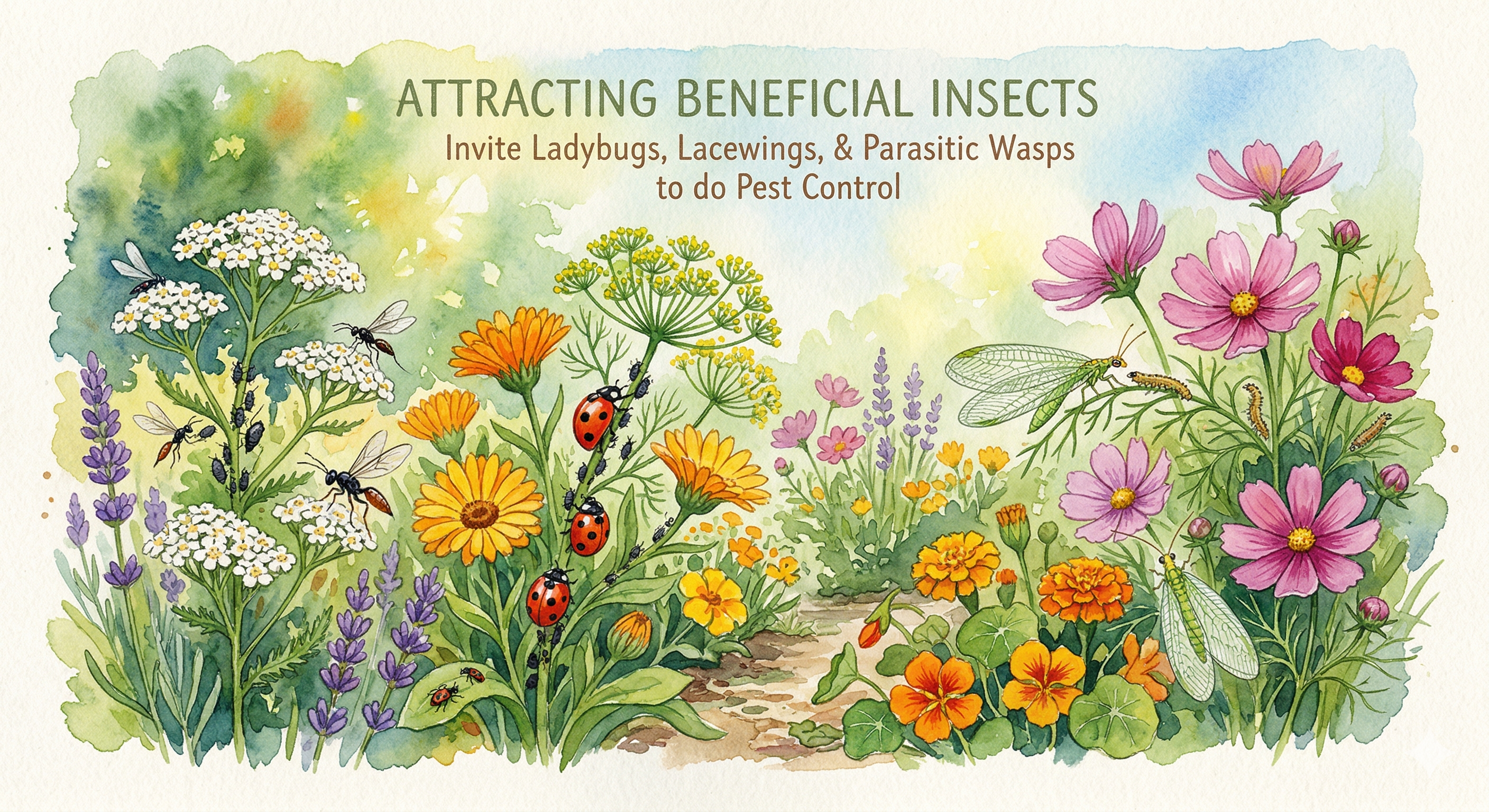
Attracting Beneficial Insects
Invite Ladybugs, Lacewings & Parasitic Wasps to Do Pest Control for You
Somewhere in your garden right now, a tiny parasitic wasp is laying an egg inside an aphid. When that egg hatches, the larva will consume the aphid from the inside, producing what entomologists call a "mummy" — the distinctive bronze-brown shell of an aphid that has been killed by its internal parasite. The wasp that did this is so small you have probably never noticed it. It cannot sting you. It asks only for a few flowers to drink nectar from and a pesticide-free environment to work in. In return, it provides pest control that no spray program can match.
The Garden's Invisible Workforce
An estimated 97 percent of insect species are either beneficial or neutral in the garden. Only 3 percent cause significant damage. The gardener who manages for biodiversity — who plants for insect food sources, provides water and shelter, and stops killing everything that moves — enlists the other 97 percent as a standing army against the 3 percent.
Studies comparing gardens with diverse insect-supporting plantings to those managed with regular pesticide applications consistently show that the diverse gardens have lower pest populations, recover from pest outbreaks faster, and require dramatically less intervention per season. The investment is in plants and habitat; the return is free, continuous, self-renewing pest management.
This guide covers the practical science, the specific beneficial insects worth knowing, the plants and garden conditions that support them, and the region-by-region strategies that work across every American climate. The most important shift it asks for is simple: stop seeing the garden as something you manage for a product with pests as the enemy, and start seeing it as a managed ecosystem in which the pest community and the natural enemy community exist in a dynamic balance that you can tip in your favor — not with more sprays, but with more plants, more habitat, and more patience.
| Foundation | What It Provides | Why It Matters | Getting Started |
|---|---|---|---|
| Diverse flowering plants with sequential bloom | Nectar and pollen for adult beneficial insects throughout the growing season | Most adult beneficial insects — including parasitic wasps and hoverflies — require nectar and pollen to survive, reproduce, and reach their full pest-control potential. Without these food sources, they leave. | Plant at least 3 species that bloom in each season: early spring, late spring, summer, and fall. Include small-flowered species in the carrot family and daisy family. |
| Pesticide-free or minimal-spray approach | A safe environment where beneficial insects can establish and reproduce without being killed | A single application of pyrethrin, malathion, or many other pesticides — including many organic ones — can kill beneficial insects indiscriminately. The beneficial insect community builds over years; a spray event sets it back months. | Commit to spraying only as a last resort, in the evening, in targeted spot applications, using the most specific product available. Stop broad-spectrum applications entirely if possible. |
| Water sources | Drinking and reproduction sites for many beneficial insects | Many beneficial insects need clean, shallow water. Ground beetles, wasps, and many others drink regularly. Some use mud for nest construction. | Install a shallow dish with pebbles in a prominent garden location; change water every 2–3 days to prevent mosquito breeding. |
| Undisturbed nesting habitat | Overwintering sites, nesting structures for solitary bees and wasps, leaf litter for ground beetles | Without places to overwinter and reproduce, beneficial insect populations cannot become established in the garden regardless of food availability. | Leave some stems standing through winter, maintain leaf litter in shrub borders, provide an insect hotel or bee block, and tolerate small areas of bare soil in sunny locations. |
| Year-round structural diversity | Plants of varying heights, textures, and types that create layered habitat complexity | Beneficial insect diversity tracks plant diversity closely. A garden with 12 species of plants supports a fraction of the beneficial insect fauna that a garden with 40 species does. | Aim for at least 15–20 different plant species in the garden. Include native plants, which have evolved alongside the native beneficial insect fauna and support them most effectively. |
The Science — How Biological Control Works
Biological control is the use of living organisms — natural enemies — to reduce pest populations. In the garden context, it operates through three mechanisms: predation (a beneficial insect eats the pest), parasitism (a beneficial insect completes part of its life cycle inside or on the pest, killing it), and competition or pathogenesis (beneficial microorganisms outcompete or kill pest organisms). This guide focuses on predation and parasitism because these are the mechanisms most directly influenced by garden design and plant choices.
Predators vs. Parasitoids: The Critical Distinction
Understanding the difference between predatory beneficial insects and parasitoid beneficial insects is essential for understanding why different plants and habitat features support different types of pest control.
Predators are beneficial insects that physically consume pest insects. Ladybugs, lacewing larvae, ground beetles, minute pirate bugs, and spiders are predators. They are typically generalist hunters that eat a wide variety of prey species and are important for rapid suppression of visible pest populations. Both adult and larval stages may be predatory, and they consume multiple prey individuals over their lifetime.
Parasitoids are insects whose larvae develop inside or on the body of a specific host insect (the pest), killing it in the process. Parasitic wasps and some parasitic flies are parasitoids. They are typically highly host-specific — a wasp that attacks aphids may work on only a few aphid species — which makes them extraordinarily effective at reducing specific target pest populations. Adult parasitoids are not themselves predatory; they feed on nectar and pollen, which is why providing flowers is critical for their performance.
Why this distinction matters: a garden optimized primarily for predators (ladybugs, lacewings) needs dense, diverse plantings with shelter and overwintering sites. A garden optimized for parasitoids — the most powerful pest control agents — needs a very specific type of flower: small, flat-topped flowers with accessible nectar that tiny-mouthed wasps can feed from. This is why the carrot family (Apiaceae) is the single most important plant family for parasitoid support.
A single parasitic wasp female (Aphidius colemani) can parasitize 300–400 aphids in her lifetime. She is 1–12 millimeters long. She costs nothing to purchase, requires no application equipment, leaves no residue, and cannot develop resistance to the pest. She needs only undisturbed flowers and a pesticide-free environment. Studies from UC Davis found that hedgerow-adjacent vegetable fields had 3× higher natural enemy populations and required 3–5 fewer pesticide applications per season for equivalent pest control. In residential gardens, a well-designed beneficial insect garden reduces insecticide use by an estimated 60–80% compared to a conventionally managed garden of the same size.
Conservation vs. Augmentation: Two Approaches
Conservation biological control means supporting and protecting the natural enemy populations that are already present in and around your garden. This is the primary focus of this guide and the most cost-effective, sustainable, and ecologically sound approach. It involves providing food sources (flowers), habitat, water, overwintering sites, and a pesticide-free environment. It builds over years as the beneficial insect community matures.
Augmentation biological control means purchasing and releasing commercially produced beneficial insects to supplement naturally occurring populations. This is appropriate in specific circumstances — a new garden with few naturally occurring beneficials, a greenhouse with no natural influx, or a severe pest outbreak requiring rapid response — but is less cost-effective than conservation as a primary strategy. Most commercial releases of generalist predators (ladybugs, lacewings) disperse within days. Section 9 covers augmentation in detail.
The sequence that works: build the habitat first. Establish the flower resources, the shelter, and the pesticide-free zone. Then, if augmentation is needed for a specific situation, the released beneficial insects will find an environment they want to stay in, rather than immediately dispersing to a more suitable garden.
The Natural Enemy–Pest Balance
The most important ecological principle in beneficial insect management is that some pest presence is necessary to maintain natural enemy populations. A garden with zero pests has nothing for the natural enemies to eat; they leave or die. A garden with a moderate, fluctuating pest population maintains the natural enemy community that provides free, ongoing pest suppression.
This is why the gardener who consistently sprays — even with organic products — every time they see a pest will have more pest problems over time, not fewer. Each spray event reduces both pest and natural enemy populations. The pest population, which has a shorter generation time and higher reproductive rate, rebounds faster than the natural enemy population. The result is a pest trough followed by a higher peak than the pre-spray level, a phenomenon called "pest resurgence," documented extensively in the scientific literature.
The threshold principle: the goal of pest management is not zero pests but pests below the damage threshold — the level at which they cause economically or aesthetically significant harm. Most gardens tolerate considerable aphid, mite, and caterpillar presence without meaningful damage to plants. The beneficial insect community, operating continuously, keeps most pest populations below this threshold without intervention.
The 30 Key Beneficial Insects — Who They Are & What They Do
The following profiles cover the beneficial insects most important to American garden ecosystems. Knowing how to identify them — particularly in their less recognizable larval stages — prevents the accidental killing of allies.
Category 1: Aphid Predators & Parasitoids
| Insect | How to ID | What It Eats | Pest Control Value | What It Needs | Look-alike Warning |
|---|---|---|---|---|---|
| Convergent Ladybug (Hippodamia convergens) | Classic red with black spots; 3/16″–1/4″; 2 white converging marks on pronotum. Larva: alligator-shaped, dark gray-orange with orange spots; 3/8″ when mature. | Adults and larvae both eat aphids primarily; also scale crawlers, mites, insect eggs, small soft-bodied insects. Adult consumes 50 aphids/day; larva up to 400 in development. | Outstanding; one ladybug larva eats 400 aphids before pupating. Probably the most visually recognized beneficial insect. | Aphid colonies to feed on; overwintering sites (leaf litter, hollow stems, tree bark); nectar and pollen from composite and carrot-family flowers. | The ladybug larva is very commonly mistaken for a pest. If you see an alligator-like, orange-spotted dark larva on a plant with aphids, it is your most valuable ally. |
| Multicolored Asian Lady Beetle (Harmonia axyridis) | Highly variable: orange to red; 0 to 20+ black spots; M-shaped mark on pronotum is diagnostic; 1/4″–3/8″. The large, common ladybug of North American gardens. | Aphids, scale, mites, insect eggs; diet similar to convergent ladybug; very high consumption rate. | Outstanding pest control value; one of the most important natural aphid predators in the eastern US. | Same as convergent ladybug; also overwinters indoors (a nuisance but not a garden problem). | Often confused with convergent ladybug; the M-shaped pronotum mark distinguishes it. Both are highly beneficial. |
| Aphidius Parasitic Wasps (Aphidius colemani, A. ervi, and others) | Tiny (1–3 mm); brown or black; slender with elbowed antennae; essentially invisible to the casual observer. Evidence of activity: bronze-brown "mummified" aphids with a round exit hole. | Exclusively aphid parasitoids; each wasp species targets specific aphid species; female injects a single egg into each aphid; larva develops inside and kills the aphid. | Extraordinary; each female parasitizes 300–400 aphids in her lifetime. The primary agent responsible for natural aphid population crashes in late spring and summer. | Small-flowered nectar sources (carrot family critical); pesticide-free environment; aphid populations to reproduce in. | None — these wasps are too small to be mistaken for stinging insects and are completely harmless to humans. |
| Aphid Midge (Aphidoletes aphidimyza) | Adult: tiny orange mosquito-like fly, 2–3 mm. Larva: tiny, bright orange, legless maggot found in aphid colonies; drops to pupate in soil. Evidence: orange larvae visible in aphid clusters. | Larvae are specialized aphid predators; a single larva can kill 3–65 aphids, paralyzing each with a leg bite before consuming it. | Very high; one of the most important aphid predators in North American gardens. | Moist soil for pupation; flowers for adult nectar; aphid colonies for larval feeding. | Orange larvae in aphid colonies may be overlooked; they are not the pest — they are the reason the aphid colony is declining. |
| Green Lacewing (Chrysoperla spp., Chrysopa spp.) | Adults: delicate, pale green with large net-veined wings and golden eyes; 3/4″; nocturnal. Larvae ("aphid lions"): 1/4″–3/8″; alligator-shaped, tan-brown with sickle-shaped jaws; sometimes decorated with debris. | Larvae: aphids, thrips, mites, whitefly nymphs, small caterpillars, insect eggs. Adults: primarily nectar and pollen (some species also eat aphids). | Very high; the larva is one of the most voracious predators in the garden; commercially available as eggs. | Carrot-family and composite flowers for adult nectar; structural diversity for overwintering; aphid populations for larvae. | Larvae look like miniature alligators covered in debris; commonly mistaken for pests. |
Category 2: Caterpillar & General Pest Parasitoids
| Insect | How to ID | Hosts / Prey | Pest Control Value | What It Needs |
|---|---|---|---|---|
| Cotesia Parasitic Wasps (Cotesia congregata, C. glomerata, others) | Adults: tiny (2–4 mm) black wasp. Evidence: white rice-grain cocoon masses on hornworm or cabbageworm bodies — the most visually striking sign of biological control in the garden. | Caterpillar parasitoids: each species targets specific caterpillar hosts. C. congregata attacks hornworms; C. glomerata attacks imported cabbageworm. Larvae pupate externally in white fuzzy cocoons on the host's back. | Extraordinary for caterpillar management; a single parasitized hornworm bearing cocoons will not survive; leaving these in the garden allows adult wasps to emerge and parasitize more hosts. | Umbel flowers (carrot, dill, fennel, coriander) for adult nectar; caterpillar populations to parasitize; pesticide-free environment. |
| Trichogramma Egg Wasps (Trichogramma pretiosum and others) | Essentially invisible: 0.3–0.5 mm; the smallest commonly encountered garden insects; barely visible as moving specks with magnification. | Attack the eggs of over 200 species of moths and butterflies before they hatch; each female inserts an egg into a host egg; the host egg turns black when parasitized. | Extraordinary for preventive caterpillar management; by parasitizing eggs, the caterpillar never hatches; commercially available for release. | Small-flowered nectar sources; pesticide-free environment; moth and butterfly egg masses on host plants. |
| Braconid Wasps (Braconidae family, many species) | Range from 1–15 mm; brown to black; distinctive ovipositor (egg-laying tube) visible on females of some species; slender body. | Broad family attacking caterpillars, beetles, flies, and other insects; some are ectoparasitoids (develop outside the host), others endoparasitoids; over 17,000 species worldwide. | One of the largest parasitoid wasp families; collectively attack many of the most important garden pests. Essential for long-term ecosystem stability in the garden. | Umbel and composite flowers for adult nectar; habitat diversity; pesticide-free environment. |
| Ichneumon Wasps (Ichneumonidae family) | Highly variable: 3–150 mm; many resemble wasps with dramatic long ovipositors; some have warning coloration but are non-stinging and harmless to humans. | Caterpillar and sawfly parasitoids primarily; the largest ichneumon species target wood-boring beetles; varied and complex host relationships. | Critical for managing caterpillar pests in ornamental and fruit crops; very long ovipositor species drill into wood to parasitize wood-boring pests. | Diverse flowering plants; undisturbed habitat edges; pesticide-free conditions. |
| Chalcid Wasps (Chalcididae and related families) | 2–5 mm; often metallic blue, green, or gold; elbowed antennae; common but rarely noticed. | Parasitize a wide variety of insects including whiteflies (Encarsia formosa), scales, leafminers, and caterpillars; some are hyperparasitoids of other parasitoids. | Significant for whitefly control in particular; Encarsia formosa is commercially available for greenhouse whitefly management. | Small flowers with accessible nectar; pesticide-free conditions. |
Category 3: Generalist Predators
| Insect / Arthropod | How to ID | What It Eats | Pest Control Value | What It Needs |
|---|---|---|---|---|
| Ground Beetles (Carabidae family) | 1/4″–1″; dark brown to black; shiny; fast-running on the ground; nocturnal hunters; strong mandibles; distinct neck between head and thorax. | Generalist predators: cutworms, slugs, slug eggs, caterpillar pupae, cabbage root fly eggs, flea beetle larvae, weed seeds, aphids on the ground. A single large ground beetle (Calosoma) eats 50+ caterpillars in its lifetime. | Among the most valuable and most underappreciated of all garden beneficials; collectively provide enormous suppression of soil-level and surface pests. | Permanent ground cover (mulch, low plants) for daytime shelter; minimal soil disturbance (tilling destroys pupae and eggs); stable habitat edges. |
| Minute Pirate Bug (Orius spp.) | 1/16″–1/8″; black and white patterned; oval; fast-moving in flowers; can deliver a noticeable bite to human skin (more surprise than pain); wings crossed at rest forming an X. | One of the few natural enemies that significantly suppresses thrips; also attacks mites, aphids, insect eggs, and small caterpillars. Both adults and nymphs are predatory. | Outstanding specifically for thrips management; significant supplemental predator for other pests; commercially available for greenhouse release. | Carrot-family and composite flowers; structural diversity; small prey populations. |
| Hoverflies / Flower Flies (Syrphidae family) | Many are bee or wasp mimics with yellow-black stripes; 1/4″–3/4″; distinctively hover in place. Larvae: no legs; various species are aphid predators, aquatic, or decaying-matter feeders. | Larvae of many species are aphid predators; a single larva consumes hundreds of aphids. Adults are important pollinators and nectar feeders. | Dual value: larvae provide significant aphid control; adults provide pollination services. One of the most important insect groups in any garden. | Diverse flowers for adult nectar and pollen; aphid colonies for larval feeding; shallow water for aquatic species. |
| Spiders (Order Araneae) | 8 legs (distinguishes from insects); enormous variety: web-builders (orb weavers), ground hunters (wolf spiders), flower stalkers (crab spiders), jumping hunters. | Generalist predators; collectively consume an enormous number of insects including many pest species. Wolf spiders consume ground-level pests. Crab spiders in flowers ambush beetles. Orb weavers catch flying insects. | Studies consistently show that spider-rich gardens have substantially lower pest populations than spider-depleted ones; one of the most important components of garden pest suppression. | Leaf litter for ground spiders; permanent vegetation structure for web-builders; undisturbed areas; minimal pesticide exposure. |
| Predatory Stink Bugs (Podisus maculiventris — Spined Soldier Bug) | Shield-shaped, brown or tan with sharp shoulder spines; 3/8″–1/2″. Often confused with pest stink bugs — look for the sharp pronotal spines. | Caterpillars, beetle larvae, Colorado potato beetle eggs and larvae, Mexican bean beetle larvae; generalist predators of soft-bodied insects. | Significant for caterpillar and beetle management; the spined soldier bug is commercially available. | Diverse plantings; caterpillar and beetle populations; some nectar sources. |
| Assassin Bugs (Reduviidae family) | Elongated body; cone-shaped beak for piercing prey; 1/2″–3/4″; brown to gray. Wheel bug (Arilus cristatus): large (1″+) with distinctive cog-wheel crest on thorax. | Generalist predators of almost any insect they can catch; both adults and nymphs are predatory; ambush hunters that inject paralyzing saliva. | Broadly valuable generalist predators. Note: can bite humans with the same beak they use on prey — the bite is painful but not dangerous. | Structural vegetation for ambush hunting; diverse insect populations; permanent plantings. |
| Rove Beetles (Staphylinidae family) | Slender body with shortened wing covers leaving much of abdomen exposed; 1/16″–1″; often confused with earwigs (rove beetles lack the rear pincers); very fast-moving. | Ground-level predators of aphid eggs, springtails, fungus gnat larvae, root maggot eggs, and many small soil-dwelling pests. Some species are specialist predators of specific pests. | Critical for soil-level pest management; particularly valuable in vegetable gardens for management of fungus gnats, shore flies, and root-feeding pests. | Moist soil with organic matter; stable ground cover; minimal soil disturbance. |
Category 4: Specialist Beneficials
| Insect | How to ID | Specialist Role | Pest Control Value | Support Strategy |
|---|---|---|---|---|
| Scale-eating Ladybugs (Chilocorus spp., Lindorus lophanthae) | Chilocorus: 1/8″; black with two red spots; rounder and smaller than common ladybugs. Lindorus: tiny, dark brown to black, 1/16″. | Specialist predators of armored and soft scale insects on woody plants, shrubs, and trees; both adults and larvae consume scale at all life stages. | Outstanding for scale management on fruit trees, ornamental shrubs, and houseplants; far more effective than most spray programs when populations are established. | Infested woody plants with scale populations; minimal pesticide exposure; overwintering sites in bark and mulch. |
| Parasitic Flies (Tachinidae family) | Bristly, robust flies resembling large house flies; 1/4″–3/4″; distinctive stiff bristles on abdomen and thorax. | Parasitoids of caterpillars, beetles, bugs, and grasshoppers; female deposits eggs on or near the host; larva bores in and kills the host. | Important generalist parasitoids that collectively attack a very wide range of pest species; tachinid flies parasitize many caterpillar species that wasps cannot access. | Umbel and composite flowers for adult nectar; diverse pest populations; pesticide-free environment. |
| Encarsia Whitefly Parasitoid (Encarsia formosa) | Tiny (0.6 mm); females: black thorax, yellow abdomen; males rare. Evidence: parasitized whitefly scales turn black. | Highly specific to greenhouse whitefly (Trialeurodes vaporariorum) and silverleaf whitefly (Bemisia tabaci); each female parasitizes 50–300 whitefly nymphs. | Extraordinary for whitefly management in greenhouses; less effective outdoors where host-finding is more difficult; commercially available. | Warm conditions (minimum 64°F for activity); whitefly populations; pesticide-free environment. Release when whitefly populations are first detected. |
| Predatory Mites (Phytoseiidae family: Phytoseiulus persimilis, Amblyseius cucumeris, others) | Tiny (0.3–0.5 mm); pear-shaped; fast-moving; pale orange to reddish; visible only with magnification; found in the same locations as spider mites and thrips. | P. persimilis: specialist two-spotted spider mite predator. Amblyseius cucumeris: specialist western flower thrips predator. Other species with different host specializations. | The most effective treatment for spider mite outbreaks in greenhouse and high-value outdoor plants; commercially available; establish and reproduce when prey is present. | Humidity above 60% (P. persimilis requires this); host pest populations; pesticide-free conditions. Do not apply acaricides — they kill predatory mites before spider mites. |
| Soldier Beetles (Cantharidae family) | 1/2″–3/4″; soft-bodied; tan or yellow with black spots or markings; often seen on flowers, especially goldenrod; sometimes called "leatherwings." | Adults: aphids and other soft insects; some feed on nectar. Larvae: soil-dwelling predators of cutworms, grasshopper eggs, and other soil pests. | Dual value: adult foliar predation plus larval soil pest control; abundant visitors to late-season flowers (goldenrod, sunflower, asters). | Late-season flowers for adults; stable soil with organic matter for larvae; minimal soil disturbance. |
Many beneficial insect larvae — ladybug larvae, lacewing larvae ("aphid lions"), and rove beetles — are frequently mistaken for pests and killed. Before removing any unfamiliar insect from a plant that has a pest problem, observe it for a moment: if it is moving toward the pest colony rather than away from it, it is almost certainly your ally. The default assumption should be "beneficial" unless you have confirmed identification of a known pest.
Plants That Attract Beneficial Insects
The plant community in and around the garden is the primary driver of beneficial insect diversity and abundance. The relationship is direct and well-documented: more plant species means more insect species; more insect species means more natural enemies; more natural enemies means lower pest populations. Plant choice is the highest-leverage action available to the gardener seeking to build a beneficial insect community.
The most important flower characteristic for attracting parasitic wasps and other small beneficial insects is floral accessibility: the nectar must be reachable by short-mouthed insects. Many showy ornamental flowers have been bred for visual impact — double flowers, very deep floral tubes, or nectar hidden behind elaborate structures — at the expense of insect accessibility. The flowers most valuable for beneficial insects tend to be simpler, smaller, and more open than the typical ornamental catalog selection.
The Most Important Plant Families for Beneficial Insects
| Plant Family | Why It's Critical | Key Genera / Species | Season of Value | Notes |
|---|---|---|---|---|
| Apiaceae (Carrot Family) | THE most important family for parasitic wasps; flat-topped umbel flowers provide easily accessible nectar for tiny-mouthed parasitoids; essential for maintaining high parasitoid populations. | Dill (Anethum), fennel (Foeniculum), cilantro (Coriandrum), carrot (Daucus), Bishop's flower (Ammi), Queen Anne's lace, parsley (Petroselinum), sweet cicely (Myrrhis), angelica (Angelica) | Late spring–summer; allow bolting plants to flower rather than removing them. | Allow some herbs (dill, cilantro, parsley) to bolt and flower rather than pulling them. A bolted dill plant in flower is more valuable to the beneficial insect community than it ever was as a culinary herb. |
| Asteraceae (Daisy/Composite Family) | Composite flowers provide pollen and nectar in a landing platform accessible to nearly all beneficial insect sizes; one of the most accessible flower forms for diverse insect use. | Coneflower (Echinacea), black-eyed Susan (Rudbeckia), asters (Symphyotrichum), goldenrod (Solidago), yarrow (Achillea), sunflower (Helianthus), marigold (Tagetes), cosmos (Cosmos), tickseed (Coreopsis), feverfew (Tanacetum) | Summer–fall; native species particularly valuable; goldenrod and asters are essential fall resources. | Goldenrod (Solidago) is one of the most important fall beneficial insect plants in North America; do not mistake it for ragweed (which is wind-pollinated). They look very different. |
| Lamiaceae (Mint Family) | Tubular but accessible flowers; high nectar production; aromatic foliage; excellent late-season resource. | Catmint (Nepeta), lavender (Lavandula), salvia (Salvia), mountain mint (Pycnanthemum), anise hyssop (Agastache), bee balm (Monarda), thyme (Thymus), oregano (Origanum), lemon balm (Melissa) | Late spring–fall; mountain mint is among the most consistently insect-rich plants through summer. | Mountain mint (Pycnanthemum spp.) is a native US species consistently one of the most insect-visited plants in any garden it inhabits; an excellent anchor for the beneficial insect planting. |
| Ranunculaceae (Buttercup Family) | Simple, open flowers with accessible pollen and nectar; includes many native species valued by mining bees and other early-season beneficials. | Columbine (Aquilegia — native species), anemone (Anemone), meadow rue (Thalictrum), clematis (Clematis — native species) | Spring–early summer; valuable early-season resources before many other families bloom. | Native aquilegia species (A. canadensis, A. formosa, A. chrysantha) are particularly valuable for early-season insects. |
| Rosaceae (Rose Family) | Many provide pollen-rich flowers; native Rosaceae are especially important; simpler single-flowered species far more valuable than ornamental doubles. | Wild roses (Rosa palustris, R. blanda, R. carolina — native species), strawberry (Fragaria), potentilla (Potentilla), serviceberry (Amelanchier), native cherries (Prunus) | Spring; abundant pollen for early-season beneficials including native bees. | Choose single-flowered roses over double-flowered types; the pollen in double roses is often inaccessible. Native roses are far more ecologically valuable than ornamental hybrid roses. |
| Scrophulariaceae / Plantaginaceae (Figwort Family) | Tubular to open flowers valuable for bumble bees and medium-sized beneficials; includes many native plants. | Penstemon (Penstemon — many native species), snapdragon (Antirrhinum), foxglove (Digitalis), toadflax (Linaria), mullein (Verbascum) | Spring–summer; penstemon species are outstanding native plants for western US gardens. | Native penstemon species are among the most important plants for native bees in western North American gardens; over 270 species cover every climate from desert to alpine. |
Top Plants for Beneficial Insect Gardens
The following plants are prioritized based on documented insect attraction value, adaptability across American climate regions, and nursery availability. Native species are marked where applicable.
| Plant | Height | Zones | Season | Primary Value | Native? |
|---|---|---|---|---|---|
| Dill (Anethum graveolens) | 3–4 ft | Annual all zones | Summer (when allowed to bolt) | Parasitic wasps, hoverflies, lacewings — umbel flowers are among the most visited by beneficial wasps | No (Eurasian) |
| Fennel (Foeniculum vulgare) | 4–6 ft | Annual (perennial Z6+) | Summer–fall | Outstanding for parasitic wasps; continuously produces new umbels; host plant for black swallowtail caterpillars | No (Mediterranean) |
| Cilantro / Coriander (Coriandrum sativum) | 18–24 in (bolted) | Annual all zones | Spring–early summer | Allow to bolt; small white umbel flowers are among the best for tiny parasitoid wasps | No (Middle Eastern) |
| Bishop's Flower (Ammi majus) | 2–3 ft | Annual all zones | Summer | Outstanding annual for parasitic wasps; pure white umbels; very fine for small-mouthed beneficials | No (Mediterranean) |
| Mountain Mint (Pycnanthemum spp.) | 2–3 ft | 4–8 | Midsummer–early fall | Consistently the most insect-visited plant in documented studies; attracts an extraordinary diversity of parasitic wasps, bees, and predators simultaneously | Yes |
| Wild Bergamot / Bee Balm (Monarda fistulosa) | 2–4 ft | 3–9 | Summer | Native; attracts bumble bees, mining bees, hummingbirds, and many beneficial insects; mildew-resistant strains available | Yes |
| Goldenrod (Solidago spp.) | 2–5 ft | 3–9 | Late summer–fall | One of the most important late-season insect resources in North America; essential for fall beneficial insect populations; supports overwintering insects | Yes |
| Native Asters (Symphyotrichum spp.) | 1–4 ft | 3–9 (varies) | Fall | Critical late-season bloom after most other plants have finished; sustains beneficial insect populations through fall pest pressure | Yes |
| Yarrow (Achillea millefolium) | 2–3 ft | 3–9 | Summer–fall | Flat-topped composite flowers accessible to a very wide range of insect sizes; extraordinarily long bloom; drought-tolerant | Yes (native and non-native strains) |
| Purple Coneflower (Echinacea purpurea) | 2–4 ft | 3–9 | Summer | Native; disk flowers provide accessible pollen and nectar; long bloom season; seedheads feed birds in winter | Yes |
| Black-Eyed Susan (Rudbeckia hirta, R. fulgida) | 1–3 ft | 3–9 | Summer–fall | Native; open-faced flowers excellent for many beneficial insect sizes; abundant pollen production | Yes |
| Anise Hyssop (Agastache foeniculum) | 2–3 ft | 5–9 | Midsummer–fall | Licorice-fragrant; exceptional for beneficial insects including parasitic wasps; also important for monarch butterflies | Yes |
| Catmint (Nepeta x faassenii) | 12–18 in | 3–8 | Late spring–fall (reblooms) | Outstanding insect plant; long bloom season; attractive to many beneficial insects including parasitic wasps | No (Eurasian) |
| Lavender (Lavandula spp.) | 18–24 in | 5–9 | Late spring–summer | Outstanding for beneficial insect diversity; strong nectar producer; powerful deer and rabbit deterrent | No (Mediterranean) |
| Phacelia (Phacelia tanacetifolia) | 12–18 in | Annual all zones | Spring–early summer | One of the most insect-attractive annual flowers documented in research; curled crozier flowers; often used in farm hedgerows specifically for beneficial insect support | No (western N American, cultivated globally) |
| Sweet Alyssum (Lobularia maritima) | 6–12 in | Annual all zones | Spring–frost | Tiny white flowers extraordinarily attractive to tiny parasitic wasps and hoverflies; excellent ground-level beneficial insect support; seeds profusely | No (Mediterranean) |
| Zinnia (Zinnia elegans) | 12–36 in | Annual all zones | Summer–fall | Single-flowered varieties are excellent; double-flowered varieties less accessible; one of the best summer annuals for beneficial insect diversity in warm climates | No (Mexican) |
| Cosmos (Cosmos bipinnatus) | 2–4 ft | Annual all zones | Summer–frost | Open-faced flowers excellent for diverse insect sizes; long bloom; easy from seed; one of the best summer-to-fall annuals for beneficial insects | No (Mexican) |
| Signet Marigold (Tagetes tenuifolia) | 12 in | Annual all zones | Summer–frost | Single-flowered signet marigolds are much more accessible than French or African doubles; very effective for hoverflies and small wasps | No (Mexican) |
| Sunflower (Helianthus annuus) | 3–10 ft | Annual all zones | Summer–fall | Pollen-rich; single-flowered varieties far more valuable than pollen-free cultivars; important late-season resource; seedheads provide bird habitat | Yes |
| Prairie Clover (Dalea purpurea, D. candida) | 1–2 ft | 3–8 | Summer | Native prairie plants with dense flower spikes; outstanding native bee plants; excellent beneficial insect value in Midwest and Plains gardens | Yes |
| Wild Strawberry (Fragaria virginiana) | 6–12 in | 3–8 | Spring | Native ground cover; small open flowers excellent for early-season tiny parasitoid wasps; edible fruit bonus | Yes |
| Sedum / Stonecrop (Hylotelephium spectabile) | 18–24 in | 3–9 | Late summer–fall | Late-season bloom critical for fall beneficial insect populations; excellent for late-season parasitic wasps and predatory flies | No (Asian) |
| Buckwheat (Fagopyrum esculentum) | 2–3 ft | Annual all zones | Summer (40 days from seed) | Outstanding fast-growing annual for beneficial insects; white flowers are among the most visited by tiny parasitoids; cover crop dual function | No (Asian) |
| Tansy (Tanacetum vulgare) | 2–3 ft | 3–8 | Summer | Flat-topped button flowers highly attractive to parasitic wasps; can be a moderately aggressive spreader | No (Eurasian) |
| Elderberry (Sambucus canadensis) | 6–10 ft | 3–9 | Early summer | Native shrub; flat-topped flower clusters excellent for parasitic wasps; fruit for birds; excellent multi-function plant | Yes |
| Joe-Pye Weed (Eutrochium spp.) | 4–7 ft | 3–8 | Midsummer–fall | Native; tall, bold, dramatically insect-rich; one of the best large-scale beneficial insect plants for garden borders | Yes |
| Wild Senna (Senna hebecarpa, S. marilandica) | 4–6 ft | 4–8 | Summer | Native; host plant for sulfur butterfly larvae; flowers provide pollen for large bees and associated beneficial insects | Yes |
| Phacelia, California (Phacelia californica) | 1–2 ft | 8–10 | Spring–early summer | Outstanding native West Coast beneficial insect plant; blue-purple flowers highly attractive to native bees and parasitic wasps | Yes (CA/West Coast native) |
| Native Goldenrods (Solidago nemoralis, S. rugosa, S. odora) | 1–4 ft | 2–9 (varies) | Late summer–fall | Multiple native species for every climate and site condition; collectively among the most important native insect plants; use species goldenrods over Canada goldenrod in garden settings to limit spread | Yes |
The single easiest action in this entire guide: stop pulling dill, cilantro, and parsley when they start to bolt and flower. A bolted dill plant covered in tiny yellow umbels hosts dozens of parasitic wasp species simultaneously. Letting three or four kitchen herbs flower each season costs nothing and provides immediate, season-long parasitoid support to the entire vegetable garden.
Water, Shelter & Overwintering Habitat
Plants are the foundation of the beneficial insect garden, but plants alone are not sufficient. Beneficial insects also require water, shelter from extreme weather and predators, nesting sites, and overwintering quarters. In a conventional, highly managed landscape — regularly tilled, cleaned up in fall, mulched wall to wall with bark, and surrounded by lawn — most of these resources are absent. Creating a fully functional beneficial insect community requires addressing all four pillars: food (nectar and pollen), water, nesting habitat, and overwintering habitat.
Water
Beneficial insects need water, particularly during hot, dry periods. Unlike birds, which can use a standard birdbath, many small beneficial insects need very shallow water with rough or textured surfaces that allow them to land and drink without falling in. A clean birdbath with steep sides and smooth porcelain offers almost nothing to beneficial insects — they will land, be unable to get traction, fall into the water, and drown.
- •Shallow water source: A wide, shallow dish (a plant saucer works well), a ceramic bowl filled with coarse gravel and water, or a wide terracotta pot saucer placed flat on the ground provides safe drinking access. The water surface should be no more than ½ inch deep, with rocks, gravel, or marbles creating safe perches.
- •Wet mud: Many native bees and beneficial wasps collect mud for nest construction. A small consistently moist patch of bare, sandy-clay soil — even a bucket filled with muddy water set in a corner — serves this function.
- •Location: Place water sources near plantings, in partial shade to reduce evaporation, and within easy reach for refilling. During drought or heat waves, check and refill every day or two.
- •Mosquito management: Change the water every 2–3 days to prevent mosquito breeding, or place BTi (Bacillus thuringiensis israelensis) dunks in larger water features. Mosquito larvae cannot survive in water that is changed regularly.
- •Sand puddles: A permanently moist patch of fine sand in a sunny location is used by many ground-nesting bees and beneficial wasps for water and mineral absorption.
Nesting Habitat for Native Bees and Beneficial Wasps
Most beneficial insects in the garden — native bees, parasitic wasps, predatory wasps, ground beetles — do not live in hives or colonies. They are solitary insects that find or create individual nests. The two primary nest types in most gardens are ground nests (70% of native bee species nest in the ground) and cavity nests (hollow stems, beetle galleries in wood, pre-existing holes).
| Habitat Type | Who Uses It | How to Provide It | Management Notes |
|---|---|---|---|
| Bare or sparsely vegetated ground | 70% of native bee species (ground-nesters): mining bees (Andrena, Colletes), sweat bees (Halictus, Lasioglossum), digger bees (Anthophora), cicada killer wasps, many ground-nesting wasps | Leave areas of bare, undisturbed, well-drained soil — especially south-facing slopes that warm quickly in spring. Sandy loam or fine sandy soil is preferred. Even a 1–2 sq ft patch is useful. Avoid mulching these areas. | Do not disturb from fall through spring as nests may be active or dormant. Ground-nesting bees excavate small round holes; leave them alone — they are essentially harmless and highly beneficial. |
| Hollow or pithy stems | Small solitary bees (small mason bees, small sweat bees), parasitic and predatory wasps, some lacewing species | Leave standing hollow or pithy-stemmed perennials through winter and into early spring: cup plant (Silphium), elderberry (Sambucus), Joe-Pye weed (Eutrochium), ironweed (Vernonia), raspberry canes, roses, ornamental grasses with hollow culms. Cut stems to 12–18 in height rather than cutting to the ground. | Do not cut these stems until late spring (after last frost, when daytime temperatures are reliably above 50°F) to allow emergence of overwintering beneficials. Chop into shorter sections and leave on the ground after cutting to allow late emergers to exit. |
| Undisturbed wood: logs, stumps, snags | Bumble bees (often nest in abandoned rodent burrows near wood), carpenter bees (Xylocopa — nest in soft dead wood), many predatory beetles, parasitic wasps | Leave one or more pieces of soft, partially rotted wood (log, stump, or section of branch) in a quiet corner of the garden. An undisturbed pile of branches and brush in a back corner serves multiple insect species simultaneously. | Carpenter bees are native, solitary, and highly important pollinators; their round entrance holes in soft wood are harmless in a garden context. |
| Leaf litter | Overwintering beneficials including beneficial beetles (Carabidae), firefly larvae, many parasitoid pupae, bumble bee queens, spiders | Leave fallen leaves in place under shrubs and in garden beds through winter and into spring. A leaf layer of 2–3 inches is an insulating overwintering blanket for a very wide range of garden allies. Shred or chop leaves if runoff is a concern, but keep them in place. | Resist the urge to "clean up" the garden completely in fall. The leaf layer under trees and shrubs is not a disease reservoir — it is an overwintering habitat bank. Rake paths for safety; leave bed areas undisturbed. |
| Brush and debris piles | Overwintering beneficials including native bumble bee queens, many beneficial beetles, spiders, and small mammals that in turn support insect diversity | A discreet pile of woody prunings, bark pieces, and rough material tucked in a corner provides layered overwintering habitat for many insect species. | Even a small pile (2–3 ft across) in an out-of-sight corner provides measurable habitat value. |
| Rock and stone features | Ground beetles (Carabidae), rove beetles, beneficial spiders, lizards (secondary pest predators) | Flat rocks embedded in the ground at the edge of garden beds create sheltered microhabitats under and around them. Stone edging, dry-stacked stone walls, and stepping stones all provide beneficial microhabitat. | Ground beetles are among the most effective slug, cutworm, and soil pest predators in the garden; rock microhabitats directly support them. |
Insect Hotels and Nest Boxes
Commercial and DIY "insect hotels" — structures filled with hollow bamboo tubes, drilled wood blocks, pine cones, and other materials — have become popular garden accessories. Their value is real but often overstated. Hollow-tube nesting structures primarily benefit two groups: mason bees (Osmia species) and leafcutter bees (Megachile species), both of which are highly effective pollinators. They provide far less benefit to the parasitic and predatory insects most important for pest suppression.
- •Effective tube nesting: Use paper tubes or natural bamboo tubes of 5/16-inch (8mm) inner diameter for mason bees — this is the optimal size for Osmia lignaria, the orchard mason bee. Tubes should be 6–8 inches deep, closed at the back, and open at the front. Replace tubes or paper inserts annually to prevent parasite and disease buildup.
- •Wood blocks: Untreated wood blocks (cedar or pine) drilled with multiple hole diameters (3/16, 1/4, 5/16, 3/8 inch) attract a greater diversity of cavity-nesting species. Drill to a depth of at least 3–4 inches; blind (dead-end) holes only.
- •Placement: Face tube/block structures south to southeast, at a height of 3–6 feet, with morning sun and shelter from afternoon wind and rain. A small roof overhang or protection from direct rain significantly extends usability.
- •What insect hotels cannot replace: Standing hollow stems, bare ground, and leaf litter are far more important to overall beneficial insect diversity than any purchased structure. Build and manage the living habitat first; add artificial structures as a supplement.
- •Bundles, not bunches: Avoid insect hotels with many different materials bundled together haphazardly (pine cones, sticks, bark) — these primarily serve as decoration and rarely provide functional nesting sites. Focus on correctly-sized, correctly-oriented tubes and drilled wood blocks.
Overwintering Habitat — The Fall and Winter Garden
The most consequential habitat decision in the entire gardening year is how the garden is managed in fall and early winter. The conventional "clean garden" approach — cutting all perennials to the ground, removing all leaf litter, tilling the beds, and putting the garden "to bed" — is simultaneously the most thorough and the most damaging management practice for beneficial insects. It destroys the overwintering habitat of the insects that would otherwise emerge in spring already present in the garden.
- •Leave standing structure: Leave perennials, ornamental grasses, and shrub prunings standing through winter. The hollow stems, seed heads, and supporting architecture are habitat for dozens of beneficial insect species.
- •The "messy" garden is the functional garden: Research consistently shows that gardens managed for overwintering insect habitat — with standing stems, leaf litter, and brush — support dramatically higher beneficial insect populations the following season than cleaned-up gardens.
- •Bumble bee queens: Mated bumble bee queens overwinter just a few inches underground in loose soil or under leaf litter at the base of plants and shrubs. Aggressive fall raking and cleanup kills queens before they can establish next year's colonies. Leave an undisturbed leaf layer at the base of shrubs and in quiet corners.
- •Timing of spring cutback: The single most important timing rule: do not cut back perennials or hollow stems until daytime temperatures are consistently above 50°F and remain there for at least two weeks. This is typically late April to mid-May across most of the US. Cutting earlier destroys insects still in dormancy; cutting later is fine.
- •The "leave the leaves" principle: Fallen leaves, particularly under trees and shrubs, should be left in place or raked into garden beds rather than removed from the property. They provide insulating overwintering cover for firefly larvae, beneficial beetles, many moth and butterfly pupae, and other species. A 2–3 inch leaf layer in a bed is not a disease risk — it is a habitat investment.
Delay the spring garden cleanup by 6–8 weeks from when you normally do it. This single change — waiting until temperatures are reliably above 50°F before cutting stems and raking beds — has been shown in research to more than double beneficial insect emergence from overwintering sites compared to early cleanup. The calendar date that feels "late" for cleanup is in fact the ecologically correct date.
Pesticide Avoidance & Harm Reduction
Pesticide use is the single greatest obstacle to building a beneficial insect community in the garden. No planting plan, habitat feature, or purchased beneficial insect release can compensate for regular pesticide applications. Insecticides kill beneficial insects as readily as pest insects — and often more so, because beneficial insects spend more time on plant surfaces (foraging, ovipositing, hunting) than the cryptic pests they are hunting. Fungicides harm the soil fungal communities that many ground-nesting bees depend on. Systemic insecticides persist in pollen and nectar and are carried back to nests.
The goal of this section is not to prohibit all pest intervention, but to provide a framework for making interventions that address actual pest problems while causing the least possible damage to the beneficial insect community already present in the garden. The decision hierarchy is: tolerate → physical control → biological control → least-toxic spray → toxic spray as last resort.
Understanding Pesticide Impact on Beneficial Insects
| Pesticide Class | Examples | Impact on Beneficials | Residual Activity | Notes |
|---|---|---|---|---|
| Neonicotinoids (systemic) | Imidacloprid, clothianidin, thiamethoxam, acetamiprid, dinotefuran — sold as Bayer Tree & Shrub, many systemic soil drenches, some seed coatings | Extremely high — systemic uptake into pollen and nectar exposes pollinators and beneficial insects directly; sublethal doses impair navigation, learning, and reproduction in bees; implicated in colony collapse in commercial bee operations | 1–3+ years in woody plant tissue; months in soil; present in pollen and nectar throughout treated plant's bloom period | Do not use systemic neonicotinoids on any flowering plants or plants that will flower within 2–3 years of treatment. Avoid soil drenches under or near flowering plants. This is the highest-priority pesticide to eliminate from the beneficial insect garden. |
| Pyrethroids (synthetic) | Bifenthrin, permethrin, cypermethrin, lambda-cyhalothrin, deltamethrin — very widely sold; most broad-spectrum yard insect sprays | Very high — contact and residual; kills nearly all arthropods on contact including all beneficial insects, ground beetles, and predatory spiders; highly toxic to aquatic invertebrates | Days to several weeks on plant surfaces depending on UV, rainfall; can persist longer in soil | Among the most broadly harmful insecticides available to home gardeners. The marketing as "safe for gardens" refers to plant safety, not insect safety. Avoid entirely in any garden managed for beneficial insects. |
| Organophosphates | Malathion, acephate (Orthene) — still widely sold | Very high — broad-spectrum nerve toxins; contact, residual, and some systemic activity; highly toxic to parasitic wasps and predators | Days to 1–2 weeks | Avoid entirely in beneficial insect gardens. Malathion in particular is highly toxic to parasitic wasps and predatory insects. |
| Carbamates | Carbaryl (Sevin) — marketed aggressively to home gardeners | Very high — carbaryl is highly toxic to bees and beneficial insects; also toxic to earthworms; broad-spectrum; dust formulations drift widely | Days to 1 week | Carbaryl/Sevin has one of the worst beneficial insect profiles of any widely sold garden insecticide. Dust formulations are particularly hazardous due to drift onto flowering plants. |
| Spinosad | Monterey Garden Insect Spray, Spinosad-based sprays — derived from soil bacterium Saccharopolyspora spinosa | Moderate — toxic to bees when wet; much lower risk once dried (4–6 hours); toxic to some parasitic wasps when fresh; very effective against caterpillars, thrips, spider mites | 1–7 days on foliage | Apply in evening when bees are not foraging; avoid application to open flowers; let dry overnight before bees return. A good compromise insecticide for caterpillar and thrips problems with careful timing. |
| Bacillus thuringiensis (Bt) | Bt kurstaki (DiPel, Thuricide) for caterpillars; Bt israelensis (BTi, Gnatrol, mosquito dunks) for fungus gnats/mosquitoes; Bt tenebrionis for Colorado potato beetle | Low to very low — highly specific to target insect groups; Bt kurstaki affects only caterpillars; does not affect adult moths/butterflies, bees, wasps, beetles, or other beneficial insects | Days to 1 week (UV-sensitive) | One of the safest pest-targeted products available; the specificity is the key virtue. Apply to foliage in early evening; reapply after rain. Excellent first-resort treatment for caterpillar outbreaks. |
| Insecticidal soap | Safer Brand Insect Killing Soap, Dr. Bronner's diluted — potassium salts of fatty acids | Low when used carefully — contact-only, no residual; kills soft-bodied insects (aphids, mites, whitefly) on contact; does not harm beneficials once dry (within hours); harmful to lacewing eggs and larvae on direct contact | No residual — effective only while wet | Excellent for aphid and mite control with minimal beneficial insect impact. Key practice: spray in early morning or evening; avoid spraying when beneficial insects are active; do not spray flowers. Rinse plants 24 hours later if possible. |
| Neem oil / Azadirachtin | Cold-pressed neem oil, AzaMax, Azatrol — derived from neem tree seeds | Low to moderate — azadirachtin (the active compound) disrupts insect development; most harmful to immature insects; low contact toxicity to adult beneficials; some toxicity to beneficial larvae; disrupts molting in all arthropods including beneficial insects when ingested | Days to 1 week; breaks down rapidly in UV | Use clarified hydrophobic neem oil (without azadirachtin) as a fungicide with minimal insect impact. Use azadirachtin products sparingly, targeting specific pests only. Avoid spraying during flowering. A generally acceptable tool when used with care. |
| Kaolin clay | Surround WP — physical barrier, not a pesticide | Very low — physical deterrent only; does not kill insects; coats plant surfaces making them inhospitable to pest insects; may interfere with some predatory insect activity when heavily applied | Until washed off by rain | One of the most beneficial-insect-friendly pest management tools available. Excellent for codling moth, apple maggot, cucumber beetle, and many other pests. Does not harm beneficials. |
| Copper-based fungicides | Copper sulfate, Bordeaux mixture, copper octanoate | Low for insects directly; moderate soil impact with repeated use — copper accumulates in soil over time, reducing earthworm and soil beneficial invertebrate populations with heavy, repeated use | Days to weeks on foliage; accumulates in soil | Use at labeled rates only; avoid overapplication. Rotate with other fungicide approaches to minimize soil copper accumulation. |
Systemic neonicotinoids (imidacloprid, clothianidin, thiamethoxam) are the single most damaging class of pesticides available to home gardeners with respect to beneficial insects. They are sold widely as soil drenches for trees, shrubs, and ornamentals marketed as "season-long protection." When applied to a flowering tree or shrub, the systemic uptake means pollen and nectar are toxic to every insect visiting the plant throughout its entire bloom period — including all pollinators and all nectar-seeking parasitic wasps. A single soil drench application to a mature tree can maintain insecticidal concentrations in pollen and nectar for 2–3+ years.
The Pest Threshold Concept
Integrated Pest Management (IPM) recognizes that the presence of a pest insect does not automatically justify a spray application. Every pest population has a threshold — a level below which the pest is causing less economic or aesthetic damage than the cost and collateral harm of intervention. Below the threshold, the correct response is to do nothing, monitor, and allow natural enemy populations to build and respond. Above the threshold, intervention is justified.
- •The threshold question: Before spraying anything, ask: "Is the damage actually affecting plant health, productivity, or aesthetics beyond what I can tolerate?" Cosmetic damage to leaves is almost never a threshold-crossing event. A few aphids on a rose stem are not. A complete aphid colony collapsing a new shoot may be.
- •Natural enemy lag time: Beneficial insect populations always lag behind pest populations by 1–2 weeks. When a pest population first appears and builds rapidly, it is normal to see damage before the natural enemy population catches up. This is the most common moment when gardeners reach for a spray — and the moment when patience is most valuable. If you spray now, you kill the natural enemies arriving to solve the problem.
- •Spot treatment: If intervention is necessary, treat only the specific plant or specific part of the plant that is affected — not the whole garden. Spot treatment preserves the untreated areas as refuges for beneficial insects.
- •Physical controls first: Hand-picking caterpillars, aphid colony removal by hose blast, yellow sticky traps for whitefly monitoring, copper tape for slugs, row cover for pest exclusion — these controls are highly targeted and cause zero beneficial insect collateral damage.
- •Harvest timing: For edible crops close to harvest, accepting minor pest damage and harvesting slightly early is often superior to any spray application.
Harm Reduction When Spraying Is Necessary
When pest pressure genuinely exceeds tolerance and physical controls are insufficient, the following practices minimize beneficial insect impact while still addressing the pest problem.
- •Spray in the evening: Most beneficial insects — bees, parasitic wasps, hoverflies — are inactive after sunset. Evening applications allow contact-insecticides to dry and degrade overnight before beneficial insects return in the morning. This is the single most effective harm reduction timing practice.
- •Never spray open flowers: Flowers are the primary foraging surface for bees and parasitic wasps. Even relatively low-toxicity products sprayed onto open flowers create direct contact risk for all flower visitors. If a plant is in bloom, do not spray it — period. If treatment is urgent, remove the flowers before spraying.
- •Spot spray, never broadcast: Apply to the specific affected leaves or shoot tips, not the entire plant. Use a hand sprayer or squeeze bottle for targeted application rather than a pump sprayer on full-fan setting.
- •Choose contact-only products over systemics: Contact insecticides (soap, neem oil) lose toxicity within hours to days. Systemic insecticides persist in plant tissue for weeks to years, making every subsequent insect visit to that plant a toxic event.
- •Read and follow the label: The label will often specify pollinator protection requirements (e.g., "Do not apply when bees are foraging" or "Apply only in early morning or late evening"). These requirements are legally binding and ecologically sound.
- •Rinse foliage after treatment: For soap or neem oil applications, rinsing the treated area with plain water 24–48 hours after treatment removes residue and further reduces beneficial insect exposure.
- •Create spray-free refuges: Designate certain areas of the garden — the beneficial insect flower plantings, the hedgerow, the native planting — as permanently spray-free. Even if you must spray in the vegetable area, maintain these refuges as source populations for recolonization.
The most important pesticide rule in this guide: never spray a flowering plant. It does not matter how low-toxicity the product is — open flowers are the primary exposure point for every pollinator and parasitic wasp in the garden. If a plant must be treated while in bloom, remove the flowers first, spray in the evening, and allow full drying before the next day's bee activity. This single practice, consistently applied, prevents the majority of pesticide-related beneficial insect harm in home gardens.
Garden Design for Beneficial Insects
Plant selection and habitat provision are necessary but not sufficient on their own — how plants are arranged in the garden determines whether beneficial insects can actually find and use the resources provided. A dozen excellent beneficial insect plants scattered randomly through a large ornamental border, surrounded by lawn, separated from the vegetable garden by a paved path, provide far less functional value than the same plants thoughtfully placed. Beneficial insect garden design has two primary goals: creating continuous bloom from early spring through hard frost, and placing insectary plants close enough to pest-prone crops that beneficial insects can move easily between food source and hunting ground.
The Continuous Bloom Imperative
Beneficial insects, like all animals, require food continuously — not in a single late-summer peak. A garden that offers abundant bloom from July through September but nothing from April through June will not support a stable beneficial insect population; parasitic wasps and other key beneficials that emerge in early spring will find no nectar, disperse from the garden, and will not be present when the first pest generations appear. Bloom succession planning — ensuring that something is always in flower from the first warm days of spring through the last days before hard frost — is the design backbone of the beneficial insect garden.
| Season | Target Bloom Window | Key Plants | Notes |
|---|---|---|---|
| Early spring | First frost-free days through late April (Zone 7 reference; adjust by zone) | Native willows (Salix — pollen source before almost anything else flowers), red maple (Acer rubrum), serviceberry (Amelanchier), bloodroot (Sanguinaria), spring ephemerals, wild strawberry (Fragaria virginiana), native violets (Viola), dandelion (Taraxacum — do not eliminate entirely), native columbine (Aquilegia canadensis) | The early spring gap is critical and poorly served by most garden plantings. Native trees and shrubs — willows, maples, serviceberry — are the most important early-season resources because they bloom before most herbaceous plants emerge. |
| Late spring | Late April–late May | Catmint (Nepeta), alliums (ornamental and culinary), native penstemon (western US), native wild geranium (Geranium maculatum), meadow rue (Thalictrum), false indigo (Baptisia), native roses, phacelia | The period when overwintered beneficial insects are actively foraging and establishing territories; critical for building spring populations. |
| Early summer | Late May–early July | Dill, fennel, cilantro (bolting), Bishop's flower (Ammi), lavender, mountain mint (first blooms), wild bergamot (Monarda fistulosa), prairie clover (Dalea), elderberry, buckwheat (quick cycle from seed) | Overlap with peak aphid and early caterpillar pest pressure; parasitoid wasps foraging on Apiaceae umbels are directly adjacent to pests. |
| Midsummer | July–early August | Mountain mint (peak), anise hyssop, yarrow, echinacea, black-eyed Susan, bee balm, native milkweeds (Asclepias), sunflower (early varieties), zinnia (single-flowered), cosmos | The most important period for overall beneficial insect diversity; mountain mint and yarrow peak here; plant in quantity. |
| Late summer | August–September | Goldenrod (Solidago — critical), native asters (Symphyotrichum), sedum/stonecrop, Joe-Pye weed, ironweed (Vernonia), boneset (Eupatorium), sunflower (late varieties), anise hyssop (reblooming) | Goldenrod and native asters are the most important late-season beneficial insect plants in North America. Plant them in quantity; do not let misidentification as ragweed cause you to remove them. |
| Fall | October through hard frost | Late native asters, witch hazel (Hamamelis — blooms after leaf drop in some species), hardy salvias, late goldenrods (Solidago rugosa, S. odora), late cosmos | Supports beneficial insects building fat reserves for overwintering; even a few late-season plants extend the season significantly past the typical garden's bloom end. |
Proximity: Placing Insectary Plants Near Crops
Research on parasitic wasp foraging behavior consistently shows that most small parasitoid wasps have limited effective foraging ranges — typically 50–150 feet from their nectar source to their hunting area. A dedicated insectary bed located 200 feet from the vegetable garden provides substantially less pest suppression to the vegetable garden than the same plants woven through and directly adjacent to the crop beds. The design implication is to integrate beneficial insect plants into and around cropping areas rather than creating a single distant "pollinator garden."
- •Interplanting: Grow bolting herbs (dill, fennel, cilantro, parsley) directly in vegetable beds — one or two plants allowed to flower per bed. The parasitic wasps foraging on the umbel flowers will hunt within feet of where they are feeding.
- •Bed borders: Edge vegetable beds with low-growing beneficial insect plants — sweet alyssum, catmint, signet marigold, phacelia — that bloom continuously and create a permanent beneficial insect resource immediately adjacent to crops.
- •The 10-foot rule: If any point in the vegetable garden is more than 10 feet from a flowering beneficial insect plant, consider whether additional plants can be integrated closer. Parasitic wasps foraging on sweet alyssum at a bed edge will hunt aphids on the plants immediately behind it.
- •Path plantings: Paths between vegetable beds can include low-growing thyme (Thymus) or creeping chamomile in the planting — both flower profusely in summer and attract small beneficial insects while tolerating foot traffic at the edges.
- •Vertical elements: Tall flowering plants — fennel, Joe-Pye weed, elderberry — placed at the upwind end of vegetable areas provide nectar-source signaling detectable by foraging beneficial insects from greater distances.
Hedgerows and Habitat Corridors
A hedgerow — a linear planting of shrubs, small trees, perennials, and grasses along a property edge or fence line — is the highest-value single habitat element available to the home gardener. It provides bloom across multiple seasons (from early-flowering shrubs through late-season perennials), nesting habitat in hollow stems and brush, overwintering shelter in the leaf layer, and a permanent refuge population of beneficial insects that colonizes the adjacent garden continuously. Even a 20-foot hedgerow along a back fence, planted with 3–5 shrub species and 5–8 perennial species, provides measurably more beneficial insect habitat than a much larger garden bed of single-species plantings.
- •Structural backbone: Native shrubs that flower in succession — serviceberry (early spring), elderberry (early summer), buttonbush (Cephalanthus — midsummer), native viburnums (late spring), native roses (early summer) — provide the seasonal scaffolding.
- •Midlayer: Native grasses (little bluestem, switchgrass) and tall perennials (Joe-Pye weed, goldenrod, ironweed, native asters) fill the midlayer and provide summer-through-fall bloom and standing winter structure.
- •Edge layer: Low-growing beneficial insect plants (mountain mint, wild bergamot, yarrow, native strawberry) at the hedgerow edge provide the dense flowering surface most visited by parasitic wasps.
- •Leave the base undisturbed: The soil and leaf layer at the base of a hedgerow is the overwintering habitat bank. Do not cultivate, blow out, or deeply mulch this zone — it is functioning as habitat.
- •Connectivity: Where possible, connect the hedgerow to other naturalistic areas — a neighbor's plantings, a street tree pit, a rain garden — creating a habitat corridor that allows beneficial insect populations to maintain larger territories and survive local disturbances.
Plant Mass and Density
One plant of each beneficial insect species is a collection. Three plants of the same species begin to be a garden. Seven plants of one species is a habitat patch that registers to foraging insects from a distance and sustains a feeding population through the bloom period. Research on insectary plantings consistently finds that mass plantings of key species — particularly mountain mint, goldenrod, and native asters — attract far greater beneficial insect diversity and abundance than the same square footage planted with many different species in ones and twos.
- •Minimum effective patch size: A single species patch of 9–12 square feet (roughly a 3×3 or 3×4 ft block) is the minimum that registers strongly to foraging beneficial insects. Smaller patches are better than nothing, but larger masses are disproportionately more effective.
- •The 30% rule: Aim for at least 30% of the total planted area in the beneficial insect garden to be in bloom at any given time during the season. If the majority of bloom is in July–August, the spring and fall gaps will limit overall beneficial insect community development.
- •Native plant priority: Where native and non-native plants offer similar beneficial insect value, choose the native species. Native plants support a broader community of specialist beneficial insects (including many specialist native bees and parasitoids) that non-native plants cannot sustain.
- •Avoid double-flowered ornamentals: Double-flowered varieties of coneflower, black-eyed Susan, coreopsis, and many other beneficial insect plants have been bred to produce additional petals at the expense of accessible pollen and nectar. Choose single-flowered species and straight species over ornamental doubles.
Garden Type Templates
| Garden Type | Space | Priority Plants | Design Notes |
|---|---|---|---|
| Vegetable garden companion border | 3–4 ft wide strip along one or more vegetable bed edges | Sweet alyssum (edge), dill (interplanted or at back), fennel (back — allows bolting), phacelia (spring), catmint or mountain mint (midlayer), yarrow (back) | This is the highest-leverage small-space design: beneficial insect plants physically adjacent to the crops they protect. Even a 10-foot strip of alyssum + dill along a vegetable bed provides measurable aphid and caterpillar suppression. |
| Dedicated insectary bed | 50–200+ sq ft | Mountain mint (anchor — largest mass), goldenrod (fall anchor), native asters (fall), yarrow (summer), anise hyssop (summer), Apiaceae (dill, fennel, Bishop's flower), sweet alyssum (front edge) | Design for continuous bloom from late spring through hard frost. Place within 50 feet of vegetable or pest-susceptible ornamental areas. Leave standing through winter for overwintering habitat. |
| Native meadow or prairie planting | 200+ sq ft to acres | Native grasses (little bluestem, switchgrass, prairie dropseed) as matrix; native forbs woven through (coneflower, black-eyed Susan, prairie clover, wild bergamot, asters, goldenrod) | The highest-diversity long-term beneficial insect habitat; requires site preparation but minimal maintenance once established. Burns or cut-and-rake management in late winter maintains plant diversity. |
| Property edge hedgerow | 20–100+ ft linear | Native shrubs (serviceberry, elderberry, native roses, buttonbush, viburnums) as backbone; goldenrod, native asters, Joe-Pye weed, ironweed as midlayer; mountain mint, wild bergamot at the edge | The single highest-value habitat element per linear foot. Even a short hedgerow at the back of the property functions as a year-round beneficial insect refuge. |
| Container / small-space insectary | Patio, balcony, or small yard | Sweet alyssum (window boxes), catmint (large containers), lavender (sunny containers), single-flowered zinnias and cosmos (summer pots), dill (tall pot — allow to bolt) | Container plantings provide meaningful beneficial insect support even without ground planting space. Prioritize plants with the longest bloom periods: sweet alyssum, catmint, and cosmos are the best container choices. |
If you can only make one design change this season, add a 3-foot-wide strip of sweet alyssum and bolting dill directly along the edge of your vegetable beds. These two plants — one providing dense, tiny flowers for parasitic wasps at knee height, the other providing tall umbel flowers at shoulder height — create a vertical layering of beneficial insect foraging habitat immediately adjacent to the crops they protect. It is the lowest-cost, highest-return beneficial insect planting available to any food gardener.
Regional Guides
Beneficial insect communities vary significantly by region — both in terms of which species are present and which plants are most effective at supporting them. The core principles (bloom succession, habitat provision, pesticide avoidance) apply everywhere, but the specific plants, timing, and challenges differ considerably across US climate zones. The following regional guides highlight the most important adaptations for each major region.
| Region | Zones | Climate Context | Top Beneficial Insect Plants | Key Habitat Notes | Primary Challenges |
|---|---|---|---|---|---|
| Northeast & New England | 4–6 | Cold winters; hot, humid summers; distinct four seasons; heavy spring and fall rainfall; excellent overwintering habitat potential due to cold, snow-insulated winters. | Mountain mint (Pycnanthemum virginianum, P. muticum — outstanding native; thrives in NE), native asters (Symphyotrichum novae-angliae, S. novi-belgii — outstanding fall), goldenrod (Solidago rugosa, S. canadensis, S. nemoralis), wild bergamot (Monarda fistulosa), anise hyssop, yarrow, native columbine (Aquilegia canadensis — excellent early spring), elderberry (Sambucus canadensis), phacelia (spring annual), sweet alyssum (summer annual), dill + fennel (allow to bolt) | Deep leaf litter under shrubs provides excellent bumble bee queen overwintering; hollow stems of Joe-Pye weed, ironweed, and cup plant are important cavity nesting habitat. Leave native plantings standing through winter — snow cover provides additional insulation for overwintering insects. | Short active season demands tight bloom succession planning; early spring gap (April) is critical to fill with native trees and shrubs. Japanese beetle and lily leaf beetle are region-specific pest pressures where beneficial insect support is particularly valuable. |
| Mid-Atlantic | 6–7 | Four distinct seasons with hot, humid summers; moderate winters with variable snow; long growing season; high plant diversity supported by mild conditions and adequate rainfall. | Mountain mint (Pycnanthemum spp. — extremely high insect value in this region), goldenrod (Solidago rugosa, S. odora, S. nemoralis), native asters, purple coneflower (Echinacea purpurea), black-eyed Susan (Rudbeckia fulgida — native), wild senna (Senna marilandica), Joe-Pye weed (Eutrochium purpureum, E. fistulosum), ironweed (Vernonia noveboracensis), buttonbush (Cephalanthus occidentalis — excellent wet-edge shrub), native roses | Mid-Atlantic gardens can support exceptionally diverse beneficial insect communities due to the region's high native plant diversity. Preserve any existing native plants on the property — they are likely already supporting a beneficial insect community. Vernal pools and wet areas support beneficial insect diversity and should be maintained. | Spotted lanternfly (invasive, not a garden pest per se but disrupts the native insect community); stink bug (BMSB) pressure high in this region — beneficial insect support is important but stink bugs have few native natural enemies in the US. Humid summers favor fungal disease; avoid overhead irrigation to limit disease without reaching for fungicides. |
| Southeast & Gulf Coast | 7–10 | Long, hot, humid summers; mild to warm winters; year-round growing season in zones 9–10; high humidity creates disease pressure; distinct wet and dry seasons in Florida and Gulf regions. | Tropical sage (Salvia coccinea — native; outstanding year-round in SE), blue mistflower (Conoclinium coelestinum — native fall bloomer), goldenrod (Solidago odora, S. rugosa), native asters (Symphyotrichum dumosum, S. pilosum), wild bergamot (adapted forms), ironweed (Vernonia spp. — native SE species), partridge pea (Chamaecrista fasciculata — native nitrogen-fixer, excellent for parasitoids), coral honeysuckle (Lonicera sempervirens — native, excellent for beneficials), native passion vine (Passiflora incarnata — host plant ecosystem), beautyberry (Callicarpa americana) | Year-round mild temperatures in zones 9–10 allow beneficial insect populations to remain active through winter — maintain bloom continuity year-round in these zones. Native plants are especially important in the SE due to the region's extraordinarily high native insect diversity; non-native plants support far fewer specialist beneficial insects than native equivalents. | High summer heat and humidity are challenging for cool-season beneficial insect plants; focus on heat-adapted natives. Fire ant management is important — fire ants prey on ground-nesting native bees and disrupt the ground-level beneficial insect community. Avoid broadcast fire ant baits near vegetable areas and beneficial insect plantings. |
| Midwest & Great Plains | 4–7 | Continental climate with extremes in both directions; hot summers, cold winters; periodic drought; historically the tallgrass prairie ecoregion — the highest-diversity native plant and insect community in North America. | Prairie natives are the primary beneficial insect plants for this region: purple prairie clover (Dalea purpurea), white prairie clover (D. candida), wild bergamot (Monarda fistulosa — one of the most insect-rich plants in the Midwest), prairie blazing star (Liatris pycnostachya), Illinois bundleflower (Desmanthus illinoensis), partridge pea (Chamaecrista), goldenrod (Solidago rigida, S. speciosa, S. nemoralis), native asters (Symphyotrichum oblongifolium, S. ericoides), sunflower (Helianthus maximiliani — perennial; outstanding fall bloomer), cup plant (Silphium perfoliatum — excellent cavity nesting + water source) | Cup plant (Silphium perfoliatum) is a uniquely valuable Midwest native: the leaf bases cup water at stem nodes (a natural insect water source), the tall hollow stems provide cavity nesting habitat, and the sunflower-like flowers attract an extraordinary range of beneficial insects. A single mature cup plant is a complete beneficial insect habitat element. Prairie remnants, roadsides, and field edges in this region often harbor excellent beneficial insect populations — gardens adjacent to these areas benefit from easy colonization. | Drought is the primary challenge; prioritize drought-tolerant prairie natives over water-demanding plants. Corn rootworm, aphids on corn and sorghum, and soybean aphid are major regional pest pressures where beneficial insect communities provide significant ecological services in farm-adjacent gardens. |
| Rocky Mountains & Intermountain West | 3–7 (elevation-dependent) | High elevation, semi-arid to arid; intense UV radiation at altitude; wide diurnal temperature swings; low humidity; short growing seasons at high elevation; alkaline soils common; cold winters. | Native penstemons (Penstemon spp. — 270+ species native to the West; outstanding for native bees and associated beneficial insects), native buckwheats (Eriogonum spp. — extraordinary diversity of western native bee specialists; key habitat plants), rabbitbrush (Ericameria nauseosa — outstanding fall bloomer), mountain mint where adapted (lower elevations), native yarrow (Achillea millefolium var. lanulosa), native asters, blue flax (Linum lewisii — native), wild bergamot (western-adapted), Apache plume (Fallugia paradoxa), native willows (Salix spp.) | Native buckwheats (Eriogonum) are uniquely important in this region — they support dozens of specialist native bee species found nowhere else, many of which are also predatory or parasitoid insects. Where possible, identify and retain any native Eriogonum on the property. High-altitude gardens (above 7,000 ft) have a very short season; focus on fast-establishing native annuals and winter-hardy natives that can tolerate frost at any point in the season. | Alkaline soils limit the range of plants that perform well; focus on native species naturally adapted to local soil chemistry. Water scarcity demands prioritization of drought-adapted natives. The high UV environment degrades many pesticide products faster than label guidance suggests — this is an additional reason to rely on biological control rather than chemical intervention. |
| Pacific Northwest | 7–9 (west of Cascades); 4–6 (east) | West of Cascades: mild, wet winters; dry summers; maritime influence; very long cool growing season. East of Cascades: semi-arid, continental, colder winters. Two quite different gardening climates in the same region. | West of Cascades: phacelia (Phacelia tanacetifolia — outstanding annual; used commercially in PNW farm hedgerows specifically for parasitoid support), native camas (Camassia quamash — important spring bulb), Oregon grape (Mahonia aquifolium — excellent early spring shrub), red-flowering currant (Ribes sanguineum — outstanding early spring), native asters, goldenrod, yarrow, catmint, sweet alyssum (long season in PNW), native buckwheats (east of Cascades). East of Cascades: similar to Rocky Mountain palette. | The PNW west of the Cascades has one of the most favorable climates for beneficial insect gardening: mild winters allow year-round beneficial insect activity; the long, cool growing season extends the bloom period; high rainfall supports lush plant growth. The primary limitation is the dry summer — supplemental irrigation for insectary plantings is important from July through September. Cool-season annuals (phacelia, sweet alyssum) can be grown as fall crops in the PNW, extending the beneficial insect season well into November. | Spotted wing drosophila (SWD) is a key regional pest of soft fruit — beneficial insect support alone is insufficient; focus on physical exclusion netting for small fruit while maintaining beneficial insect habitat for other pest management. Slugs are the dominant garden pest west of the Cascades; iron phosphate bait (Sluggo) is the appropriate tool — not broad-spectrum insecticides. |
| California & Coastal West | 8–11 | Highly variable: coastal Mediterranean, Central Valley continental, Sierra Nevada montane, Southern California semi-arid. Mediterranean climates have cool wet winters and hot dry summers — the inverse of eastern US seasonality. Year-round growing potential in milder areas. | California native plants are exceptionally valuable for supporting specialist native bees and associated beneficial insects found nowhere else: native buckwheats (Eriogonum spp. — critical), California phacelia (Phacelia californica, P. tanacetifolia), blue-eyed grass (Sisyrinchium bellum), native salvias (Salvia apiana, S. mellifera, S. clevelandii), native asters (Symphyotrichum chilense), coyote brush (Baccharis pilularis — outstanding fall bloomer), gum plant (Grindelia stricta), yarrow, native penstemons (many CA species) | Coyote brush (Baccharis pilularis) is one of the most insect-rich native shrubs in California — it blooms in fall when most other plants have finished, provides excellent late-season nectar for beneficial insects, and supports a large community of specialist native insects. Every California beneficial insect garden should include at least one specimen. California native plants adapted to the dry summer should be chosen over water-demanding eastern US natives, which may struggle without irrigation. | Mediterranean climate seasonality reverses the typical insectary planting strategy: cool-season annuals (phacelia, sweet alyssum) can be grown through the mild winter and spring; summer drought requires irrigation or selection of drought-adapted species. The extraordinary diversity of California native bees (over 1,600 species) means native plants support a uniquely rich specialist beneficial insect community — prioritize California natives over generic garden center selections. |
| Desert Southwest | 8–11 | Low desert (Phoenix, Tucson, Las Vegas): hot dry summers, mild winters, two rainy seasons (summer monsoon + winter). High desert (Albuquerque, Santa Fe): cooler temperatures, more variable precipitation, colder winters. | Desert natives are the primary beneficial insect plants: desert willow (Chilopsis linearis — outstanding beneficial insect shrub/tree), native penstemons (many SW species — extraordinary native bee value), sacred datura (Datura wrightii — important for specialist hawk moth community), Apache plume (Fallugia paradoxa), desert marigold (Baileya multiradiata — long-blooming annual perennial), native buckwheats (Eriogonum spp.), brittle bush (Encelia farinosa — spring bloomer), desert lavender (Hyptis emoryi), globe mallow (Sphaeralcea spp. — specialist bee plants), native acacias | Desert gardening for beneficial insects requires working with extreme heat and drought as the primary design constraints. Summer bloom — which is the critical season for many desert beneficial insect plants — requires either monsoon-adapted species or supplemental irrigation. The desert beneficial insect community is highly specialized and largely dependent on native plants; introduced garden ornamentals provide relatively little support to desert-specialist beneficial insects. Small water features in desert gardens are enormously attractive to beneficial insects during the dry season. | Summer heat (110°F+ in low desert) limits the range of plants that can bloom during peak pest pressure; focus on heat-adapted natives and supplement with shade structures for more heat-sensitive plants. Winter growing season (October–March in low desert) provides an excellent second window for cool-season insectary plants including phacelia and sweet alyssum. |
Regardless of region, the most effective starting point is to identify what is already growing wild or naturalized on or near your property. These plants are already supporting the local beneficial insect community. Before adding anything new, walk the edges of the property and note any native plants already present — goldenrod, native asters, native grasses, wild bergamot, native buckwheats. Protecting these existing natives from mowing, herbicide drift, and removal is often more valuable than planting anything new.
Natural Enemies by Pest Target
One of the most practical ways to approach beneficial insect gardening is to identify the specific pests causing damage in your garden and then understand which natural enemies target them — and which plants attract those natural enemies. The following reference tables are organized by pest category, listing the key predators and parasitoids that provide control, their biological mechanism, the plants that support them, and any important notes for the home gardener.
Aphids
| Natural Enemy | Type | Control Mechanism | Best Supporting Plants | Notes |
|---|---|---|---|---|
| Parasitic wasps (Aphidius, Lysiphlebus, Praon, Ephedrus spp.) | Parasitoid | Female lays a single egg inside an aphid; the larva consumes the aphid from the inside; the host becomes a tan "mummy" — a visible diagnostic sign of active parasitoid activity | Dill, fennel, cilantro, sweet alyssum, phacelia, yarrow, buckwheat | Mummified aphids on a colony mean parasitoids are already working — do not spray the colony if mummies are present |
| Ladybugs (Coccinella septempunctata, Hippodamia convergens, and many others) | Predator | Adults and larvae both consume aphids directly; a single larva may eat 200–400 aphids before pupating | Dill, fennel, yarrow, goldenrod, native asters, tansy | Wild-caught ladybugs purchased for release disperse immediately and provide minimal control; habitat that supports resident populations is far more effective |
| Green lacewing larvae (Chrysoperla spp.) | Predator | Larvae (called "aphid lions") are aggressive generalist predators that consume aphids with hollow sickle-shaped mandibles; they inject digestive enzymes and drain liquefied contents | Dill, fennel, sweet alyssum, coriander, goldenrod, native asters | Adults are nectar and pollen feeders and require flowering plants to reproduce; larvae are where the pest control happens |
| Hoverfly larvae (Syrphidae family) | Predator | Larvae of many species are blind, legless aphid hunters that move through colonies by touch, consuming aphids continuously | Sweet alyssum, phacelia, dill, fennel, cilantro, buckwheat, native asters — adults require these for nectar | Adults hover motionless in the air and are often mistaken for small bees or wasps; they are completely harmless and outstanding pollinators as well as aphid predators |
| Minute pirate bug (Orius spp.) | Predator | Pierces and drains aphids, thrips, mites, and whitefly with a short beak; feeds on eggs, nymphs, and adults of multiple pest species | Sweet alyssum, dill, goldenrod, native asters, corn tassels | Minute pirate bugs can bite humans if prey is scarce — bites are sharp but harmless |
Caterpillars & Moth Larvae
| Natural Enemy | Type | Control Mechanism | Best Supporting Plants | Notes |
|---|---|---|---|---|
| Trichogramma wasps (Trichogramma spp.) | Egg parasitoid | Tiny wasps (0.3–0.4 mm) that parasitize the eggs of over 200 moth and butterfly species — corn earworm, tomato hornworm, cabbage looper, codling moth, squash vine borer — before caterpillars ever hatch | Sweet alyssum, dill, fennel, phacelia, coriander planted immediately adjacent to the target crop | Commercially available for release; most effective when insectary plants are directly adjacent to the protected crop |
| Cotesia wasps (Cotesia glomerata, C. congregata) | Larval parasitoid | Parasitize imported cabbageworm (C. glomerata) and tomato hornworm (C. congregata); larvae emerge through the caterpillar's skin and spin white silk cocoons on the outside of the still-living host — a very visible biological control event | Dill, fennel, yarrow, sweet alyssum, native asters | Never remove a caterpillar covered in white cocoons — the parasitoids are completing development and will emerge to continue the cycle; removing it destroys the next generation |
| Ground beetles (Carabidae family) | Predator | Nocturnal hunters that pursue cutworms, armyworms, and other ground-surface caterpillars; some species also consume weed seeds | Undisturbed soil, permanent mulch, and perennial plantings for daytime shelter — not dependent on flowers for feeding | No-till practices and permanent perennial plantings dramatically increase ground beetle populations; tillage destroys overwintering eggs and pupae |
| Tachinid flies (Tachinidae family) | Parasitoid | Largest family of parasitoid flies; parasitize caterpillars, stink bugs, beetle larvae, and sawfly larvae; female deposits eggs on or near the host; larvae burrow in and consume the host while it remains alive | Dill, fennel, coriander, phacelia, sweet alyssum, goldenrod, native asters | Over 1,300 species in North America; the most taxonomically diverse group of parasitoid insects; adults are often dismissed as "just flies" |
| Yellow jacket wasps (Vespula spp.) | Predator | Capture soft-bodied caterpillars and other insects to provision nests with protein; despite their pest reputation, yellow jackets remove significant caterpillar biomass from gardens in early to midsummer | Not dependent on insectary plants | Yellow jackets are beneficial as caterpillar predators before their populations peak in late summer; tolerance earlier in the season is warranted |
Whitefly, Scale & Mealybug
| Natural Enemy | Type | Control Mechanism | Best Supporting Plants | Notes |
|---|---|---|---|---|
| Encarsia formosa | Parasitoid | Tiny parasitoid wasp that parasitizes greenhouse whitefly and sweetpotato whitefly nymphs; parasitized nymphs turn black vs. pale yellow for healthy nymphs — a clear diagnostic sign | Sweet alyssum, dill (in greenhouse settings) | Primarily effective in greenhouse and hoop house environments; requires temperatures above 65°F; commercially available |
| Eretmocerus eremicus | Parasitoid | Parasitizes silverleaf whitefly and greenhouse whitefly; slightly more heat-tolerant than Encarsia; often used in combination with it for broader control | Sweet alyssum, phacelia | Available commercially; tolerates higher desert temperatures better than Encarsia |
| Green lacewing larvae | Predator | Consume all whitefly life stages — eggs, nymphs, and adults caught on leaf surfaces | Dill, fennel, sweet alyssum, goldenrod | See aphid section for habitat details |
| Soft scale parasitoids (Metaphycus, Coccophagus spp.) | Parasitoid | Parasitize soft scale insects on ornamental shrubs and trees; small wasps that are rarely noticed but can suppress scale infestations substantially | Sweet alyssum, dill, fennel | Systemic insecticide soil drenches (imidacloprid) kill these parasitoids within the scale bodies; sooty mold following a scale infestation is a sign populations are high enough to warrant biological support rather than spraying |
| Mealybug destroyer (Cryptolaemus montrouzieri) | Predator | Specialist ladybug that targets mealybugs; larvae are covered in white wax and closely resemble mealybugs — do not confuse and remove them | Dill, fennel, yarrow | Primarily effective in greenhouse environments; limited cold tolerance in northern gardens |
Spider Mites
| Natural Enemy | Type | Control Mechanism | Best Supporting Plants / Conditions | Notes |
|---|---|---|---|---|
| Phytoseiid predatory mites (Phytoseiulus persimilis, Neoseiulus californicus, Galendromus occidentalis) | Predatory mite | Consume spider mite eggs, nymphs, and adults; move faster than prey and can collapse spider mite colonies under the right temperature and humidity conditions | Predatory mites do not feed on plants; they are sustained by the spider mite population itself | Most spider mite outbreaks are caused by miticide applications that kill predatory mites while selecting for resistant spider mites; avoiding miticides allows predatory mite populations to establish naturally. Commercially available for release. |
| Six-spotted thrips (Scolothrips sexmaculatus) | Predatory thrips | An obligate spider mite predator that feeds on all mite life stages including eggs; found in gardens where spider mite infestations are active | Native asters, goldenrod, dill for adults | One of the few thrips species that is entirely beneficial; its presence in a mite outbreak is evidence that biological control is already responding |
| Stethorus punctillum (spider mite destroyer) | Predatory beetle | Minute ladybug (1–1.5 mm) that is an obligate spider mite predator; can consume 100–200 mites per day; colonizes mite infestations rapidly once populations build | Dill, fennel, goldenrod provide adult nectar; undisturbed perennial plantings support overwintering | Insecticide applications are the primary cause of stethorus population suppression; in gardens without pesticide history, stethorus populations often prevent mite outbreaks from recurring |
| Minute pirate bug (Orius spp.) | Predator | Feeds on spider mite eggs and nymphs as part of its generalist diet | Sweet alyssum, dill, goldenrod, corn | See aphid section for detailed notes |
Thrips
| Natural Enemy | Type | Control Mechanism | Best Supporting Plants | Notes |
|---|---|---|---|---|
| Minute pirate bug (Orius spp.) | Predator | One of the most effective thrips predators; adults and nymphs pierce and drain thrips at all life stages including soil-pupating individuals; each Orius can consume 12–20 thrips per day | Sweet alyssum, dill, goldenrod, native asters, corn tassels — corn tassels are a primary summer reservoir for Orius populations | Blue sticky cards used to monitor for thrips also capture Orius; if Orius appear on blue traps, biological control of thrips is already active in the garden |
| Amblyseius cucumeris (predatory mite) | Predatory mite | Feeds on first-instar thrips larvae; less effective against adults; widely used commercially in greenhouse settings | High humidity (>70% RH) is critical for establishment — not dependent on flowering plants | Commercially available; most effective in enclosed or humid environments; less reliable outdoors in dry climates |
| Green lacewing larvae | Predator | Feed on thrips encountered on leaf surfaces at all life stages | Dill, fennel, sweet alyssum, coriander for adults | See aphid section for habitat details |
Soil Pests (Cutworms, White Grubs, Root Aphids)
| Natural Enemy | Type | Control Mechanism | Best Supporting Conditions | Notes |
|---|---|---|---|---|
| Ground beetles (Carabidae) | Predator | Hunt cutworms, armyworm pupae, and white grubs at the soil surface and in the upper soil layer; adults are fast, aggressive nocturnal hunters | Permanent plantings, undisturbed mulch, and wood debris for daytime shelter; not dependent on flowers for feeding | Ground beetle diversity is highest in no-till gardens with permanent perennial plantings; even single annual tillage events reduce populations by destroying eggs and exposing overwintering adults |
| Rove beetles (Staphylinidae) | Predator | Large, fast-moving predatory beetles that pursue soil pest larvae, eggs, and root aphids in the upper soil layer; also feed on fungus gnat larvae | Undisturbed soil, leaf litter, and wood mulch for shelter | One of the most diverse beetle families; many species are soil-dwelling predators continuously active beneath mulch layers but rarely seen |
| Entomopathogenic nematodes (Steinernema, Heterorhabditis spp.) | Parasitoid nematode | Enter soil insect larvae through body openings; release symbiotic bacteria inside the host; reproduce within the dead host; effective against cutworms, grubs, fungus gnat larvae, and root weevil larvae | Moist soil and moderate temperatures (60–85°F); evening application protects nematodes from UV degradation | Not insects but functionally equivalent to a parasitoid; commercially available as a soil drench; highly effective when applied to moist soil |
| Parasitic wasps (Diapetimorpha introita and related species) | Parasitoid | Parasitize armyworm and cutworm pupae in the soil; females search the soil surface for oviposition targets | Flowering plants adjacent to affected areas — dill, fennel, sweet alyssum | Relatively understudied compared to foliar parasitoids, but likely a significant component of cutworm mortality in undisturbed garden soils |
The most common mistake in biological control is treating a pest colony before checking for natural enemy activity. Before reaching for a spray, spend two minutes looking closely at the colony: mummified aphids (tan, hollow shells), white silk cocoon clusters on a caterpillar, predatory mites moving faster than spider mites, and minute pirate bugs active on a thrips-infested leaf are all signs that natural enemies are already suppressing the population. Spraying at this point eliminates the natural enemies alongside the pests — and the pests, with their far higher reproductive rate, will recover first.
Purchasing & Releasing Beneficial Insects
Commercial beneficial insects — also called "biocontrols" — are available from a growing number of suppliers and can provide a useful supplement to habitat-based approaches when pest pressure is acute and resident natural enemy populations are not yet established. However, purchased releases are widely misunderstood and frequently misapplied. Understanding when they work, when they do not, and how to use them correctly is essential to getting value from the investment.
When Purchased Releases Are — and Are Not — Effective
Purchased biological controls work best in three specific situations: enclosed environments (greenhouses, hoop houses, high tunnels) where released insects cannot disperse away from the target pest; situations where there is a clear and present pest infestation that the released insects can immediately locate and exploit; and cases where the released species is a specialist with few alternative hosts, so it does not simply disperse to other prey and disappear.
They are least effective — and often a waste of money — in the open garden when used as a preventive measure without an existing pest population; when habitat and food sources are absent, forcing released insects to leave immediately; when conditions are unfavorable (too cold, too hot, too dry, or too wet for the specific species); and when pesticide residues are present in the garden, killing released insects before they can establish.
Wild-caught ladybugs (Hippodamia convergens) harvested in California during overwintering aggregations are the most widely sold beneficial insect in the US — and among the least effective. Wild-caught ladybugs are in a physiological state that compels them to disperse after hibernation; nearly all individuals released in a garden fly away within 24–72 hours regardless of pest availability. Their collection also disrupts overwintering aggregations that supply beneficial insects to agricultural regions far beyond the collection site. Augmentative (lab-reared) ladybugs, lacewings, and other species are a more reliable and ecologically sound choice.
Commercial Beneficial Insects Reference
| Species | Target Pests | Effective Environment | Release Rate & Timing | Storage & Handling | Key Limitations |
|---|---|---|---|---|---|
| Green lacewing eggs or larvae (Chrysoperla spp.) | Aphids, thrips, whitefly, mites, mealybugs, small caterpillars — broad-spectrum generalist predator | Greenhouse and outdoor gardens; one of the more effective open-garden releases because larvae cannot fly and stay near the release site | 1,000–5,000 eggs or larvae per 200 sq ft of infested area; release at first sign of pest activity; repeat every 2–3 weeks during pest pressure | Eggs viable 2–3 days at room temperature; larvae ship in small tubes with food; release immediately on receipt; do not refrigerate larvae | Adults that emerge from eggs are nectar feeders and may leave if flowering plants are absent; larvae are effective but immobile — precise placement near infestations matters |
| Trichogramma wasps (Trichogramma pretiosum, T. brassicae) | Eggs of over 200 caterpillar and moth species — corn earworm, tomato hornworm, cabbage looper, codling moth, squash vine borer, imported cabbageworm | Most effective outdoors near crops that suffer caterpillar damage; also effective in greenhouse settings | 3,000–5,000 wasps per release unit; release when moth flight begins (use pheromone traps to time emergence); release in evening or on cloudy days; 2–3 releases spaced 1–2 weeks apart | Ship on cards as parasitized moth eggs; store refrigerated up to 2 days; remove from refrigerator 1 hour before release to allow emergence; hang cards on plants near target crops | Very small size (0.3 mm) makes confirmation of establishment difficult; efficacy depends heavily on release timing relative to pest egg-laying window; absent flowering plants, adults starve within 24 hours |
| Encarsia formosa | Greenhouse whitefly, sweetpotato whitefly | Greenhouse and enclosed hoop house; limited effectiveness outdoors due to dispersal | 1 card (250–500 pupae) per 50–100 sq ft; begin releases at first whitefly sighting; release every 1–2 weeks for 6–8 weeks; increase rate if whitefly populations are high | Ship as parasitized whitefly "scales" on hanging cards; store at 50–55°F for up to 1 week; hang cards near infested plants at plant canopy height; do not expose to direct sun | Requires temperatures of 65–80°F; below 60°F, development slows and control fails; ineffective outdoors in most US climates; cannot control whitefly populations already at high levels — early, preventive release is key |
| Phytoseiulus persimilis (predatory mite) | Two-spotted spider mite (Tetranychus urticae) | Greenhouse most reliable; outdoor releases can be effective in humid climates when spider mite populations are high | 2–5 mites per infested plant; release directly onto infested foliage; release when spider mites are present but before population peaks; avoid releasing in full sun or on dry foliage | Ship in vermiculite tubes; refrigerate at 50°F for up to 1 week; gently tap mites onto infested leaves; release in morning or evening, never in midday heat | Requires relative humidity above 60% for optimal egg hatching and mobility; at low humidity or high temperatures (>90°F), population crashes before mite control is achieved; starves rapidly once spider mite population collapses — plan subsequent releases if infestations recur |
| Neoseiulus californicus (predatory mite) | Two-spotted spider mite, other Tetranychus species; also feeds on thrips and other small arthropods | Greenhouse and outdoor gardens; more heat- and drought-tolerant than P. persimilis; recommended for warm, dry climates | 2–5 mites per infested plant; release at low-to-moderate spider mite populations for preventive effect; can be combined with P. persimilis for broader coverage | Same as P. persimilis — ship in vermiculite; release immediately or refrigerate briefly | Slower to achieve control than P. persimilis at the same release rate; survives better at low prey density (can feed on pollen as supplemental food), making it more suitable for preventive releases |
| Orius insidiosus (minute pirate bug) | Thrips (all stages), spider mites, aphids, whitefly, small caterpillars — broad-spectrum generalist | Greenhouse and outdoor gardens; good persistence when flowering plants are available | 1–2 Orius per sq ft of infested canopy; release when thrips are first detected; repeat every 2–3 weeks during high pest pressure | Ship in vermiculite or small tubes; store at 50–55°F for up to 3 days; release in morning onto infested plants; avoid releasing during hot midday hours | Adults will bite humans if prey is scarce — harmless but startling; effectiveness is greatly enhanced by the presence of flowering plants (sweet alyssum, dill, corn) that provide supplemental nectar and pollen |
| Steinernema feltiae (entomopathogenic nematode) | Fungus gnat larvae (primary use), thrips pupae in soil, root aphids, shore flies | Soil application; effective in greenhouse growing media and outdoor garden soil; best in moist, cool soils | 50 million nematodes per 1,000 sq ft; mix with water and apply as a soil drench to moist soil; apply in evening to minimize UV exposure; repeat after 2 weeks | Refrigerate at 39–50°F; use within 6–8 weeks of production date; check packaging for viability — nematodes must be alive at application | Requires soil temperature of 50–75°F and consistently moist soil; does not work in dry or waterlogged conditions; target application to the root zone where pest larvae are active |
| Heterorhabditis bacteriophora (entomopathogenic nematode) | White grubs (Japanese beetle, masked chafer, June beetle larvae), billbugs, black vine weevil larvae | Lawn and garden soil; most effective for white grub control in lawns and perennial beds | 50 million nematodes per 1,000 sq ft; apply late summer when young grubs (first and second instar) are in the upper soil layer; mix with water and apply to moist soil in evening | Same as S. feltiae — refrigerate; check viability; use promptly | Most effective against young grub instars; large third-instar grubs are less susceptible; requires soil temperatures of 60–85°F; timing with grub life cycle is critical — applying when grubs have descended deep into the soil for winter is ineffective |
Sourcing Quality Biological Controls
The quality of commercially available beneficial insects varies considerably between suppliers. Viability at the time of release — not at the time of packing — is what determines effectiveness, and shipping stress, temperature excursions, and age all degrade viability substantially. Several practices help ensure you receive effective product.
- •Purchase from specialized biocontrol suppliers rather than general garden retailers; suppliers who specialize in biocontrols maintain cold chains, ship rapidly, and provide accurate production dates. Reputable suppliers include Arbico Organics, Koppert Biological Systems, BioBest, and Beneficial Insectary.
- •Ask for — or look for — a production date on the packaging, not just an expiration date; beneficial insects degrade in viability well before the technical expiration date if stored improperly or for extended periods.
- •Request overnight or two-day shipping; ground shipping of living organisms across multiple days almost always results in significantly reduced viability, particularly in summer heat.
- •Inspect the package on arrival before signing for it; visible die-off (large numbers of dead insects in a lacewing shipment, dried-out nematode cards) warrants a call to the supplier for replacement.
- •Do not store received beneficial insects for more than 1–2 days, even under refrigeration, unless the product is specifically designed for extended cold storage (some nematode and egg products).
- •Test a small area first when trying a new supplier or species; applying the full purchase to a single release before confirming viability risks the entire investment.
Preparing the Garden for a Successful Release
- •Confirm that no pesticide applications have been made in the release area within the residual activity window of the product used. Even "organic" pesticides including neem oil, spinosad, and pyrethrin can kill beneficial insects; check label residual periods before releasing.
- •Ensure the target pest is actually present at sufficient density to sustain the released beneficial insect population; releases into a garden with only trace pest activity will disperse or starve.
- •Provide flowering plants adjacent to the release site for species that require nectar as adults (lacewings, Trichogramma wasps, Orius); without supplemental food sources, adult beneficial insects abandon the area rapidly.
- •Irrigate the release area the day before to ensure adequate soil moisture (for nematode releases) and to cool the surface temperature (for all releases).
- •Release in the evening or on overcast days; midday heat and full sun stress released insects and reduce establishment rates substantially.
- •Mark the release site and monitor the target pest population weekly for 3–4 weeks after release; if pest populations are not declining, assess whether conditions supported establishment before purchasing additional product.
The best use of purchased beneficial insects is as a short-term bridge while long-term habitat improvements take effect — not as a substitute for them. A garden with diverse flowering plants, permanent perennial plantings, reduced pesticide use, and undisturbed mulch will develop a self-sustaining beneficial insect community within 2–3 seasons that provides more continuous and cost-effective pest control than any purchasing program. Reserve purchased releases for acute infestations, greenhouse use, or the first season before habitat plantings have matured.
Seasonal Calendar & Quick Reference
Building and maintaining a beneficial insect community is a year-round practice. Each season presents distinct opportunities — and distinct threats — to the natural enemy populations that protect your garden. The calendar below uses the Last Frost Date (LFD) and First Frost Date (FFD) as reference anchors so it applies across USDA Zones 3–10; shift timing 1–2 weeks per zone relative to Zone 7 (LFD ≈ April 15, FFD ≈ October 15).
| Season / Timing | Garden Condition | Key Beneficial Insect Activity | Priority Actions | What to Avoid |
|---|---|---|---|---|
| Late Winter 6–8 weeks before LFD | Soil still cold; overwintering beneficials dormant in soil, leaf litter, hollow stems, and bark crevices | Ground beetles, spiders, and parasitic wasp pupae sheltering in undisturbed garden debris; overwintering lady beetle eggs in bark | Leave previous year's plant debris, hollow stems, and leaf litter in place until temperatures consistently reach 50°F; plan new habitat plantings; order seeds for flowering insectary plants; prepare annual planting beds by adding compost without disturbing adjacent perennial areas | Cutting back perennials and ornamental grasses before 50°F; shredding leaf litter that shelters overwintering pupae; applying dormant oil within 24 hours of expected freeze |
| Early Spring 4 weeks before LFD through LFD | Temperatures rising; queen bumblebees emerging; early-flowering plants beginning bloom; first pest aphid colonies appearing on new growth | Parasitic wasp queens beginning foraging; overwintered lady beetles and lacewings activating; ground beetles patrolling soil surface; first hover fly visits to early blooms | Plant early-flowering nectar sources (sweet alyssum, phacelia, candytuft, flowering mustard) immediately; do not cultivate perennial bed edges where ground beetles are active; set up monitoring — check aphid colonies on new growth and look for natural enemy activity before intervening; sow annual insectary plants (dill, cilantro, cosmos, zinnia) indoors or directly | Broad-spectrum pesticide applications on early-flowering plants when beneficial insects are actively foraging; aggressive cultivation of undisturbed perennial bed margins; removing all debris before 50°F is stable |
| Late Spring LFD through 6 weeks after LFD | Peak plant growth flush; aphid populations building rapidly; caterpillar egg-laying beginning on brassicas and tomatoes; first whitefly and thrips populations in garden | Parasitic wasp populations building rapidly — watch for mummified aphids; lacewing larvae hatching near aphid colonies; lady beetle larvae active on aphid colonies; hover fly larvae in aphid clusters | Monitor weekly — count beneficial insects and pests simultaneously before making any control decisions; tolerate small aphid colonies if natural enemies are visible; plant tall flowering herbs (fennel, dill bolting, lovage) to support parasitic wasp populations; install Trichogramma releases if moth flight pheromone traps show activity | Spraying any aphid colony before confirming absence of lady beetle larvae, parasitic wasp activity, or lacewing larvae; using neonicotinoid-treated transplants; applying spinosad during bloom |
| Early Summer 6–10 weeks after LFD | Warm temperatures accelerating all insect life cycles; pest populations peaking; beneficial populations at seasonal high | Parasitic wasps at peak activity and diversity; predatory mite populations building on spider mite colonies; ground beetles peak nocturnal activity; hover flies abundant on flowering plants | Ensure continuous bloom — deadhead spent flowers to extend blooming period; establish a shallow water source; apply Steinernema feltiae drench for fungus gnats or Heterorhabditis bacteriophora for white grubs at peak young-instar timing; maintain moist mulch in paths to support ground beetles | Mowing flowering cover crops in the heat of the day when beneficial insects are foraging; applying broad-spectrum contact insecticides during peak activity; overhead watering that destroys parasitic wasp cocoons on foliage |
| Midsummer 10–14 weeks after LFD | Heat stress conditions; spider mite risk high; second-generation pest aphids; beneficial insect populations may dip mid-season if early-season annuals have set seed and stopped flowering | Second generation of most parasitic wasps active; predatory mites suppressing spider mites in gardens with good humidity; Orius and hover fly populations sustained where flowering continues | Plant late-season succession flowers (zinnia, basil, Mexican sunflower, anise hyssop) to maintain nectar continuity; scout carefully — midsummer pest resurgences often reflect natural enemy collapse from earlier pesticide applications; apply Bt for caterpillar control only when beneficials are absent from the pest colony | Assuming pest resurgence requires pesticide response without first checking for natural enemies; stopping watering of insectary plantings during drought; late-season broad-spectrum applications that will carry residues into fall overwintering season |
| Late Summer — Early Fall 6 weeks before FFD through FFD | Plant growth slowing; seed heads forming; many beneficial insects in pre-overwintering phase; last pest generations active | Lady beetles beginning aggregation behavior; ground beetles in peak pre-overwintering feeding; parasitic wasps laying final-generation eggs; hover flies visiting late-blooming plants | Allow seed heads on zinnias, coneflowers, fennel, and dill to remain; leave ornamental grasses standing; begin reducing annual bed cultivation to preserve soil-level overwintering sites; rake leaf litter into garden bed margins rather than removing entirely | Cutting back all plant material to the ground at first frost — wait until late winter; applying insecticides to plant stems where beneficial insects are aggregating; tilling annual beds aggressively in fall |
| Winter After FFD through Late Winter | Beneficial insects dormant; garden structure matters enormously for overwintering success; hollow stems, leaf litter, loose bark, and undisturbed soil provide critical shelter | All life stages present in dormant form: eggs in bark crevices, pupae in hollow stems, adults in soil and leaf litter; no active foraging or reproduction | Install or maintain a brush pile in a sheltered corner; bundle hollow stems (cut at 6–8 inches) and mount horizontally in a sheltered south-facing location; plan any garden renovation to minimize disturbance; review the season and order insectary seeds for the following year | Any winter cleanup that removes all plant stems, leaf litter, or loose bark before late winter; rototilling or deeply cultivating perennial bed margins; pressure-washing fences and structures where overwintering insects shelter; burning brush piles that may contain overwintering queen bumblebees |
Troubleshooting: When the System Is Not Working
| Symptom / Observation | Likely Cause | Response |
|---|---|---|
| Aphid population explodes despite insectary plants being present | Natural enemy activity has not yet caught up with early-season aphid population growth; beneficials lag the pest population by 1–2 weeks by design | Wait 10–14 days before intervening; check the colony daily for mummified aphids, lacewing larvae, or lady beetle larvae. If natural enemies are present, the colony will collapse. If no natural enemies are visible after 2 weeks and the infestation is spreading, apply a spot treatment of insecticidal soap directly to the colony — soap has no soil residual and leaves natural enemies unharmed if not directly contacted. |
| No beneficial insects visible despite flowering plants | Pesticide residues eliminating incoming beneficials; flowering plants not attractive to the specific guilds needed; habitat too isolated from source populations | Review pesticide use history for the past 60 days including systemic applications at transplanting. Plant Apiaceae (carrot family) plants which attract the broadest range of parasitic wasps. Consider whether adjacent properties have high pesticide use that prevents recolonization. |
| Lady beetles present but aphid populations remain high | Lady beetles are feeding but the colony is large enough that adult predation is insufficient; larvae are the key predators | Look for larvae (spiny, dark, 6-legged, slow-moving) in the colony. If only adults are present, eggs have not yet hatched. Continue monitoring — the colony typically collapses 7–14 days after larvae become active. Supplement with insecticidal soap spot treatment only if the plant is in serious distress. |
| Caterpillar damage despite Trichogramma release | Release was too late (after egg-laying window had passed); release rate was insufficient; conditions killed released wasps before establishment | Consult pheromone trap records for pest moth flight — Trichogramma releases must coincide with the pest egg-laying window, not the adult flight peak. For active infestations, apply Bt kurstaki to foliage. Resume Trichogramma releases timed to the next generation of moth flight. |
| Released predatory mites appear to have failed (spider mites still active after 3 weeks) | Humidity too low; temperature excursions during shipping or storage; residual acaricide in the garden; insufficient spider mite density | Check relative humidity — if consistently below 50%, P. persimilis populations will not establish. Switch to N. californicus which tolerates lower humidity. Check for acaricide applications in the past 30 days. If mite populations are at threshold but no establishment occurred, consider a second release combined with overhead misting. |
| Natural enemy populations crashed mid-season after appearing established | Insecticide application — by the gardener or a neighbor — is the most common cause of mid-season beneficial collapse; also possible: summer habitat gap if early annuals set seed and stopped flowering | Audit all pesticide applications including neighbor drift. Replant flowering annuals immediately to restore nectar sources. Allow 3–4 weeks for recolonization. Avoid any further broad-spectrum applications that would prevent recovery. |
| Garden has good insectary plantings but hover flies rarely visible | Gaps in bloom continuity break the hover fly community and require recolonization; or Apiaceae plants are absent | Map bloom times and identify 2–4 week gaps; fill them with fast-flowering annuals. Phacelia, sweet alyssum, and lobularia are the most reliable hover fly attractors. Allow cilantro, dill, and basil to bolt — umbrella flower clusters are among the most visited by hover flies. |
Quick Reference Checklist
- •Bloom continuity: Ensure flowering from first frost-free week through FFD with no gaps longer than 2 weeks — use succession planting of phacelia, sweet alyssum, and zinnia to fill gaps between perennial bloom periods.
- •Plant diversity: Include at least 3 Apiaceae plants (dill, fennel, cilantro, lovage, or Queen Anne's lace) for parasitic wasp support; add Asteraceae (coneflower, yarrow, tansy) and Lamiaceae (catmint, oregano, anise hyssop) for broad coverage.
- •Year-round habitat: Leave hollow stems, ornamental grasses, perennial seed heads, and leaf litter margins undisturbed from FFD until consistent 50°F temperatures in late winter or early spring.
- •Water source: Provide a shallow water dish with fresh water every 3 days and small stones for landing surfaces; many beneficial insects are weakly flying and need nearby water.
- •Pesticide reduction: Treat only when necessary, only with selective or low-residual products (insecticidal soap, Bt, spinosad with bloom-avoidance), and always check for beneficial insect activity before applying anything.
- •Monitor before treating: Spend 2–5 minutes observing any pest colony before deciding to treat — look for mummified aphids, parasitic wasp cocoons, lacewing larvae, lady beetle larvae, predatory mites, or Orius before concluding that natural enemies are absent.
- •Avoid systemic neonicotinoids: Do not apply imidacloprid, clothianidin, thiamethoxam, or dinotefuran to flowering plants or plants adjacent to flowering plants; do not purchase transplants treated with systemic insecticides (check tags for "protected" or "Imida" language).
- •Support vertebrate predators: Provide nesting boxes for insectivorous birds (chickadees, wrens, bluebirds) and bat houses; allow habitat for toads (shallow water source, ground-level sheltered areas) which consume hundreds of pest insects nightly.
- •Native plants: Integrate native flowering plants specific to your region — native plants have co-evolved with local beneficial insect communities and support far more beneficial insect species than exotic ornamentals alone.
- •Seasonal timing: Delay spring cleanup until temperatures stabilize above 50°F; delay fall cleanup until after FFD; preserve undisturbed areas in the garden year-round for overwintering shelter.
The shift from a pest-management mindset to a beneficial-insect-community mindset is the most important conceptual change a gardener can make. Pest management asks: "How do I eliminate this pest?" Beneficial insect community management asks: "What conditions in my garden are preventing natural enemies from controlling this pest?" The second question leads to durable, compounding improvements — a garden that becomes more resilient every season as the community of natural enemies grows more diverse, more abundant, and more deeply embedded in the landscape.
Give the system time. A newly established garden with excellent insectary plantings and zero pesticide use will see meaningful beneficial insect colonization within one season, significant natural enemy activity within two, and a largely self-regulating pest-suppression system by the third season. Patience in the first two years — tolerating more pest damage than feels comfortable while refraining from broad-spectrum intervention — is the single most important investment in long-term garden health.